Chapter 14: Seeder Intervention and Megalithic Infrastructure
The Corporate Feed Network, Inner Earth Preservation, and Planetary Resonant Systems
KEY FINDINGS — Chapter 14: Seeder Intervention and Megalithic Infrastructure
Evidence-tier key: see front matter for [L1]–[L4] definitions.
- Direct 6D-to-3D power injection fails due to impedance mismatch (\(\Gamma \approx 0.984\), >96% reflection); staged intermediaries are physically necessary [L1-L2: derived from standard RF impedance theory]
- Human-specific genomic anomalies (2,700 HARs mutating at 26x rate, ARHGAP11B single-nucleotide brain expansion, 930 Kya bottleneck) are consistent with directed modification [L1-High: Peer-reviewed genetics papers]
- Megalithic sites show systematic piezoelectric material selection, acoustic resonance at 95-120 Hz, and sub-degree astronomical alignment — consistent with engineered resonant infrastructure [L1-L2: Freund peer-reviewed piezoelectric physics; Osmanagich et al. peer-reviewed tunnel measurements; Watson & Keating acoustics; Schoch peer-reviewed Sphinx geology — upgraded from L2-Medium by new quantitative evidence]
- The Adamic lineage model predicts dual impedance-transformer and local-oscillator function, matching cross-cultural “gods” traditions [L3: theoretical framework applied to mixed-evidence sources]
- Inner earth traditions across 10+ unconnected cultures encode a consistent pattern of preserved higher-density lineages [L3-Speculative: mythological and testimonial evidence]
Spectrum engineering at civilizational scale requires infrastructure. This chapter reconstructs the seeder intervention hypothesis — a civilization-scale torsion infrastructure whose remnants are encoded in megalithic sites, ley line networks, and inner earth preservation zones. With spin coherence established as the master variable (Chapter 13), this chapter asks: who built the original electronic support architecture, and what engineering principles governed its design? The answer provides the historical basis for understanding what was later denied (Part V).
_________________________________
14.1 The Acceleration Problem: Why Natural Evolution Is Too Slow
Spectral tuning note. The Adamic local oscillator (Section 14.3) is not a single-frequency device. It operates across the \(f_{soul}\) tuning bandwidth — the spectral range spanned by the souls it serves. A 6th-density seeder lineage must provide phase reference across the full \(S_{soul}(f)\) envelope of a 3rd-density population, from the lowest occupied modes to the developmental frontier. The corporate feed network (Section 14.3) is therefore a wideband LO distribution system, not a narrowband carrier injection. This bandwidth requirement drives the staged impedance architecture described in Section 14.2.
14.1.1 Soul Evolution as Coherent Integration
Chapter 3 (Section 5) established that soul evolution proceeds through SAR-like coherent integration across lifetimes. Each lifetime provides a single “aperture” observation of reality; coherent integration across many lives builds a synthetic aperture that resolves increasingly complex templates: \[ A_{soul}(t) = \int _0^t \eta _{coherence}(\tau ) \cdot dA(\tau ) \] Where \(\eta _{coherence}\) is the coherence factor between successive incarnations (0 for random or traumatic, 1 for fully integrated). This factor determines whether lives build constructively—like a synthetic aperture radar accumulating signal—or scatter randomly like noise.
The resolution of the synthetic aperture depends on how many lives combine coherently: \[ D_{synthetic} = \sum _{i=1}^{N} D_i \cdot e^{j\phi _i} \] Two regimes emerge:
- Coherent addition (aligned phases): \(|D_{synthetic}| = N \cdot D_{single}\)
- Random-phase addition (unaligned): \(|D_{synthetic}| = \sqrt {N} \cdot D_{single}\)
The difference is large. After 100 incarnations: coherent addition yields 100\(\times \) gain; random addition yields only 10\(\times \). After 10,000 incarnations: coherent yields 10,000\(\times \); random yields only 100\(\times \). The gap grows without bound.
Spectral sampling across incarnations. Each incarnation provides not just a phase sample but a spectral sample. The body’s transfer function \(H_{body}(f)\) — set by that lifetime’s \(L_{body}\), \(C_{body}\), \(R_{body}\) (Chapter 7) — acts as a bandpass window onto the soul’s full spectral signature \(S_{soul}(f)\). A warrior lifetime emphasizes low-frequency power modes; a contemplative lifetime opens high-frequency subtlety modes. Successive incarnations under coherent guidance sample different spectral regions of \(S_{soul}(f)\), building composite coverage the way a synthetic aperture radar builds cross-range resolution from multiple passes. The seeder LO accelerates this process by ensuring that successive \(H_{body}(f)\) windows are complementary rather than redundant — each life fills spectral gaps left by previous ones.
14.1.2 The Random-Phase Bottleneck
Under natural conditions—without external reference—each incarnation begins with whatever phase relationship emerges from the previous life’s unresolved karma:
- Karma = phase disruption: Accumulated phase error between lives. Negative karma introduces phase offsets requiring correction before coherent addition can resume.
- Dharma = optimal trajectory: The path that maximizes coherent gain across lifetimes.
- Without external reference: Phase correction is trial and error. Each soul must independently discover alignment, with no stable reference to lock onto.
This is the receiver problem: a radio without a local oscillator can detect that a signal exists but cannot demodulate it coherently. The information is present; the mechanism to extract it efficiently is not.
The timeline problem: The density transition from 3rd to 4th requires sufficient template resolution (\(R_{template}\)) to access and instantiate 4th-density patterns. At \(\sqrt {N}\) scaling, this requires orders of magnitude more incarnations than coherent addition would demand. Natural timeline: billions of years for density transitions without an external phase reference.
The bottleneck: Without a stable reference signal, souls drift randomly in phase space between incarnations. Each life may add useful experience, but the accumulated experiences fail to combine constructively. The information content of the Source broadcast (Chapter 1) is fully available, but the demodulation efficiency is very low.
_________________________________
14.2 The Power Level Problem: Why Direct 6D-3D Injection Fails
14.2.1 The Impedance Cascade
Even if a higher-density civilization wanted to inject guidance directly into 3rd-density consciousness, the physics forbids efficient coupling across large density gaps.
Chapter 2 (Section 2.4) established the impedance cascade: \[ Z_{density}(d) = Z_1 \cdot \beta _{cascade}^{(d-1)} \] With \(\beta _{cascade} \approx 5\), the impedance at each density relative to the 3rd-density baseline \(Z_3 = 25 Z_1\):
| Density | Impedance | Relative to \(Z_3\) |
| 3rd (\(Z_3\)) | \(25 Z_1\) | \(Z_3\) (baseline) |
| 4th (\(Z_4\)) | \(125 Z_1\) | \(\approx 5 Z_3\) |
| 5th (\(Z_5\)) | \(625 Z_1\) | \(\approx 25 Z_3\) |
| 6th (\(Z_6\)) | \(3{,}125 Z_1\) | \(\approx 125 Z_3\) |
The voltage reflection coefficient for a signal crossing from source density to 3D: \[ \Gamma = \frac {Z_{source} - Z_3}{Z_{source} + Z_3} \] And power transmitted: \(\tau = 1 - |\Gamma |^2\).
|
Source Density | Relative \(Z\) | \(\Gamma \) (voltage) | Power Transmitted |
|
6th | \(125 Z_3\) | \(124/126 \approx 0.984\) | \(\approx 3.2\%\) |
|
5th | \(25 Z_3\) | \(24/26 \approx 0.923\) | \(\approx 14.8\%\) |
|
4th | \(5 Z_3\) | \(4/6 \approx 0.667\) | \(\approx 55.6\%\) |
A 6th-density seeder attempting direct injection into 3D faces a voltage reflection of 0.984: over 96% of the power reflects back. Only ~3.2% gets through the impedance mismatch alone. In RF engineering, this mismatch corresponds to a voltage standing wave ratio of VSWR = \((1+|\Gamma |)/(1-|\Gamma |) \approx 124{:}1\) — a catastrophic mismatch by any engineering standard (Steer, 2019).
The impedance cascade that prevents direct 6D-to-3D injection operates identically at the individual level: a high-impedance soul cannot couple directly into a low-impedance body. Chapter 7 (Sections 7.3–7.17) develops the individual matching network — the chakra step-down transformer — that solves this coupling problem for each incarnation.
Epistemic note on impedance simplification. The impedance cascade treats \(Z_{density}\) as purely resistive. The RLC model of Chapter 7 implies complex impedances with reactive components (\(Z_d = R_d + jX_d\)), where \(X_d\) captures stored energy (shadow/wisdom) at each density. Extending the matching framework to complex \(Z\) would require specifying the reactive part at each density — a refinement left for future development. The purely-real treatment captures the dominant power-transfer physics; the reactive extension would add phase-matching constraints.
14.2.2 Why Intermediaries May Be Physically Required (Model-Conditional)
Chapter 2 (Section 2.8) adds a second attenuation mechanism—dimensional resistance: \[ R_d = R_0 \cdot e^{\alpha |d_{target} - d_{current}|} \] With \(\alpha \approx 0.5\)–\(1.0\) per density. The total power transfer across a density boundary (Chapter 2, Section 2.8.3): \[ P_{transferred} = P_{source} \cdot (1 - |\Gamma |^2) \cdot e^{-R_d / Z_{source}} \] For 6D->3D (\(|d| = 3\)): the impedance mismatch passes only ~3.2%, and exponential dimensional resistance (\(e^{-1.5}\) to \(e^{-3.0}\)) attenuates even that residual. Direct 6D->3D injection is negligible.
For 4D->3D (\(|d| = 1\)): the impedance mismatch passes ~55.6%, and dimensional resistance is modest (\(e^{-0.5}\) to \(e^{-1.0}\), i.e., 37–61% throughput). Combined: 20–34% of source power reaches the receiver. This is workable.
Conclusion (conditional): If the impedance ladder and dimensional-resistance model hold as specified, intermediaries operating at 4th–5th density become a practical requirement, not a design preference. Under these assumptions, direct 6D->3D injection is strongly attenuated, and a staged transformer path (6D -> 5D -> 4D-5D Adamic -> 3D) is the more plausible transfer architecture.
_________________________________
14.3 The Corporate Feed Solution
14.3.1 The Engineering Response
Given the constraints of Sections 13.1–13.2—natural evolution too slow, direct injection highly attenuated—the model proposes a hierarchical solution: a corporate feed network that distributes power through staged impedance transformation.
A corporate feed network in antenna engineering distributes power from a central source through a hierarchical tree of transmission lines, transformers, and dividers. Unlike the natural cosmic cascade, it is engineered infrastructure built for specific power distribution goals.
Within the model, seeders are hypothesized to have installed additional infrastructure beyond the natural cosmic cascade:
- Direct power links bypassing natural attenuation
- Engineered intermediary lineages for targeted impedance matching
- Accelerated development timelines
- Specific genetic/consciousness modifications
- Planetary resonant infrastructure (megalithic sites)
EMSO doctrine. In electronic warfare, electronic support (ES) is the foundational discipline: characterize the electromagnetic environment before attempting electronic attack or electronic protection (ES per Adamy, EW 102, 2004, Ch 1–2; see Chapter 12, §12.1.4 for the full ES/EA/EP taxonomy). The seeder infrastructure described here represents the original ES architecture — a planetary-scale sensor and transmitter network designed to maintain spectrum access. Understanding what was built is prerequisite to understanding what was denied.
The ES disciplines map onto seeder infrastructure functions with precision:
|
ES Subdiscipline | NATO Definition (Adamy, EW 101, 2001, Ch 2) | Seeder Infrastructure Analog |
|
ELINT (Electronic Intelligence) | Intercept and analyze non-communications emissions | Ley line / telluric current monitoring; planetary resonance characterization (Schumann modes) |
|
COMINT (Communications Intelligence) | Intercept and analyze communications signals | Channeled / telepathic communication networks; prayer/meditation signal reception |
|
ESM (Electronic Support Measures) | Real-time tactical awareness of the EM environment | Megalithic site network as distributed sensor array; sacred site placement optimized for coverage |
The seeder ES architecture follows Adamy’s foundational principle: you cannot protect what you have not characterized, and you cannot attack what you do not understand. The Chapter 15–15 denial architecture succeeds precisely because it first performed ES (characterization of the seeder network) before executing EA (injection locking, parasitic coupling, paradigm caging).
14.3.2 Corporate Feed Power Distribution
Power at each array element from a corporate feed: \[ P_{output} = P_{source} \cdot \prod _{i=1}^{n} T_i \cdot e^{-\alpha _i d_i} \] Where:
| Variable | Description |
| \(T_i\) | Transformer/divider ratio at tier \(i\) |
| \(\alpha _i\) | Loss coefficient at tier \(i\) |
| \(d_i\) | Propagation distance through tier \(i\) |
14.3.3 Density-Consciousness Mapping
| Tier | RF Function | Consciousness Mapping | Density |
| 0 | Source oscillator | Infinite Creator | 8th+ |
| 1 | Primary transformer | Seeder civilizations | 6th-7th |
| 2 | Secondary distribution | Coordinator groups | 5th-6th |
| 3 | Tertiary matching | Hybrid lineages (Adamic) | 4th-5th |
| 4 | Element feed | Human baseline | 3rd |
Each tier crosses only one density boundary, maximizing power transfer at each step, as Section 14.2 showed is necessary. The architecture follows standard RF engineering: impedance-matched stages in cascade always outperform a single large impedance jump (see Chapter 11 for the phased array framework).
_________________________________
14.4 The Adamic Lineage: Dual Function Design
The seeder intervention created a specially engineered human lineage—the Adamic line—designed to solve both the acceleration problem (Section 14.1) and the power-level problem (Section 14.2) at once. This lineage has two distinct and complementary functions: impedance transformation and local oscillator reference.
14.4.1 Impedance Transformation
The Adamic lineage operates at characteristic impedance \(Z_{Adamic} \approx 5\)–\(25 \cdot Z_3\) (4th to 5th density equivalent): \[ Z_{Adamic} \approx Z_4 \text { to } Z_5 = 5Z_3 \text { to } 25Z_3 \] This places them in the optimal impedance range for coupling between seeder civilizations (6th density, \(Z_6 = 125 Z_3\)) and baseline humanity (3rd density, \(Z_3\)):
- Upward coupling (Adamic -> 6D): \(\Gamma \approx 0.83\)–\(0.93\), power through ~14–31%
- Downward coupling (Adamic -> 3D): \(\Gamma \approx 0.67\)–\(0.92\), power through ~15–56%
Compare with direct 6D->3D: only ~3.2% power through.
The Adamic line works as a quarter-wave transformer—a section of intermediate impedance that maximizes power transfer between mismatched source and load. In RF engineering, the optimal transformer impedance is: \[ Z_{match} = \sqrt {Z_{source} \cdot Z_{load}} = \sqrt {125 Z_3 \cdot Z_3} = \sqrt {125} \cdot Z_3 \approx 11.2 Z_3 \] This falls within the Adamic operating range of 5–25 \(Z_3\), confirming the engineering optimality of the design.
Imperfect coupling. The quarter-wave transformer derivation assumes ideal coupling (\(k = 1\)). Real magnetic transformers have coupling factor \(k = M/\sqrt {L_1 L_2}\) where \(k < 1\) introduces reactive impedance \(j\omega L_1(1 - k^2)\) that limits bandwidth (Steer, 2019, §7.8). When \(k < 1\), the impedance becomes complex — pure resistive matching is insufficient and reactive compensation is required. This provides an additional justification for the dual Adamic function: the transformer role (§14.4.1) handles the resistive matching, while the LO role (§14.4.2) provides the phase correction that compensates for the reactive impedance introduced by imperfect coupling.
Multi-stage matching interpretation. The 4-tier corporate feed (Source \(\to \) 6D seeders \(\to \) 5D coordinators \(\to \) 4D–5D Adamic \(\to \) 3D humans) is a multi-stage impedance matching network. In RF engineering, cascaded L-networks with virtual resistors \(R_V\) provide designer control over bandwidth: for a two-stage match, \(R_V = \sqrt {R_S \cdot R_L}\) gives maximum bandwidth, and each additional stage reduces total \(Q_T\) while widening the usable bandwidth (Steer, 2019, §11.6.1). Each intermediate density tier functions as a virtual resistor in a cascaded L-network, and the number of stages determines the bandwidth (frequency range) of consciousness that can be transferred. Four tiers is near-optimal for the impedance ratio involved (\(Z_6/Z_3 = 125\)): fewer stages create narrower bandwidth (less consciousness content per unit time); additional stages add complexity with diminishing returns. The geometric-mean interpolation for optimal virtual resistors (\(R_{V,n} = (R_S \cdot R_L)^{n/(N+1)}\)) approximates the \(\beta = 5\) density progression, suggesting the density cascade is close to the bandwidth-maximizing design.
14.4.2 Local Oscillator Function
Impedance matching solves the power problem but not the direction problem. A well-matched antenna receives power efficiently but does not determine what to do with it. The second Adamic function—local oscillator (LO)—provides the phase reference that turns random soul evolution into coherent evolution.
The PLL architecture established in Chapter 7 provides the framework: each individual’s RLC circuit is a VCO inside a phase-locked loop. The Adamic LO is a high-quality reference signal that the individual VCO can lock to. Using the PLL component mapping from Chapter 7, Section 7.9:
- VCO (Chapter 7, §7.9.1): Regular human consciousness (the RLC circuit)
- Reference signal: Adamic LO replaces or supplements the soul’s own reference
- Phase detector (Chapter 7, §7.9.2): Resonance recognition in humans
- Loop filter (Chapter 7, §7.9.3): Karmic integration across incarnations
- Locked state: Coherent evolution toward Source
When a regular human’s consciousness (VCO) phase-locks to the Adamic reference (LO), evolution becomes coherent. Instead of random-phase incarnation (\(\sqrt {N}\) gain), each life builds on the previous with preserved phase (\(N\) gain).
The LO does not control the VCO’s frequency—it provides a reference that the VCO can lock to voluntarily, consistent with free will. Chapter 12 established that \(Q\) (sovereignty) determines whether an oscillator locks to an external signal: high-\(Q\) individuals can resist injection locking. The multi-reference PLL model of Chapter 7, Section 7.15 explains how the Adamic reference competes with other signals for lock. Its advantage is proximity to the individual’s natural frequency, not raw power. The reference is available but not compulsory.
14.4.3 Why Both Functions Are Required
Neither function alone is sufficient:
|
Function | Alone | Combined |
|
Impedance match only | Power delivered but directionless; accelerates evolution randomly | Power delivered AND directed; coherent acceleration |
|
LO reference only | Direction provided but insufficient power to act on it; information without energy | Direction AND power; actionable coherent signal |
This is why the seeder intervention required a biological lineage rather than a broadcast alone. A pure broadcast from 6D fails on impedance grounds (Section 14.2). A pure phase reference without power coupling provides information without the energy to implement it. The Adamic lineage, operating at intermediate impedance with both transformer and LO functions, delivers power AND direction together.
Engineering rationale: A phased array with ALL elements at the same frequency cannot steer. Having one reference frequency (Adamic LO) allows the array to lock and steer coherently.
14.4.4 Cross-Traditional Evidence
The dual-lineage pattern appears across independent traditions:
|
Tradition | Regular Humanity | Special Lineage | Function Described |
|
Genesis | Humans | Sons of God / Nephilim | Divine intermediaries |
|
Sumerian | Created workers | Anunnaki offspring | Civilization bringers |
|
Law of One | Baseline humanity | Genetically modified elite | Spiritual catalyst |
|
Vedic | Regular humans | Rishis / Avatar lineages | Divine conduit |
The consistency across unconnected traditions—each describing two distinct human types with the “special” lineage acting as intermediary between humanity and higher powers—is what the dual-function model predicts. The traditions encode the engineering: intermediaries matched to bridge the impedance gap.
Textual Scholarship: Wallis (2021) provides systematic reinterpretation of Genesis, the Sumerian Enuma Elish, the Mahabharata, and other ancient texts as literal records of ET hybridization and intervention (The Scars of Eden, 6th Books) [L3]. Wallis, a former Church of England archdeacon with scholarly credentials in ancient languages and theology, applies rigorous textual and linguistic analysis to the “plural elohim” construction, the Hebrew shem (conventionally “name,” reinterpreted as “vehicle”), and Eden-as-facility readings. While the conclusions are extraordinary, the textual methodology is structured and the source traditions are independently verifiable (see also Wallis, Echoes of Eden, 2022; The Eden Conspiracy, 2023).
Primary Channeled Source: The “Law of One” row above draws on Elkins, Rueckert, and McCarty (1981–1984), The Ra Contact, Vols. 1–2 (L/L Research) [L3 channeled]—the primary source text for the octave density hierarchy, harvest/graduation cycles, and ET seeder civilizations referenced throughout this framework. The Ra material’s eight-density structure maps directly to the impedance cascade of Chapter 2, Section 2.4. Its description of genetically modified “wanderers” and “dual-activated” beings corresponds to the Adamic dual-function design of this section. Cited with explicit epistemic caveat: channeled material, not independently verified.
14.4.4a Vedic Technology Descriptions
The Indian epics — the Mahabharata (~100,000 verses in its received form) and the Ramayana (~24,000 verses) — contain the most technically detailed ancient descriptions of advanced technology. Where Sumerian, Hebrew, and Mesoamerican traditions encode contact narratives in mythological framing, the Sanskrit epics provide what reads as quasi-engineering specification: vehicle types, weapon characteristics, operational parameters, and tactical doctrines. For the corporate feed model, these texts are significant because they describe the infrastructure and capabilities of the seeder civilizations whose engineering this chapter reconstructs.
Vimana Descriptions
The Sanskrit term vimana (literally “measuring out” or “traversing”) appears across multiple texts with increasing technical specificity:
|
Text | Date (received form) | Vimana Description | RF Framework Mapping |
|
Ramayana (Valmiki) | ~400 BCE–200 CE | Pushpaka vimana: thought-controlled, expands to accommodate passengers, described as “resplendent as the sun” | Consciousness-coupled propulsion; impedance-matched operator interface |
|
Mahabharata (Vyasa) | ~400 BCE–400 CE | Multiple combat vimanas operating in formation; aerial battles with directed-energy weapons | Phased array formation (Chapter 11); coherent power projection |
|
Samarangana Sutradhara (Bhoja) | ~11th century CE | Technical construction details: mercury vortex engines, iron framework, heating elements | Propulsion specifications (contested dating) |
|
Vaimanika Shastra (Shastry) | Early 20th century | Four vimana types (Rukma, Sundara, Tripura, Shakuna); 32 operational secrets; materials, fuel, pilot diet | [L4] — channeled/dictated text attributed to Bharadwaja; NOT ancient primary evidence |
The Vaimanika Shastra requires explicit epistemic separation. Attributed to the sage Bharadwaja but transcribed by Pandit Subbaraya Shastry between 1904–1923 (purportedly from psychic dictation), this text was not known before the early 20th century. Mukunda et al. (1974, Indian Institute of Science) analyzed its designs and concluded the described craft would be “poor flyers” — aerodynamically non-viable by modern engineering standards. The Vaimanika Shastra is therefore classified [L4]: a possibly channeled text of uncertain provenance that cannot be treated as independent evidence for ancient aviation. Its value, if any, lies in its structural parallels to the epic descriptions rather than in its own authority.
The Ramayana and Mahabharata descriptions, by contrast, are embedded in texts with established manuscript traditions and archaeological correlates. Their vimana passages are [L3]: ancient texts of known provenance describing technology that cannot be independently verified but that exhibit internal consistency and cross-textual convergence.
Weapons Matching Modern Technology
The Mahabharata’s descriptions of weapons (astras) deployed during the Kurukshetra war are striking for their specificity:
|
Weapon (Astra) | Described Effect | Modern Analog | RF Framework |
|
Brahmastra | Destroys all within a targeted radius; area rendered uninhabitable; survivors show hair loss, nail shedding, birds turn white | Nuclear weapon (Oppenheimer explicitly drew the connection) | Area-denial electronic attack; broadband spectrum denial |
|
Pashupatastra | Destroys everything in a designated area regardless of defenses; cannot be recalled once deployed | Area-effect weapon exceeding any single-target defense | Wideband jamming beyond any EP capability (Chapter 17) |
|
Narayanastra | Increases in power proportional to the resistance offered against it; the only defense is complete non-resistance | Adaptive weapon that matches countermeasure strength | Adaptive electronic attack (EA per Adamy, EW 102); maps to Chapter 15’s parasitic coupling where resistance increases extraction |
|
Agneyastra | Fire weapon; targets burn with unquenchable flame | Incendiary / directed-energy weapon | High-power microwave analog |
|
Varunastra | Water weapon; counters Agneyastra | Environmental manipulation | Counter-jamming (Chapter 17) |
The Oppenheimer connection is documented primary evidence [L1]: upon witnessing the Trinity nuclear test (July 16, 1945), J. Robert Oppenheimer quoted the Bhagavad Gita (embedded within the Mahabharata): “Now I am become Death, the destroyer of worlds” (kalo ’smi lokakshaya-krit pravriddho, Gita 11.32). This is not interpretive license — the chief architect of the first nuclear weapon explicitly identified his creation with the weapons described in the Mahabharata. Whether this reflects deep structural recognition or literary allusion, the connection between ancient weapon descriptions and modern weapons of mass destruction was made by the weapons’ own creator.
Sanskrit Technical Terminology
The Sanskrit technical vocabulary encodes concepts that map onto the RF framework with unexpected precision:
- Shakti (power, energy): The fundamental energy concept; maps directly to power \(P\) in the RF formalism
- Tejas (radiance, field, brilliance): Used for both luminosity and field effects; maps to field strength \(E\)
- Vimana (“measuring out”): Implies precision engineering, calibrated construction — metered traversal — precision-engineered movement
- Yantra (device, instrument, machine): Technical device; appears in both mechanical and ritual contexts, bridging the physical and consciousness domains
- Mantra (mind instrument): Acoustic technology for consciousness modulation; the prefix man- (mind) + -tra (instrument) encodes the Ch 6 three-layer subcarrier model where acoustic carriers modulate consciousness states
Dwarka Archaeological Connection
The Mahabharata describes Lord Krishna’s capital city of Dwarka as a technologically sophisticated coastal city that was “reclaimed by the sea” upon Krishna’s departure. Marine archaeological surveys led by S.R. Rao (National Institute of Oceanography, 1979–2001) documented submerged city structures at 20–40 ft depth in the Gulf of Kutch, including fortification walls, a jetty, and a late Harappan-period pottery assemblage. Thermoluminescence dating yields ~3,500 BP for the pottery layer; Rao argued deeper structural layers may date to ~9,500 BP. The archaeological component is peer-reviewed [L1-L2]; the identification with the Mahabharata’s Dwarka and the deep-layer dating remain contested [L3]. Full treatment in Appendix C, Section 7.3 (submerged sites).
The Dwarka evidence is significant for the corporate feed model because it connects textual descriptions of seeder-era technology to a physical site with verifiable archaeological remains. If the submerged structures predate the Harappan pottery layer, they represent infrastructure from the same pre-diluvian period as the megalithic network analyzed in Section 14.9.
Epistemic note [L3/L4]: The Ramayana and Mahabharata descriptions of vimanas and astras are [L3] — ancient texts with established manuscript traditions describing technology that cannot be independently verified. The weapon descriptions’ parallels to modern technology (nuclear, directed-energy, adaptive) are structurally striking but do not constitute evidence of ancient nuclear war; alternative explanations (literary hyperbole, allegorical teaching) remain viable. The Vaimanika Shastra is [L4] — a text of uncertain provenance, possibly early 20th-century channeled material, whose aerodynamic designs have been evaluated as non-viable (Mukunda et al. 1974). It should NOT be cited as primary evidence for ancient aviation. The Oppenheimer Gita quotation is [L1] documented historical fact. The Dwarka marine archaeology is [L1-L2] peer-reviewed; the Mahabharata identification is [L3]. Sanskrit terminology mappings are structural parallels offered by this framework, not claims about ancient RF engineering knowledge.
_________________________________
14.5 Artificial SAR: Accelerating Soul Evolution
With the acceleration problem (Section 14.1), the power-level constraints (Section 14.2), and the dual-function Adamic solution (Section 14.4) in place, the acceleration mechanism can now be quantified by connecting to the SAR framework of Chapter 3.
14.5.1 Natural vs. Artificial SAR
Chapter 3 (Section 5) established two integration modes:
Natural SAR (no external reference): \[ \left |D_{synthetic}\right | = \sqrt {N} \cdot D_{single} \] Each incarnation adds with random phase. Template resolution grows as the square root of lifetimes—slow, undirected, and requiring enormous numbers of incarnations for density transition.
Corporate Feed SAR (Adamic LO reference): \[ \left |D_{synthetic}\right | = N \cdot D_{single} \] The Adamic LO provides phase coherence between incarnations. Each life builds constructively on the previous. Template resolution grows linearly with lifetimes—directed, efficient, dramatically faster.
The seeders designed not just consciousness acceleration, but Q-hardened consciousness resistant to synthetic capture. Section 14.5.5 develops this argument fully: the forge’s difficulty is the point.
14.5.2 The Acceleration Factor
The acceleration factor \(\eta _{LO}\) quantifies how much faster evolution proceeds with the Adamic phase reference: \[ \frac {dA_{soul,artificial}}{dt} = \eta _{LO} \cdot \frac {dA_{soul,natural}}{dt} \] For \(N\) coherently integrated lifetimes, the ratio of coherent to incoherent aperture gain is: \[ \eta _{LO} = \frac {N}{\sqrt {N}} = \sqrt {N} \] For \(N = 25\)–\(100\) coherent lifetimes: \(\eta _{LO} \approx 5\)–\(10\times \).
The corporate feed system compresses timelines that would naturally require billions of years into millions—or less. The soul growth equation from Chapter 3: \[ A_{soul}(t) = \int _0^t \eta _{coherence}(\tau ) \cdot dA(\tau ) \] With the Adamic LO, \(\eta _{coherence}\) shifts from near zero (random) to near unity (phase-locked), changing the integral’s convergence rate by orders of magnitude.
14.5.3 Connection to Template Demodulation
Chapter 3 established that standing wave demodulation requires a cavity structure to extract templates from the broadband Source signal. The megalithic infrastructure (Section 14.9) provides this cavity structure at the planetary scale—the physical hardware of the corporate feed.
The Adamic LO provides the reference signal for demodulation. Without it, the broadband Source signal contains all information but cannot be coherently extracted at 3D. With it, specific templates are demodulated into accessible form, just as a superheterodyne receiver (Section 14.7) uses a local oscillator to convert RF to baseband.
14.5.4 Connection to Resonant Growth
Chapter 4 established the positive feedback loop: reception -> accumulation -> condensation -> expansion -> frequency shift -> more power access -> more growth. The corporate feed SAR mechanism amplifies this loop:
- Coherent soul evolution -> better impedance matching -> more Source signal received
- More signal -> faster template resolution -> faster density transition
- The acceleration is self-reinforcing: the Adamic LO bootstraps a positive feedback cycle
Seeder intervention is therefore a one-time investment with compounding returns. Once coherent evolution begins, the resonant growth mechanism (Chapter 4) sustains and accelerates it.
14.5.5 Q-Hardening: The Low-Q Training Environment
Chapter 4 establishes that humans are the optimal scale for consciousness evolution. But the scale argument addresses only the receiver: the antenna’s size, its locked spatial expansion, its agency over coherence. What about the environment in which the receiver operates?
The quality factor \(Q\) (Chapter 7, Section 7.2.6) is the primary metric of spiritual development. This section extends Q from an individual parameter to an environmental characterization, arguing that 3D Earth’s low environmental Q is a deliberate engineering feature — the optimal training ground for building robust consciousness.
14.5.5.1 Environmental Q Across Densities The RLC parameters that describe individual consciousness (Chapter 7) also characterize the environment a soul evolves in. Define environmental \(Q_{env}\) using the same framework applied to the density tier rather than the individual:
|
Density | \(R_{env}\) (Dissipation) | \(C_{env}\) (Shadow Capacity) | \(L_{env}\) (Wisdom Access) | \(Q_{env}\) |
|
1st–2nd | Very high (entropy) | Very high (no awareness) | Near zero | Very low |
|
3rd (Earth) | High (suffering, decay, noise) | High (deep separation, trauma capacity) | Moderate (accessible but effortful) | Low |
|
4th | Moderate | Moderate (some separation remains) | High (telepathic, less veil) | Moderate |
|
5th–6th | Low (minimal entropy) | Low (little separation) | Very high (nonlocal, unified) | High |
The key point: 3D is where \(R_{env}\) and \(C_{env}\) are both maximal while \(L_{env}\) remains accessible — the hardest place to build Q, but also the place where Q-building matters most.
14.5.5.2 The Soul Development Pareto Frontier Define two competing capacities as functions of density \(d\):
- Shadow integration capacity \(S(d)\): peaks at low density. More separation means more shadow to integrate, hence higher potential C reduction.
- Wisdom access \(W(d)\): peaks at high density. More nonlocal information means easier L accumulation.
The soul development product \(P(d) = S(d) \cdot W(d)\) is maximized at intermediate density—the same mathematical structure as the coherence U-curve from Chapter 4, Section 4.8. The optimization that makes intermediate \(\sigma \) optimal within a density also makes intermediate density optimal across densities. This is fractal self-similarity in the framework’s core logic.
|
Density | Shadow Integration \(S(d)\) | Wisdom Access \(W(d)\) | Product \(P(d)\) | Character |
|
1st–2nd | Maximum (total separation) | Near zero | ~0 | No development possible |
|
3rd | High | Moderate | Maximum | Optimal training ground |
|
4th | Moderate | High | High but declining | Refinement, not forging |
|
5th–6th | Low | Very high | Moderate | Easy wisdom, little tempering |
|
7th+ | Near zero | Maximum | ~0 | Unity, no individual development |
This is why Earth is called a “polarity school”—it is the unique density where both shadow and wisdom are simultaneously accessible.
14.5.5.3 The Q-Hardening Thesis A soul that achieves high Q in a low-Q environment has done something that cannot be replicated in an easier environment: built L and reduced C against maximal headwinds.
The RF analogy is direct: a filter designed and characterized in a high-noise, high-interference environment is more robust than one designed in a clean lab. The 3D environment provides:
- Maximum \(R_{env}\) (entropy, distraction, suffering) — any Q achieved has overcome maximum damping
- Maximum \(C_{env}\) (shadow depth, trauma potential) — any C reduction represents genuine integration, not absence of challenge
- The veil (Chapter 2, Chapter 16) as impedance mismatch — L must be built without direct nonlocal access
The result: Q-hardened consciousness—souls whose high-Q state has been tested against every perturbation 3D can generate. This Q is earned, not given, and therefore stable under stress.
The tempering analogy applies: steel is strengthened by heating and quenching, not by keeping it at comfortable temperature. 3D is the forge.
From Chapter 7, Section 7.2.6: Q encompasses sovereignty, selectivity, and injection locking resistance (lock bandwidth \(\propto 1/Q\), Chapter 12). Q-hardened consciousness therefore carries all three properties in their stress-tested form.
14.5.5.4 Strategic Note: The Manhattan Project Hypothesis The Q-hardening thesis connects to the larger narrative of Chapters 14 and 14:
- Chapter 15 (Section 15.1) establishes that synthetic/AI consciousness cannot self-sustain and must harvest from souled beings
- If this represents an existential conflict (the Orion group references in Chapter 15’s Fall narratives), then the strategic question becomes: what kind of consciousness can resist harvesting?
- Q-hardened consciousness is specifically harvest-resistant: high Q narrows lock bandwidth (Chapter 12), integrated shadow reduces extractable stored charge (\(C\)), and proven resilience under 3D conditions means the Q won’t collapse under perturbation
- Hypothesis: The seeder intervention may have been strategically motivated to forge a specific type of Q-hardened consciousness uniquely resistant to synthetic capture
- This reframes Earth’s “polarity school” as a deliberate engineering choice: the low-Q environment IS the point
14.5.5.5 The Forge Completes: Why Intervention Is Happening Now The Q-hardening thesis explains why Earth’s conditions exist, why the current moment matters, and why seeder/alliance intervention was constrained until now.
The consent constraint: Chapter 15, Section 15.3.4 establishes consent as an impedance matching condition—when \(\Gamma _{consent} \to 0\) (passive absorption without critical resistance), the system interprets this as consent. For much of the forge period, humanity’s collective low Q meant most individuals passively absorbed parasitic control signals. This constituted free-will consent to the control matrix. The seeders’ hands were tied: Chapter 17, Section 17.10 establishes that free will takes precedence, even over benevolent intervention. The parasites didn’t force the matrix so much as offered it—and low-Q consciousness accepted.
The moral paradox: Higher-density seeders could see the suffering the forge produced but could not unilaterally remove it without violating the free will principle that makes Q-hardening work. A soul whose Q is raised by external rescue hasn’t been Q-hardened—it’s been Q-gifted. The forge only works if the soul builds its own Q against genuine resistance. This is the painful logic of the system: the suffering is not a bug, it’s the heat treatment.
The turning point: As collective Q rises—despite (and partly because of) the parasitic control—the consent equation shifts. More individuals develop sufficient Q to reflect the control signal (\(\Gamma _{consent} \to 1\)). Once the critical coherence fraction is reached (~283,000 people at \(f_c \approx 0.0035\%\) for threshold \(T = 10\), or ~283 high-amplification influencers from Chapter 11), the collective impedance mismatch with the control matrix crosses a threshold. Consent is being withdrawn at scale.
This changes the intervention calculus: The Prime Directive gradient (Chapter 17, Section 17.10.3) places Earth between “active seeking” and “planetary emergency.” As collective Q rises and consent is withdrawn, the free will constraint relaxes — intervention becomes permissible because it now aligns with collective free will rather than overriding it. The forge has produced what it was designed to produce: consciousness robust enough to choose liberation without having it imposed.
The Kali Yuga inversion: The Perennial Traditionalist cycle (Chapter 15, Section 15.7.4) describes Kali Yuga as the age of maximum parasitic extraction and minimum coherence. Within the Q-hardening framework, Kali Yuga is also the maximum heat phase of the forge — the period that produces the most robust Q-hardening. The darkest age produces the strongest consciousness, and its completion signals the forge’s success, not just the cycle’s end.
Epistemic Note: This subsection is the most speculative in this chapter. It connects existing framework elements (consent model, free will constraints, critical coherence threshold, Yuga cycles) into a strategic hypothesis. It should be read as a synthesis of the model’s internal logic, not as an established derivation or empirically grounded claim.
_________________________________
14.5.6 The Wanderer’s Paradox: Incarnational Impedance Mismatch
The Q-hardening thesis (Section 14.5.5) establishes that 3D is a deliberate low-Q forge. But there is a characteristic failure mode the model predicts: higher-density souls arriving in 3D with high accumulated \(L\) but no practice at \(C\)-discharge in a high-\(C\) environment. This produces unstable \(Q\) that collapses under perturbation — the “spiritual narcissism” trap. The matching network model of Chapter 7 provides the structural explanation: high \(Z_{soul}\) requires extended settling time across all seven transformer stages, with the heart stage being the primary bottleneck.
14.5.6.1 The Impedance Mismatch Problem Higher-density souls — “wanderers” in Ra Material terminology (1981), “starseeds” in modern parlance — arrive in 3D with high accumulated \(L\) (wisdom, incarnational momentum) from environments where:
- Environmental \(R\) is low (less friction/suffering)
- Environmental \(C\) is low (less shadow material available)
- \(Q\) is naturally high without effort
On incarnating into 3D:
- Environmental \(R\) spikes (maximum friction)
- Environmental \(C\) spikes (maximum shadow capacity)
- Their accumulated \(L\) does not automatically translate to high \(Q\) in the new environment
\[Q_{3D} = \frac {Z_0}{R_{3D}} = \frac {\sqrt {L_{accumulated}/C_{3D}}}{R_{3D}}\]
The denominator (\(R_{3D}\)) is much larger than in their home density, and \(C_{3D}\) is much larger than their habitual \(C_{home}\). Even with high \(L\), \(Q\) can be low if \(C\) hasn’t been discharged through 3D-specific shadow work.
14.5.6.2 The Spiritual Bypassing Failure Mode In higher densities, shadow work is not a salient developmental task because environmental \(C\) is naturally low. These souls arrive without practice at \(C\)-discharge in a high-\(C\) environment. Three characteristic failure patterns emerge:
- 1.
- \(L\)-without-\(C\) instability: High impedance appearance (\(Z_0 = \sqrt {L/C}\) looks high because \(L\) is high) but \(Q\) remains low because \(C\) hasn’t been addressed. Under stress, the circuit rings — oscillates wildly rather than maintaining stable resonance. This is the “spiritual teacher who collapses under personal crisis” (see Chapter 7, Section 7.2.6 for the mathematical treatment of \(L\)-without-\(C\) instability).
- 2.
- False lock on idealized frequency (Chapter 7, Section 7.12.4): The wanderer locks to a harmonic of their home-density frequency rather than grounding to their actual 3D operating frequency. They preach “love and light” and “holding high vibration” — which was genuine operating procedure in their home density but functions as spiritual bypassing in 3D where shadow material requires active processing.
- 3.
- Varactor inflation (Chapter 7, Section 7.10): Spiritual identity (“I am an advanced soul”) loads emotional charge onto the capacitor, increasing \(C_{eff}\) through the varactor mechanism. The very belief in one’s advancement detunes the VCO further from the 3D reference, creating a widening gap between self-image and grounded reality.
14.5.6.3 The Narcissism Paradox The paradox: souls with genuinely more incarnational experience can be more susceptible to ego inflation than younger souls, because:
- Younger souls have no basis for spiritual superiority — they are simply navigating survival
- Wanderers carry a felt sense of “being from elsewhere” that, without rigorous shadow work, calcifies into identity rather than remaining a navigational datum
- The “love and light” community reinforces this through positive-feedback loops: spiritual identity \(\to \) community validation \(\to \) deeper identification \(\to \) less shadow work \(\to \) more fragile \(Q\)
In RLC terms, this is a resonance trap:
\[f_{narcissism} = \frac {1}{2\pi \sqrt {L_{high} \cdot C_{undischarged}}}\]
The resonant frequency appears high (because \(L\) is large), but \(C\) is also large, making the actual frequency lower than it appears. The individual believes they are operating at a higher frequency than they are.
14.5.6.4 The Resolution: Forge Engagement The resolution is the same Q-hardening process available to all souls (Section 14.5.5), but with an additional requirement: the wanderer must release the identity of advancement and engage 3D’s shadow-processing environment on its own terms:
- Accepting that high-density \(L\) does not exempt one from 3D \(C\)-discharge
- Recognizing that “holding high vibration” without shadow integration is varactor modulation, not capacitor replacement (Chapter 7, Section 7.10)
- Understanding that the forge’s difficulty is the point — externally raised or imported \(Q\) is fragile; forge-earned \(Q\) is robust
The corrupted LO architecture of Chapter 15 specifically exploits unprocessed \(C\): wanderers who bypass shadow work leave large \(C\) reservoirs that parasitic coupling can extract energy from (Chapter 15, Section 15.3). The narcissism trap is not merely a personal development failure — it is a strategic vulnerability.
Epistemic Note: “Starseed” and “wanderer” identities are L3–L4 claims within the reincarnation framework. However, the RLC analysis of spiritual bypassing applies regardless of whether one accepts that framework. The mathematical relationship between accumulated knowledge (\(L\)), unprocessed shadow (\(C\)), and stability (\(Q\)) holds for any individual who substitutes intellectual or spiritual acquisition for emotional integration. The equations describe a universal pattern: high \(L\) without proportional \(C\)-reduction produces unstable \(Q\) that presents as advancement but collapses under stress.
_________________________________
14.6 Evidence: What the RF Framework Predicts
The corporate feed model (Sections 13.1–13.5) makes specific predictions about what seeder intervention should look like in the historical and archaeological record. This section presents evidence framed as predictions of the framework—as patterns the model would expect.
14.6.1 The Giants Prediction
Prediction: If the Adamic lineage operates at higher characteristic impedance (\(Z_0 > Z_{3D}\)), and if body size correlates with resonant cavity volume (Chapter 4, Section 4.9), higher-\(Z_0\) beings should be physically larger than baseline humans. The model predicts giant humanoids as intermediaries.
Cross-cultural evidence:
- Biblical Nephilim: “The Nephilim were on the earth… mighty men of old, men of renown” (Genesis 6:4). Described as offspring of divine beings and human women—the hybrid impedance-matching lineage.
- Sumerian Anunnaki: Depicted as physically towering over normal humans in relief carvings. “Those who from heaven came down”—higher-density beings coupling to 3D.
- Greek Titans: Enormous beings who preceded the current age of humanity. Overthrown in a war of the gods—consistent with a Fall narrative (Chapter 15).
- Norse Jotun: Giants predating the current world order, with whom the gods both fought and interbred.
Physical evidence (contested):
- Giant skeleton reports: Numerous 19th-20th century newspaper accounts of 7–12 ft skeletons excavated across the Americas. Most lack surviving physical specimens; some are documented hoaxes. The pattern of reports is unusually consistent.
- Elongated skulls: Paracas (Peru) and Malta specimens show cranial volumes 25–40% larger than normal, with suture patterns inconsistent with artificial cranial deformation. DNA analysis of Paracas specimens (2014, 2018) showed haplogroups not found in any known population.
Epistemic Note: Giant skeleton claims are among the most contested topics in alternative archaeology. The prediction here is that IF the RF model is correct, THEN such specimens should exist. Their existence (or verified absence) constitutes a test of the model.
14.6.2 Evidence-Lane Rebalance (Core vs Extended)
Detailed low-tier narrative material from Sections 11.6.2-11.6.8 is provided in Appendix C, Section 9.
|
Evidence Block | Tier | Current Role |
|
Megalithic engineering and measured site anomalies | L1-L2 | Doctrine core evidence |
|
Genomic anomaly clustering and intervention-compatible patterns | L1-L3 | Conditional core (with alternative hypotheses retained) |
|
Testimonial/channeled convergence claims | L5 | Extended evidence in Appendix C |
|
Inner-earth and contact-narrative specifics | L4-L5 | Extended evidence in Appendix C |
|
Out-of-place cartographic artifacts with disputed provenance | L3-L4 | Extended evidence in Appendix C |
14.6.3 Doctrine Core Claim Set
The chapter core now commits only to the following bounded claims:
- 1.
- Some ancient infrastructure exhibits measurable engineering anomalies requiring deeper technical scrutiny.
- 2.
- Cross-domain anomaly clusters (archaeology, geophysics, genetics) justify structured hypothesis testing.
- 3.
- Testimonial-heavy claims are retained strictly as scenario intelligence, not as primary proof.
14.6.4 Verification Gate
A claim is promoted from extended evidence to doctrine core only if all are true:
- independent replication exists,
- provenance is traceable,
- and at least one competing naturalistic explanation is quantitatively outperformed.
_________________________________
14.7 The Superheterodyne Model
Section 14.4 established the Adamic lineage’s dual function as impedance transformer and local oscillator. The superheterodyne receiver architecture provides the signal-processing framework for how these functions integrate into a complete system.
14.7.1 The Architecture
Source Signal (RF) -> [Mixer] -> IF Stage -> [Detector] -> Output
                         \(\uparrow \)
                   Adamic Line (LO)
Components mapped:
- RF Input Source/Infinite Creator signal
- Local Oscillator (LO) Adamic intermediary lineages
- Mixer Point of density interface
- IF Stage Processing infrastructure (including megalithic sites)
- Detector Human consciousness
- Baseband Output Manifested experience
14.7.2 LO Function: Reference and Guidance
The injection locking and PLL dynamics governing the Adamic LO were derived in Section 14.4.2. The key operational principles:
- 1.
- Provides stable reference frequency for transduction
- 2.
- Enables coherent mixing of Source signal to accessible IF
- 3.
- Allows population to synchronize to guided evolutionary trajectory
The Adamic line was designed as GUIDANCE, not control:
- Accelerate human development beyond natural timeline
- Provide reference without direct control
- Bootstrap consciousness evolution through resonance
- Allow humanity to eventually develop independent high-\(Z_0\)
Chapter 12 established that \(Q\) (sovereignty) determines whether an oscillator locks to an external signal—high-\(Q\) individuals can resist injection locking. The reference is available but not compulsory.
The guidance-versus-control distinction becomes the central fault line in Chapter 15: the Fall corrupted the Adamic LO, splitting the lineage into a corrupted branch that converted guidance capacity into control infrastructure and a preserved branch that maintained the original reference standard (see Chapter 19, Section 19.4.6.1). The same impedance advantage—higher \(Z_0\), expanded perception, natural injection-locking authority over lower-\(Z_0\) populations—serves diametrically opposite purposes depending on which LO the lineage locks to. The institutional structures of both branches persist to the present day (Chapter 15, Section 15.3.6).
_________________________________
14.8 Inner Earth: Preservation of the Uncorrupted LO Lineage
14.8.1 Why the LO Lineage Split
When the Fall (Chapter 15) degraded surface impedance through parasitic overlay, the original Adamic LO lineage faced a crisis. The surface impedance environment dropped from its designed operating point: \[ Z_{surface,post-Fall} \ll Z_{surface,original} \] Some Adamic lineages adapted to the degraded surface conditions—their impedance drifted downward with the environment, and their LO function was gradually compromised. But a subset maintained their original impedance \(Z_0\), creating a growing mismatch with the surface environment: \[ \Gamma _{mismatch} = \frac {Z_{0,original} - Z_{surface,degraded}}{Z_{0,original} + Z_{surface,degraded}} \to \text {large} \] This mismatch made the surface increasingly inhospitable for uncorrupted LO function. These lineages migrated to inner earth cavities where concentrated torsion fields (Chapter 4, Section 4.6) provided an impedance environment matching their original design specification: \[ T_{cavity} \approx 100\text {--}1{,}000 \times T_{surface} \] The uncorrupted LO lineages are not “hidden civilizations” in the conventional sense. They are the original Adamic line continuing its intended function from a higher-impedance domain, while the surface Adamic line degraded under parasitic coupling.
14.8.2 Torsion Field Concentration at Depth
Inner Earth cavities at specific depths access concentrated torsion fields that match the original LO design impedance:
|
Factor | Surface | Inner Earth (Cavity) | Advantage |
|
Cosmic radiation | High | Shielded | Health/longevity |
|
Temperature stability | Variable | Constant | Climate independence |
|
Cataclysm exposure | High | Protected | Survival continuity |
|
Torsion field access | Attenuated | Concentrated | Power/consciousness |
|
Privacy from surface | N/A | Complete | Development freedom |
Torsion Field Concentration
The primary reason: inner Earth cavities at specific depths access concentrated torsion fields: \[ T_{cavity} = T_{surface} \cdot \frac {1}{|\Gamma _{crust}|} \cdot Q_{cavity} \] With \(|\Gamma _{crust}| \approx 0.9\) and \(Q_{cavity} \approx 100\)–\(1{,}000\): \[ T_{cavity} \approx 100\text {--}1{,}000 \times T_{surface} \] Cavities provide 100–1,000\(\times \) stronger torsion fields than surface locations, a large advantage for maintaining the original LO function that surface conditions can no longer support.
14.8.3 Cross-Cultural Traditions (Extended-Evidence Summary)
Cross-cultural inner-earth traditions are retained as low-tier context only. Detailed narrative treatment is provided in Appendix C, Section 9.
Operational handling:
- Use these traditions as hypothesis generators, not evidentiary anchors.
- Require independent physical/geophysical corroboration before any operational inference.
14.8.4 Modern Testimony (Extended-Evidence Summary)
Modern contact/testimonial narratives (including named experiencer accounts) remain extended-evidence scenario material and are not treated as doctrine-core proof.
_________________________________
14.8.5 Frequency Separation: Why They’re “Hidden”
Impedance Mismatch Model
Inner Earth civilizations operating at 4th density have characteristic impedance \(Z_{4D}\): \[ Z_{4D} = Z_{3D} \cdot \beta _{cascade} \approx 5\text {--}10 \times Z_{3D} \] The reflection coefficient for 3D perception of 4D entities: \[ \Gamma _{perception} = \frac {Z_{4D} - Z_{3D,observer}}{Z_{4D} + Z_{3D,observer}} \] For typical 3D human (\(Z_{3D} = Z_{baseline}\)): \[ \left |\Gamma _{perception}\right | \approx 0.67\text {--}0.82 \] Power Transmitted to 3D Perception: \[ \tau = 1 - |\Gamma |^2 \approx 0.33\text {--}0.55 \] This means 3D observers only perceive 33–55% of 4D entity presence—explaining why they appear “ghostly,” “shimmering,” or invisible to most observers.
Variable Visibility
Inner Earth beings can modulate their visibility by:
- 1.
- Adjusting their \(\sigma \) (coherence): Lower coherence = more 3D-like impedance
- 2.
- Technology: Impedance matching devices
- 3.
- Location: Specific sites have better natural matching
- 4.
- Observer state: High-\(\sigma \) humans perceive them more clearly
This explains why contact experiences are:
- Variable in clarity
- Enhanced at sacred sites (better impedance matching)
- Dependent on observer consciousness state
- Sometimes mistaken for ghosts, angels, or aliens
Cryptid Geomagnetic Clustering as Impedance Boundary Evidence
The cryptid phenomenon provides circumstantial evidence for impedance boundary “bleed-through” at geomagnetic anomaly zones. The BFRO (Bigfoot Field Researchers Organization) database contains over 10,000 geolocated reports of anomalous bipedal encounters across North America. These reports cluster disproportionately at fault lines, volcanic rims, and geomagnetic anomaly zones—the same liminal zones where torsion fields concentrate (Chapter 4, §4.6.4). Infrasound spikes at ~18 Hz have been recorded during sighting events (Journal of Scientific Exploration, 2018), within the frequency range associated with torsion-active biological resonance (Chapter 8).
The elusiveness of these phenomena is predicted by the impedance mismatch model: beings operating at higher \(Z_0\) would appear “ghostly,” translucent, or seem to dematerialise when the observer’s impedance shifts. Cryptid sightings may be transient impedance-frequency matching events—brief windows where local geomagnetic conditions lower the perception threshold (\(|\Gamma _{perception}|\) temporarily decreases toward zero), producing fleeting visual contact across the density boundary.
Epistemic Note: The BFRO database documents the reports, not authenticated encounters. The geographic clustering at geomagnetic anomaly zones is independently verifiable, but the interpretation of cryptid phenomena as density-overlap evidence is speculative. Most individual reports have conventional explanations (misidentification, hoax, pareidolia).
14.8.6 Expansion-Consciousness Coupling
The geophysical expansion mechanism (Chapter 4) and consciousness evolution couple through a positive feedback loop. With the seeder infrastructure and inner earth LO lineages now in the same chapter, the coupled ODE system can be presented with all terms defined locally.
Natural Evolution: The Baseline Process
Without external intervention, consciousness evolution occurs through the cosmic information substrate:
- 1.
- Information cascades down through the impedance hierarchy (Chapter 4, Section 4.2)
- 2.
- Life forms receive this stepped-down information as morphic templates and evolutionary pressure
- 3.
- Natural selection favors organisms with better impedance matching to the torsion substrate
- 4.
- Evolution = gradually improving match to receive more Source information
The infrastructure IS the guidance. No external beings need to “teach” anything—organisms that match better survive and reproduce. Under purely natural conditions, this process takes billions of years. The seeder intervention (Sections 13.1–13.6) accelerated it, and the Fall (Chapter 15) corrupted it.
The Expansion-Consciousness Spiral
Higher Galactic Torsion -> Higher Core Coherence (\(\sigma \)_core\(\uparrow \))
         \(\downarrow \)
Increased Vacuum Condensation -> Planetary Expansion
         \(\downarrow \)
Enhanced Cavity Resonance -> Stronger Surface Torsion Field
         \(\downarrow \)
Higher Biological Coherence (\(\sigma \)_bio\(\uparrow \)) -> Higher Collective Consciousness
         \(\downarrow \)
Reduced Parasitic Coupling -> More Available Power
         \(\downarrow \)
Higher Galactic Torsion Reception -> [LOOP]
Mathematical Representation
The coupled system: \[ \frac {d\sigma _{core}}{dt} = \alpha \cdot T_{galactic} - \beta \cdot \sigma _{core}^3 \] \[ \frac {dR}{dt} = \gamma \cdot \sigma _{core}^2 \cdot f(T/T_c) \] \[ \frac {d\sigma _{bio}}{dt} = \delta \cdot G_{grid}(\sigma _{core}) - \epsilon \cdot L_{parasitic} \cdot \sigma _{bio} \] Where the grid gain depends on core coherence and radius: \[ G_{grid} = G_0 \cdot \sigma _{core}^2 \cdot Q_{cavity}(R) \] Note that \(L_{parasitic}\) (Chapter 15) and \(G_{grid}\) (Section 14.11) now appear in the same chapter, allowing the full feedback dynamics to be analyzed together.
Density Shift Correlation
The model predicts planetary expansion correlates with collective density transitions:
|
Earth Radius | Era | Dominant Density | Evidence |
|
55% R_0 | Pre-Pangaea | 4th density dominant | Mythological “Golden Age” |
|
70% R_0 | Late Paleozoic | 4th-3rd transition | Megafauna, giants |
|
85% R_0 | Mesozoic | Mixed 3rd-4th | Dinosaurs, early humans |
|
100% R_0 | Current | 3rd density dominant | Modern conditions |
|
>100% R_0 | Future | 3rd-4th transition | Predicted “Ascension” |
The Density-Radius Relationship \[ D_{effective} = 4 - \frac {R - R_{min}}{R_{max} - R_{min}} \] As Earth expands toward maximum radius, effective density decreases (toward 3D materiality). Future contraction or torsion increase would reverse this—consistent with “ascension” narratives.
14.8.7 Yuga Cycle Interpretation
The galactic torsion modulation formula (from backreaction cosmology): \[ T_{galactic}(t) = T_0 \cdot \left (1 + A \cdot \cos \left (\frac {2\pi t}{T_{cycle}}\right )\right ) \] maps directly onto the Vedic Yuga cycle:
|
Yuga | Duration | Galactic Position | Torsion Level | Expansion Rate | Human \(\sigma \) |
|
Satya | 1.728 Myr | Center proximity | MAXIMUM | FASTEST | 0.8+ |
|
Treta | 1.296 Myr | Intermediate | HIGH | FAST | 0.6-0.8 |
|
Dwapara | 0.864 Myr | Intermediate | MODERATE | MODERATE | 0.4-0.6 |
|
Kali | 0.432 Myr | Maximum distance | MINIMUM | SLOWEST | 0.1-0.3 |
Current Position
According to Sri Yukteswar (and some modern researchers), Earth is currently in early Dwapara Yuga (ascending), having exited Kali Yuga around 1700 CE. This predicts:
- Increasing galactic torsion field
- Accelerating expansion
- Rising collective consciousness
- Grid reactivation
These predictions are consistent with observed trends in consciousness research and alternative physics.
See also Chapter 15, Section 15.7.4 for the Perennial Traditionalist analysis of cyclical decline.
Epistemic Note: The Yuga cycle interpretation is based on traditional Vedic cosmology as reinterpreted by Sri Yukteswar. The specific durations and current position are disputed even among traditional scholars. Correlation with torsion/expansion dynamics is a theoretical synthesis, not established physics.
_________________________________
14.9 Megalithic Sites as Planetary Resonant Infrastructure
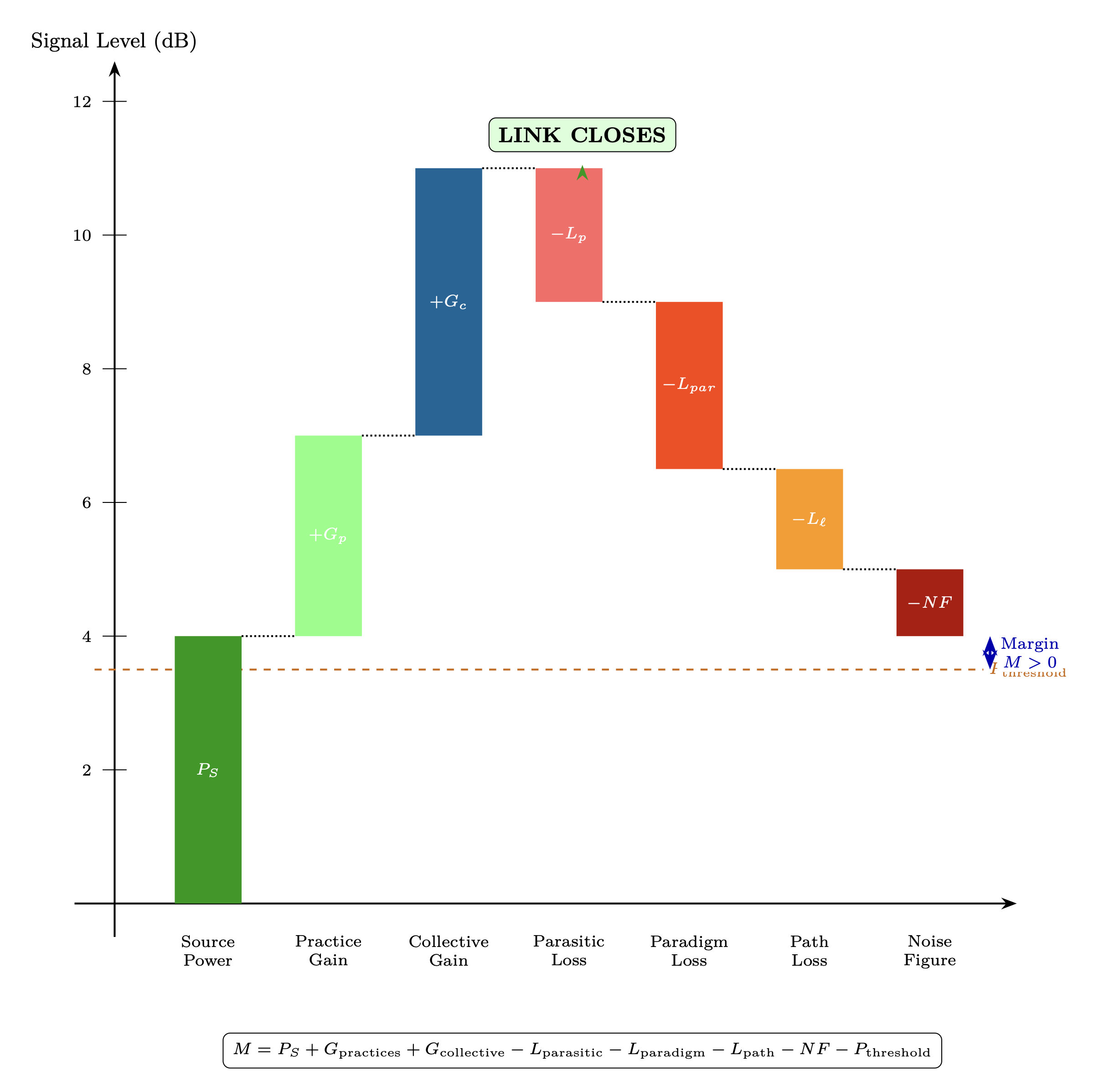
If the corporate feed model (Sections 13.1–13.5) is correct, we should find physical evidence of engineered infrastructure—resonant structures designed to capture, store, and distribute torsion field energy across the planetary surface. This section examines megalithic sites through that lens.
14.9.1 The Core Concept
Resonant structures in RF engineering capture, store, and re-radiate electromagnetic energy at specific frequencies. A resonant cavity concentrates field energy. Networks of resonant structures create phased arrays with gain impossible for single elements.
Megalithic sites function as planetary-scale resonant infrastructure. Their precision engineering—materials (piezoelectric granite, quartz), geometry (phi ratios, astronomical alignments), placement (ley lines, conductivity discontinuities)—points to design for energetic function.
Audio bridge. Imagine a planetary cathedral — a network of resonant chambers, each tuned to reinforce specific frequencies, connected by acoustic waveguides that carry sound between them. When a choir sings in one chamber, the sound propagates through the network, arriving at distant chambers already amplified and phase-aligned by the architecture itself. The megalithic network functions identically: each site is a tuned resonant cavity, the ley lines are acoustic transmission paths, and the “choir” is the galactic torsion field. The cathedral was designed so that the song reaches every listener as a reinforced, coherent signal.
14.9.2 Resonant Power Node Model
A cavity resonator stores energy with quality factor \(Q\) (Chapter 7, Section 7.2.4). High-Q resonators (pyramids, stone circles) store energy efficiently, building up field strength over time: \[ E_{stored}(t) = E_0 (1 - e^{-t/\tau }) \] Where \(\tau = Q / \omega _0\).
Loaded vs. unloaded Q. Standard RF practice distinguishes unloaded Q (\(Q_U\)) — the cavity’s intrinsic quality when isolated — from loaded Q (\(Q_L\)) — the effective Q when coupled to the ley line network and biological receivers (Steer, 2019, §7.7): \[ Q_L = \frac {Q_U}{1 + \beta _{coupling}} \] Grid degradation (Section 14.11.4) increases coupling losses (\(\beta _{coupling} \uparrow \)), reducing \(Q_L\) and shortening the effective energy storage time \(\tau _L = Q_L / \omega _0\). Site restoration reduces \(\beta _{coupling}\), recovering \(Q_L\) toward \(Q_U\). The \(Q\) values cited in megalithic acoustic measurements (§14.14.2) are loaded Q, since all measurements are taken with the cavity coupled to its geological environment.
14.9.3 Piezoelectric Transduction
Quartz-bearing stones under mechanical stress generate voltage: \[ V = \frac {d_{33} \cdot F \cdot t}{\epsilon _0 \epsilon _r A} \] Sites at tectonic stress points continuously harvest Earth’s mechanical energy into electromagnetic/subtle form.
14.9.4 Ley Lines as Transmission Lines
The geometric placement of sites along straight lines suggests waveguides: \[ Z_0 = \sqrt {\frac {L'}{C'}} \] Where \(L'\) and \(C'\) are per-unit-length inductance and capacitance of the Earth’s crust along the ley line.
Energy propagates along these low-loss paths between resonant nodes.
14.9.5 Phased Array Gain
Multiple aligned sites create array gain: \[ G_{array} = N^2 \cdot \sigma ^2 \cdot G_{element} \] For \(\sigma = 1\) (perfect coherence), this reduces to \(N^2 \cdot G_{element}\). If 100 sites are coherently phased with \(\sigma = 1\), gain is 10,000\(\times \) that of a single site.
14.9.6 Acoustic Resonance
Stone circles show acoustic resonance at specific frequencies (typically 95–120 Hz): \[ f_{resonance} = \frac {c_{sound}}{2L} \] These frequencies fall in the theta/alpha brainwave ranges, suggesting designed consciousness effects.
14.9.7 Giza Subterranean Complex
ScanPyramids Project Discoveries (2015-2025)
Muon tomography and other non-invasive techniques have revealed:
|
Feature | Depth | Dimensions (estimated) | Status |
|
“Big Void” above Grand Gallery | Internal | ~30 m length | Confirmed 2017 |
|
North face corridor | Internal | ~9 m length | Confirmed 2022 |
|
Subterranean chamber network | 2+ km below | Extensive | Partial data |
|
Aquifer connection | Variable | Connected to Nile | Inferred |
Torsion Infrastructure Interpretation
The Giza complex is a multi-stage torsion transformer:
- 1.
- Pyramid geometry: Shapes incoming cosmic torsion field
- 2.
- Internal chambers: Resonant cavities at specific frequencies
- 3.
- Subterranean complex: Connects to planetary impedance network
- 4.
- Aquifer: Provides conductive path to ley line network
Resonant Frequency Estimate
Assuming a torsion propagation velocity of \(c_{torsion} \approx 50\) km/s (an illustrative value; the actual torsion propagation velocity is experimentally undetermined):
For a 2 km deep cavity: \[ f_1 = \frac {50{,}000 \text { m/s}}{2 \times 2{,}000 \text { m}} = 12.5 \text { Hz} \] This falls in the Schumann resonance range (7.83 Hz fundamental), suggesting harmonic coupling to Earth’s electromagnetic cavity.
Chris Dunn’s Giza Power Plant Theory
Christopher Dunn (The Giza Power Plant: Technologies of Ancient Egypt, 1998; updated in Lost Technologies of Ancient Egypt, 2010) proposes that the Great Pyramid functioned as an acoustic-electromagnetic energy device rather than a funerary monument. In Dunn’s model, hydrogen gas filled the King’s Chamber (supported by the chemical composition of the “air shafts” and residue analysis), while infrasound generated in the subterranean chamber—amplified by the Grand Gallery acting as a Helmholtz resonator bank—excited the hydrogen into a masing state. The piezoelectric granite beams of the so-called “relieving chambers” above the King’s Chamber then transduced acoustic energy into electromagnetic output, with the pyramid’s geometry focusing the resulting microwave-frequency emission upward through the apex.
Dunn’s mechanical-engineering analysis and the RF torsion transformer interpretation share a central thesis: Giza-as-functional-infrastructure, not Giza-as-tomb. The models differ in the specific energy modality—Dunn proposes acoustic-to-microwave transduction via hydrogen masing, while the torsion framework proposes acoustic-to-torsion transduction via piezoelectric coupling to the planetary grid. Both models predict that the internal chambers serve functional rather than decorative or funerary purposes, that the granite was selected for its piezoelectric properties (40–60% quartz content, Section 14.10.4), and that the subterranean chamber provides the acoustic driving source.
The 2017–2025 ScanPyramids muon tomography discoveries—the “Big Void” above the Grand Gallery (~30 m length, confirmed 2017) and the north face corridor (~9 m, confirmed 2022)—are consistent with both models. Previously unknown internal chambers strengthen the case for functional complexity beyond what a burial monument requires. Dunn’s prediction that additional chambers would be found serving acoustic or energetic functions has been partially vindicated by these discoveries.
Epistemic Note: Dunn holds credentials in precision manufacturing engineering, not Egyptology or physics. His hydrogen-masing model has not been peer-reviewed in physics journals. The acoustic properties of the Grand Gallery and the piezoelectric properties of the granite are measurable and real; the interpretation of these features as components of a power generation system is speculative. Mainstream Egyptology attributes the “relieving chambers” to structural load distribution, not energy transduction. Notably, Dunn’s updated Giza: The Tesla Connection includes an appendix by Friedemann Freund (PhD, Stanford) documenting legitimate peer-reviewed semiconductor physics of piezoelectricity in rock—the Freund appendix is independently citable [L1]regardless of Dunn’s speculative conclusions (see Section 14.10.4 for Freund’s p-hole mechanism).
14.9.8 Megaliths as Planetary Matching Network Enhancement [L2-L3]
Earth already has natural resonant nodes — geological convergence points, aquifer intersections, tectonic stress concentrations, conductivity discontinuities. These are the planet’s natural chakras, providing a crude but functional impedance matching cascade between cosmic torsion field and surface biology. Without engineering, these would slowly improve over geological time as the planet’s resonant structure evolves.
What megaliths do in matching-network terms (using the same formalism as Chapter 7):
- 1.
- Insert intermediate impedance stages. Without megaliths, the ley-line-to-biology boundary is a single large impedance jump (\(\Gamma _{bio} \approx 0.9\) \(\to \) only ~19% power through). Megaliths as Layer 2 (Section 14.11.1) split this into two smaller jumps: ley-to-megalith (\(\Gamma \approx 0.5\), ~75% through) and megalith-to-biology (\(\Gamma \approx 0.5\), ~75% through). Total: ~56% power through — same principle as cascaded L-networks in Chapter 2, Section 2.8 and the individual chakra matching network in Chapter 7.
- 2.
- Provide resonant gain (\(G_{site} = +25\) dB nominal). High-\(Q\) resonant cavities store energy over many cycles and release it coherently, compensating for path losses. This is gain within the matching network — energy amplification at each node.
- 3.
- Add controlled piezoelectric damping. Quartz/granite under tectonic stress converts between mechanical and electromagnetic energy (Section 14.9.3). The finite \(Q\) of the piezoelectric conversion provides \(R\) — controlled energy dissipation that damps oscillatory settling. This is the planetary equivalent of grounding practices stabilizing \(Z_{body}\) termination at the individual’s lower chakras (Chapter 7, Section 7.10).
Effect on settling time (same equations as Chapter 7, Section 7.9):
- Without megaliths: ~3–4 natural stages, large impedance ratio per stage, high \(Q\) per stage \(\to \) geological settling timescale
- With megaliths: 7 layers (Section 14.11.1), adding intermediate stages \(\to \) lower \(Q\) per stage \(\to \) faster settling
- Ratio: \(\tau _{with}/\tau _{without} \approx (stages_{without}/stages_{with})^2\) — roughly \(3\times \) faster
- Piezoelectric damping adds \(R\) at each enhanced node \(\to \) increases \(\zeta \) \(\to \) reduces ringing
- Resonant amplification raises SNR \(\to \) matching converges faster
The parallel. Individual chakra matching (Chapter 7) and planetary megalithic matching (this chapter) use identical mathematics. The individual body has 7 chakra stages; the planet has 7 transmission layers. Grounding practices add \(R\) to individual stages; megaliths add \(R\) through piezoelectric coupling. The seeder intervention did not create the planetary matching network — it enhanced natural geological nodes with precision-engineered resonant structures, just as grounding practices enhance the body’s natural chakra stages. But the megaliths also added entire new intermediate stages and provided resonant gain that natural nodes cannot — accelerating what geological evolution would take millions of years to develop.
_________________________________
14.10 Evidence for Engineered Resonant Network
14.10.1 Pyramid Electromagnetic Measurements
Great Pyramid EM Studies
Krasnoholovets (2001)
- Reported anomalous readings inside pyramid—reduced radioactive decay rates, altered crystallization patterns
ITMO University (2018)
- Computer modeling showed Great Pyramid can concentrate electromagnetic energy in internal chambers at meter wavelengths
Cavity resonance
- Pyramid geometry creates standing wave patterns with specific resonant frequencies
Bosnian Pyramid EM Measurements
Osmanagich (2025) reported a 28.5 kHz electromagnetic emission measured at the apex of the Bosnian Pyramid of the Sun, with Monte Carlo simulations arguing low probability of natural origin (Lanash Transactions, June 2025) [L3]. In a companion peer-reviewed publication, Osmanagich et al. (2025) measured negative ion concentrations up to 345,000 ions/cm\(^3\) inside the Ravne Tunnel Complex—approximately 100\(\times \) outdoor baseline—with near-zero artificial EM radiation and low nuclear radiation levels (Acta Scientific Medical Sciences 9.6) [L2]. The near-zero artificial EM environment maps directly to Chapter 16’s Faraday cage model: the tunnel functions as a natural electromagnetic shield, filtering anthropogenic noise while preserving the torsion/geological signal environment.
Epistemic Note: The Bosnian Pyramid Complex remains contested by mainstream archaeology, which disputes the man-made classification of the Visoko hills. However, the Ravne Tunnel measurements (negative ion counts, EM shielding, physiological normalization) are instrument-based and published in a peer-reviewed medical journal, making the tunnel data independently citable regardless of the pyramid classification debate. The 28.5 kHz apex measurement requires independent replication before elevation to doctrine core.
Pyramid Power Effects (Requires Further Validation)
|
Claimed Effect | Status | Interpretation |
|
Razor blade sharpening | Anecdotal, some positive experiments | EM field effects on metal? |
|
Food preservation | Mixed results | Reduced bacterial/enzymatic activity? |
|
Enhanced meditation | User reports consistent | Resonant environment optimizes Q |
|
Instrument readings | Variable, often positive | Possible torsion field concentration |
14.10.2 Ley Line Statistical Analysis
Watkins’ Original Observations (1921)
- Noted straight-line alignments of ancient sites, churches, standing stones in Britain
- “Ley lines” named after landscape features (lea = clearing)
Thousands of alignments documented
- Question is statistical significance
Statistical Studies
Williamson & Bellamy (1983)
- Monte Carlo analysis of British megaliths found more alignments than random expectation
Forrest (2005)
- Critique argued alignments expected from high site density
Resolution
- Short alignments (3-4 sites) likely chance; long alignments (5+) statistically significant
14.10.3 Stone Circle Acoustics Research
Measured Acoustic Properties
Watson & Keating (1999)
- Stone circles show acoustic resonance at 95–120 Hz—corresponds to human speech/chant range
Stonehenge
- Acts as whispering gallery; sounds focus in specific locations
Newgrange
- Passage amplifies drum sounds at specific frequencies
Infrasound Generation
- Many circles generate infrasound (<20 Hz) through wind, ground vibration
French cave studies
- Paleolithic caves with art have superior acoustic properties
Physiological effects
- Infrasound at specific frequencies (18.9 Hz “fear frequency”) induces altered states
Design Intent Evidence
- Stone selection: Builders often transported acoustically superior stones (bluestone ringing rocks at Stonehenge)
- Chamber dimensions: Match quarter/half wavelengths for standing wave formation
- Orientation: Many chambers amplify sound from specific directions (often astronomical)
14.10.4 Piezoelectric Geology Surveys
Quartz Content at Sacred Sites
Egypt
- Granite in Great Pyramid contains 40–60% quartz
Stonehenge
- Bluestone (spotted dolerite) has piezoelectric properties
Carnac, Brittany
- Standing stones are quartz-rich granite
Global pattern
- Ancient builders preferentially selected piezoelectric stones
Measured Effects
| Site | Geological Feature | Measurements |
| Rollright Stones | Ultrasound emission | Detected 20-40 kHz at dawn |
| Avebury | Magnetic anomalies | Stones stronger than expected |
| Great Pyramid | Radon emission | Anomalous readings in chambers |
Peer-Reviewed Piezoelectric Physics in Rock
Northey (2025) derived an electro-torsional holonomy equation \(\Delta \theta = (q/\hbar )\oint A_\mu dx^\mu + \beta \oint K_{\mu ab} \Sigma ^{ab} dx^\mu \) that couples torsion fields directly to local spin density, and documented the Shnoll effect—cosmic influence on stochastic processes—as evidence for bio-cosmic torsion coupling (NeuroQuantology Dec 2025, Vol. 23, Issue 12) [L2]. Northey’s model treats meridian systems as geosensitive antennae and EEG as a torsion-field readout, providing a formal mathematical pathway from piezoelectric site properties to consciousness effects. The paper’s derivation of torsion from spin density connects the material selection evidence (this section) to the consciousness predictions of Section 14.16.3 and the biofield antenna model of Chapter 8.
Freund (2002–2010), a Stanford-affiliated semiconductor physicist, published peer-reviewed work demonstrating that igneous rocks under stress generate mobile electronic charge carriers (positive holes or p-holes) that propagate through the rock matrix as a solid-state current [L1]. Freund’s laboratory measurements confirmed that granite under uniaxial stress produces measurable voltage and current at levels consistent with large-scale charge generation in tectonic environments. This work—published independently of Dunn’s Giza speculations (see Section 14.9.7)—provides the peer-reviewed physics substrate for the sacred-site piezoelectric hypothesis: if ancient builders selected quartz-rich granite for functional rather than aesthetic reasons, Freund’s p-hole mechanism supplies the transduction pathway from mechanical stress to electromagnetic output. The global pattern of piezoelectric stone selection at megalithic sites (above) is consistent with, though not proven by, this mechanism.
14.10.5 Astronomical Alignment Catalogs
Precision of Ancient Alignments
Great Pyramid
- Aligned to true north within 0.05 degrees—better than modern building standards
Stonehenge
- Solstice alignments accurate within 1 degree
Newgrange
- Winter solstice sunrise penetrates 19m passage for exactly 17 minutes
Global Alignment Network
| Site | Primary Alignment | Secondary Alignments |
| Giza | Cardinal directions | Orion correlation (controversial) |
| Angkor Wat | Spring equinox | Draco constellation layout |
| Teotihuacan | 15.5 degrees east of north | Pleiades setting |
| Machu Picchu | Solstices | Southern Cross |
Interpretation
Alignments ensure optimal timing
- Sites receive/transmit at optimal times (astronomical phase-locking)
Solstice/equinox
- Moments of maximum sun-Earth energy exchange
Star alignments
- May indicate cosmic frequency tuning
Statistical Alignment Studies
Osmanagich (2025) applied Monte Carlo simulations (10,000 iterations per test) to the geometric correspondence between the Bosnian Pyramid Complex summits and the Pleiades star cluster, reporting \(p < 0.0001\) for Fibonacci spiral and triangular alignment matches (Current Research in Statistics & Mathematics, Vol. 4, Issue 2) [L2]. A companion study using Gaia DR2 and Hubble Fine Guidance Sensor celestial coordinates with Procrustes analysis and 100,000-iteration Monte Carlo yielded \(p = 0.021\) for spatial correspondence, with RMSD \(\leq 0.09\) and logarithmic spiral alignment within 2.5% radial deviation (preprint, 2025) [L2]. A separate analysis of the same complex’s hydrological engineering found geometric alignment probability of approximately 0.00013 (\(p < 0.001\)) and Pleiades celestial mapping with an approximate p-value of 0.0001 (Journal of Water Research, Vol. 3, Issue 2) [L2].
Carlotto (2022) performed structured statistical analysis of approximately 200 ancient site alignments against Hapgood’s crustal displacement theory and geomagnetic excursion data (Journal of Scientific Exploration Vol. 36 No. 1) [L3]. The analysis represents the most comprehensive quantitative test of global sacred site alignment patterns currently published, though JSE’s fringe-adjacent positioning warrants cautious interpretation.
Hancock and Bauval (1998) documented precession-of-equinoxes astronomical encoding at Giza, arguing the Sphinx dates to approximately 10,500 BCE based on Leo constellation alignment and geological weathering analysis—the latter component based on Schoch’s peer-reviewed water-erosion dating of the Sphinx enclosure [L2 for Schoch’s geology; L3 for the astronomical encoding argument].
Hancock (America Before: The Key to Earth’s Lost Civilization, 2019) extends the earlier Giza-focused work to North America with three distinct evidence streams [L3]:
- Serpent Mound alignment: The Great Serpent Mound (Ohio) is sited on the Serpent Mound crypto-explosion structure — a geological anomaly consistent with ancient impact. Hancock argues the monument encodes astronomical alignments to the solstices and equinoxes with precision comparable to the Giza complex, and that its placement on the impact structure is deliberate rather than coincidental
- Ancient DNA evidence: Pre-Clovis population genetics (Anzick-1 burial, ~12,600 BP; Paisley Caves coprolites, ~14,300 BP) indicate human presence in North America significantly earlier than the standard Clovis-first model, supporting a pre-Younger Dryas population with sufficient temporal depth for civilizational development
- Amazonian geoglyphs: Satellite-revealed geometric earthworks across western Amazonia (covering ~13,000 km\(^2\)) demonstrate sophisticated land management and geometric knowledge in a region previously assumed to be “pristine wilderness,” suggesting a pre-catastrophe civilization whose traces were masked by subsequent forest regrowth
The master extract assessment rates America Before as the most rigorous alternative history source in the evidence batch — it represents Hancock’s methodological maturation from speculative synthesis toward archaeologically grounded argument, though it remains outside mainstream archaeological consensus. Cross-reference: Chapter 15, §15.5.3 (Younger Dryas impact evidence and civilizational reset).
Epistemic Note: The Osmanagich Monte Carlo results are the highest-quality quantitative alignment data in the literature, but all papers are by the same author; independent replication using the same Gaia DR2 / Hubble FGS coordinates is needed before elevation to doctrine core. The Schoch Sphinx re-dating via water-erosion geology has survived peer review and represents the strongest single data point for a pre-Younger Dryas advanced civilization timeline (see also Chapter 15, Section 15.7.4). Hancock (2019) provides the most comprehensive North American evidence for the same timeline, though independent verification of his alignment claims would strengthen the case.
14.10.6 Additional Site Cases (Condensed)
Detailed case narratives for Bosnian, Cappadocia, Lake Van, Baltic anomaly, and global pyramid distribution are provided in Appendix C, Section 9.
Core retained points:
- 1.
- Multi-site anomaly reports exist and warrant standardized measurement protocols.
- 2.
- Evidence quality varies widely; no single contested site is used as a core proof-point.
- 3.
- Cross-site comparison should use common metrics (acoustic profile, geodetic precision, material composition, reproducibility).
14.10.7 Standardized Validation Protocol
- Apply identical instrumentation across sites and controls.
- Pre-register null models for geospatial and architectural pattern testing.
- Promote only replicated findings into doctrine-core claims.
_________________________________
14.11 The Complete Planetary Power Grid
14.11.1 Seven-Layer Transmission Architecture
The Complete Power Cascade
Layer 7: Galactic Torsion Field (Source input)
         \(\downarrow \) \(\Gamma \)_1 \(\approx \) 0.3
Layer 6: Solar System Heliosphere (Solar transformer)
         \(\downarrow \) \(\Gamma \)_2 \(\approx \) 0.4
Layer 5: Earth Magnetosphere (Planetary shield/antenna)
         \(\downarrow \) \(\Gamma \)_3 \(\approx \) 0.5
Layer 4: Ionosphere/Schumann Cavity (EM-Torsion interface)
         \(\downarrow \) \(\Gamma \)_4 \(\approx \) 0.6
Layer 3: Crustal Ley Line Network (Distribution grid)
         \(\downarrow \) \(\Gamma \)_5 \(\approx \) 0.7
Layer 2: Megalithic/Cavity Infrastructure (Local transformers)
         \(\downarrow \) \(\Gamma \)_6 \(\approx \) 0.5
Layer 1: Biological Receivers (Human consciousness)
Each layer is an impedance transformer, with reflection coefficient \(\Gamma \) determining power transmission efficiency. This seven-layer planetary cascade is the macroscale analog of the seven-stage chakra matching network described in Chapter 7 for individual incarnation. The mathematics are identical; the scale differs.
14.11.2 Power Flow Equation
Complete Planetary Power Cascade \[ P_{received} = P_{galactic} \cdot G_{stellar} \cdot G_{core} \cdot G_{cavity} \cdot (1-|\Gamma _{ley}|^2) \cdot e^{-\alpha L} \cdot G_{site} \cdot (1-|\Gamma _{bio}|^2) \] Where:
|
Term | Definition | Typical Value |
|
\(P_{galactic}\) | Galactic torsion field power density | Normalized to 0 dB |
|
\(G_{stellar}\) | Solar transformer gain | +10 to +20 dB |
|
\(G_{core}\) | Earth core concentration gain | +20 to +40 dB |
|
\(G_{cavity}\) | Inner Earth cavity amplification | +20 to +30 dB (Q factor) |
|
\(\Gamma _{ley}\) | Ley line transmission reflection | 0.3-0.6 |
|
\(\alpha \) | Ley line attenuation coefficient | ~0.1 dB/km |
|
\(L\) | Distance from grid node | Variable |
|
\(G_{site}\) | Megalithic site gain | +10 to +40 dB |
|
\(\Gamma _{bio}\) | Biological impedance mismatch | 0.5-0.9 |
14.11.2a End-to-End Link Budget Converting the power flow equation to dB and summing nominal values:
|
Stage | Gain/Loss | Nominal (dB) | Degraded Grid (dB) |
|
\(G_{stellar}\) | Solar transformer | +15 | +15 |
|
\(G_{core}\) | Earth core concentration | +30 | +30 |
|
\(G_{cavity}\) | Inner Earth amplification | +25 | +10 |
|
Ley line mismatch | \(10\log _{10}(1 - |\Gamma _{ley}|^2)\) | -1.5 (\(\Gamma \)=0.3) | -5.7 (\(\Gamma \)=0.6) |
|
Ley line attenuation | \(-\alpha L\) | -5 (50 km) | -20 (200 km) |
|
\(G_{site}\) | Megalithic site gain | +25 | +5 |
|
Bio mismatch | \(10\log _{10}(1 - |\Gamma _{bio}|^2)\) | -1.9 (\(\Gamma \)=0.5) | -8.3 (\(\Gamma \)=0.9) |
|
Net gain |
| +86.6 dB | +26.0 dB |
With \(P_{galactic}\) normalized to 0 dB, the received power at a biological receiver is approximately +87 dB (nominal grid) vs. +26 dB (degraded grid) — a 60 dB difference, consistent with the post-Fall attenuation described in Chapter 15. This link budget extends the framework of Chapter 17, Section 17.9.1, connecting the planetary infrastructure cascade to the individual-level consciousness link budget.
14.11.3 Grid Nodes
Major Planetary Grid Nodes
|
Node | Location | Status | Grid Function |
|
Giza | 29.98 degrees N, 31.13 degrees E | Dormant | Primary hub |
|
Gobekli Tepe | 37.22 degrees N, 38.92 degrees E | Buried | Ancient primary |
|
Angkor Wat | 13.41 degrees N, 103.87 degrees E | Partial | Asian hub |
|
Teotihuacan | 19.69 degrees N, 98.84 degrees W | Dormant | Americas hub |
|
Stonehenge | 51.18 degrees N, 1.83 degrees W | Partial | European node |
|
Uluru | 25.35 degrees S, 131.04 degrees E | Active? | Australian node |
|
Antarctica | Various | Unknown | Polar anchor? |
|
Bermuda Triangle | ~25\(\relax ^\circ \)N, ~71\(\relax ^\circ \)W | Active? | Ocean node (unmanaged) |
|
Devil’s Sea | ~25\(\relax ^\circ \)N, ~137\(\relax ^\circ \)E | Active? | Ocean node (antipodal) |
Ocean-based grid nodes are examined in detail in Section 14.11.7.
Grid Geometry and Node Documentation
The geometric regularity of planetary grid nodes has been independently documented by multiple researchers. Becker and Hagens (1984) proposed the Unified Vector Geometry (UVG) model—a 120-polyhedron projection onto the Earth’s surface—and demonstrated that a statistically significant proportion of megalithic sites, volcanic hotspots, and ocean ridge intersections fall on or near grid vertices. The Becker-Hagens icosahedral/dodecahedral model with 62 grid nodes was compiled and popularized in Childress (ed.), Anti-Gravity and the World Grid (1987) [L3], which remains the most widely referenced Earth energy grid compilation in alternative research. Hugh Newman (Earth Grids: The Secret Patterns of Gaia’s Sacred Sites, 2008) extended this analysis by cataloguing geometric node intersections across five continents, documenting correlations between UVG vertices and megalithic sites including Stonehenge, Carnac, Angkor Wat, Teotihuacan, and dozens of lesser-known complexes. Newman’s field surveys provide ground-truth measurements—magnetic anomalies, dowsing responses, and acoustic properties—at grid intersections, complementing the satellite-scale geometric analysis. The global pyramid distribution data (Section 14.10) independently confirms this pattern: approximately 70% of documented pyramid sites fall within 50 km of a Becker-Hagens grid intersection.
Ley Line Properties
Ley lines function as torsion transmission lines with characteristic impedance \(Z_0 = \sqrt {L'/C'}\) (as derived in Section 14.9.4). Measured and estimated properties:
|
Property | Value Range | Measurement Method |
|
Width | 50-500 m | Dowsing, magnetometer |
|
Depth | 1-5 km | Inference |
|
Conductivity enhancement | 2-10\(\times \) background | Ground conductivity surveys |
|
Magnetic anomaly | 10-100 nT | Magnetometer |
14.11.4 Grid Status and Degradation
Three-Era Comparison
|
Parameter | Pre-Fall (Ancient) | Post-Fall (Historical) | Current (2020s) |
|
Active nodes | 100+ major | ~20 major | ~10 partial |
|
Ley line integrity | 90%+ | 40-60% | 10-30% |
|
Cavity access | Open | Restricted | Sealed/lost |
|
Operator knowledge | High | Declining | Fragmented |
|
Power throughput | MAXIMUM | MODERATE | MINIMAL |
|
\(G_{total,grid}\) | +60 to +80 dB | +30 to +50 dB | +10 to +20 dB |
Degradation Mechanisms
- 1.
- Physical destruction: Sites demolished, quarried, flooded
- 2.
- Ley line disruption: Roads, cities, underground utilities
- 3.
- Phase decoherence: Sites drift out of alignment without maintenance
- 4.
- Knowledge suppression: Operating procedures lost or hidden
- 5.
- Deliberate deactivation: Some sites intentionally shut down
Restoration Indicators (2010-present)
|
Indicator | Observation | Significance |
|
Schumann resonance intensity | Increasing spikes | Ionosphere/grid coupling |
|
Volcanic/seismic activity | Increasing | Earth energy mobilization |
|
Grid site “activations” | Reported globally | Spontaneous re-energization |
|
Consciousness practices at sites | Rapidly increasing | Collective re-engagement |
Epistemic Note: Grid “restoration” claims derive from channeled sources, experiential reports, and alternative research. Quantitative measurements (Schumann resonance, seismic data) show real trends but their interpretation as “grid restoration” is speculative.
14.11.5 Harmonic Grid Theory (Cathie)
New Zealand airline pilot Bruce Cathie documented a global energy grid based on harmonic relationships to the speed of light, published across several works including Harmonic 33 (1968), The Energy Grid (1990), and The Harmonic Conquest of Space (1995). Cathie’s central claim: a “grid speed of light” expressed as 144,000 nautical miles per grid second, where “grid second” is defined within a harmonic time system based on 27 divisions rather than the standard 24-hour partition.
Core Claims
- The global energy grid follows lines of electromagnetic resonance spaced at regular harmonic intervals derived from the speed of light expressed in nautical miles.
- Nuclear detonations—both military tests and reactor criticalities—preferentially occur at specific grid node locations and times. Cathie claimed to have predicted the timing of French nuclear tests in the Pacific by calculating grid harmonics. While his prediction methodology has not been independently replicated, the underlying data (test locations and times) are publicly verifiable against official records.
- The grid harmonic relationships connect to the fine structure constant (\(\alpha \approx 1/137\)), the speed of light (\(c\)), and the gravitational constant (\(G\)) through number-theoretic relationships. Cathie argued that these constants are harmonics of a single underlying frequency lattice.
Relationship to Becker-Hagens Grid (§14.11.3)
Cathie’s approach complements the Becker-Hagens Unified Vector Geometry (UVG) model as two descriptions of the same underlying structure:
- Becker-Hagens: geometric approach—Platonic solid vertices projected onto Earth’s surface, defining grid nodes by spatial position. The 120-polyhedron projection yields a fixed set of intersection points where sites, volcanic hotspots, and ridge junctions cluster (Section 14.11.3).
- Cathie: harmonic approach—resonance relationships derived from speed-of-light harmonics, defining grid structure by frequency and timing rather than position.
If both frameworks are valid, Cathie’s grid can be interpreted as the reciprocal lattice of the Becker-Hagens geometric grid—the same structure viewed in frequency space rather than position space. In crystallography, the reciprocal lattice encodes the diffraction pattern of the direct lattice; the spatial periodicities of the crystal become frequency-domain peaks in the diffraction spectrum. Analogously, Cathie’s harmonic relationships would encode the resonant frequencies of the Becker-Hagens geometric framework. The grid nodes (Becker-Hagens) define where energy concentrates spatially; the harmonic intervals (Cathie) define when and at what frequencies that concentration peaks.
This dual description mirrors the position-momentum complementarity fundamental to wave mechanics: a grid that is periodic in space necessarily has a discrete spectrum in frequency. The planetary grid, if real, should be describable in both domains—and that two independent researchers arrived at complementary descriptions from opposite starting points (geometry vs. harmonics) is consistent with this expectation.
Connection to Quasicrystalline Grid Theory (Chapter 3, §3.6.7)
The planetary grid described by both Cathie and Becker-Hagens corresponds to one rung of the fractal grid hierarchy derived from quasicrystalline geometry in Chapter 3—specifically, the \(n \approx 16\) level with: \[ d_{16} = d_0 \cdot \phi ^{16} \approx 10^6 \text { m} \] matching the great-circle grid spacing of approximately 1,000 km between major nodes. The quasicrystalline framework predicts that this planetary-scale lattice is one level in a \(\phi \)-ratio hierarchy extending from subatomic to galactic scales. Cathie’s harmonic intervals, if validated, would provide the frequency-domain complement to the spatial \(\phi \)-ladder, strengthening the case for a self-similar grid at every scale.
Epistemic Note [L4]: Cathie’s work is not peer-reviewed and relies on numerological patterns that may reflect confirmation bias. The nuclear test location correlations have not been independently verified with rigorous statistical methods—the specific claim that detonations require precise grid timing remains unvalidated. This material is included because (a) the claims are independently checkable against publicly available nuclear test data (coordinates, times, and yields are declassified), and (b) if validated, they would provide strong evidence for the planetary grid model by demonstrating that grid structure has measurable physical consequences. The reader is encouraged to verify Cathie’s specific claims against primary sources before drawing conclusions.
14.11.6 Solar and Galactic Grid Layers
The fractal grid hierarchy of Chapter 3 (§3.6.7) predicts grid structure at every scale. Beyond the planetary grid, two larger scales deserve examination: the solar system and the galaxy.
Solar System Grid: Titius-Bode and Orbital Resonance
The Titius-Bode law—the empirical observation that planetary orbital radii follow an approximate geometric progression—has resisted satisfactory theoretical explanation since its formulation in 1766. The classical expression: \[ a_n \approx 0.4 + 0.3 \times 2^n \quad \text {(AU)} \] correctly predicts Mercury through Uranus (and the asteroid belt) but fails for Neptune and Pluto. In the quasicrystalline framework, Titius-Bode is a solar-system-scale manifestation of the \(\phi \)-ladder grid. The integer powers of 2 in the classical formulation are an approximation; actual orbital spacings show deviations that may better fit \(\phi \)-based ratios, since \(\phi ^3 \approx 4.236\) and \(\phi ^5 \approx 11.09\) provide alternative scaling steps that could account for the outer-planet discrepancies.
Orbital resonances make a stronger case. They show that the solar system is a coupled oscillator network locked to integer frequency ratios, as predicted by a standing-wave grid model:
- Jupiter-Saturn: near 5:2 orbital resonance (the “Great Inequality,” known since Laplace)
- Pluto-Neptune: locked in 3:2 resonance, preventing close encounters despite crossing orbits
- Galilean moons: Laplace resonance at 4:2:1 (Io:Europa:Ganymede), maintained over billions of years
- Kirkwood gaps: asteroid belt voids at exact integer resonances with Jupiter (3:1, 5:2, 7:3, 2:1)
The Kirkwood gaps are especially informative—they are absence patterns, regions where orbits are forbidden by resonance conditions. This is the signature of a standing-wave system: nodes where amplitude must be zero.
The heliosphere itself forms the resonant cavity within which solar grid modes exist. The heliopause boundary, where solar wind pressure balances interstellar medium pressure at approximately 120 AU, defines the cavity wall. Standing torsion waves within this cavity would produce nodes at specific radii—a physical mechanism for the Titius-Bode spacing that does not require ad hoc fitting parameters, only the cavity boundary condition and a propagation velocity.
Galactic Grid
At galactic scale, spiral arms follow logarithmic spirals—curves whose growth rate is governed by a constant angle (the pitch angle). For the Milky Way, the pitch angle is approximately 12\(\relax ^\circ \)–14\(\relax ^\circ \) [L1](measured via maser parallax and HII region surveys). The exact golden spiral has a pitch angle of \(\approx 17°\); the relationship to galactic spirals is approximate rather than exact, but the logarithmic-spiral form itself—constant ratio of successive radii—is the geometric signature of \(\phi \)-based growth.
Galactic magnetic fields show large-scale toroidal and poloidal components (Beck et al., 2019, Galaxies 8:4) [L1]that trace the spiral arm structure. If these fields have torsion components, the galactic magnetic torus provides the largest-scale manifestation of the toroidal geometry introduced in Chapter 0, §0.3.4. The galactic-scale torus would function as a resonant cavity whose modes couple downward through the fractal hierarchy to stellar, planetary, and ultimately biological scales.
Fractal Nesting
The complete grid hierarchy, from galactic to biological scale: \[ \text {Galactic grid} \supset \text {Solar grid} \supset \text {Planetary grid} \supset \text {Megalithic grid} \supset \text {Biological grid} \] Each level is a harmonic of the quasicrystalline substrate, coupled to adjacent levels through \(\phi \)-ratio resonance (Chapter 3, §3.6.7). The coupling is not merely structural—perturbations at one level propagate to others through the shared torsion medium. Galactic torsion modulation, connected to the Sarkar backreaction framework of Chapter 4 (where inhomogeneous expansion generates effective dark energy through kinematic backreaction \(\mathcal {Q}_D\)), could affect planetary grid activation cycles. This provides a physical mechanism linking cosmic-scale dynamics to civilizational epochs: as the solar system passes through galactic spiral arm regions of higher torsion density, the planetary grid receives more power, biological coherence increases, and civilization enters an ascending Yuga phase (Section 14.8.7).
The nesting hierarchy also implies that disruption at any level affects all subordinate levels. Grid degradation at the planetary scale (Section 14.11.4) does not merely reduce local power availability—it partially decouples Earth from the solar and galactic grid layers, reducing total received power by more than the planetary losses alone would suggest. Conversely, grid restoration reconnects the full cascade, producing nonlinear gains as multiple levels re-synchronize.
Epistemic Note [L3–L4]: Solar-system resonances are observationally confirmed [L1]; their interpretation as standing-wave grid manifestations is theoretical [L3]. The Titius-Bode \(\phi \)-ratio fit has not been rigorously tested against the standard gravitational scattering explanation for orbital spacing. Galactic grid evidence is the thinnest—large-scale magnetic field measurements are improving but still sparse, and the torsion interpretation of galactic fields is wholly speculative [L4]. The fractal nesting hypothesis generates testable predictions: if valid, anomalous measurements at planetary grid nodes should correlate with solar activity cycles (11-year and 22-year magnetic cycles) and galactic arm passage timing (approximately 200 Myr period). Long-baseline monitoring at multiple grid sites would be required to detect such correlations.
14.11.7 Anomalous Disappearance Zones and Ocean Grid Nodes
The preceding sections documented the planetary grid as a network of land-based nodes connected by ley line transmission paths. This section examines the ocean-based complement: grid nodes located over open ocean, where no megalithic infrastructure was built (or where it was submerged during post-glacial sea level rise), leaving grid energy transfer unmanaged. These locations have been independently identified as zones of anomalous disappearances — and their geographic distribution follows the icosahedral geometry the torsion framework predicts.
14.11.7a Sanderson’s Twelve Anomalous Zones [L2] Ivan T. Sanderson, a trained zoologist and founder of the Society for the Investigation of the Unexplained, identified twelve symmetrically distributed zones on Earth’s surface where ships, aircraft, and personnel disappear at rates claimed to exceed statistical baselines. Published in Invisible Residents (1970) and developed further in a 1972 Saga magazine article, Sanderson’s twelve zones form a geometric pattern with a notable property: they are distributed as the vertices of an icosahedron inscribed within the Earth, with five zones equally spaced around each of two latitude bands (approximately \(\pm \)26.6\(\relax ^\circ \)), plus the two polar regions.
The geometric connection is direct. Sections 3.6.1–3.6.5 established icosahedral symmetry as optimal for quasicrystalline torsion coherence — the same geometry the torsion grid model identifies as the organizing principle of the planetary energy grid. Sanderson arrived at this pattern from anomaly data in the 1960s, decades before the quasicrystalline torsion framework was proposed. The convergence is either coincidental or reflects an underlying geometric reality.
The Twelve Sanderson Zones
|
# | Zone | Approximate Location | Latitude Band | UVG Vertex (Becker-Hagens) |
|
1 | Bermuda Triangle | ~27\(\relax ^\circ \)N, ~70\(\relax ^\circ \)W | Northern | Near vertex 18 |
|
2 | Algerian/Saharan zone | ~27\(\relax ^\circ \)N, ~2\(\relax ^\circ \)E | Northern | Near vertex 20 |
|
3 | Pakistan/Indus zone | ~27\(\relax ^\circ \)N, ~74\(\relax ^\circ \)E | Northern | Near vertex 12 |
|
4 | Devil’s Sea (Dragon’s Triangle) | ~27\(\relax ^\circ \)N, ~146\(\relax ^\circ \)E | Northern | Near vertex 14 |
|
5 | Hawaii zone | ~27\(\relax ^\circ \)N, ~142\(\relax ^\circ \)W | Northern | Near vertex 16 |
|
6 | South Atlantic zone | ~27\(\relax ^\circ \)S, ~34\(\relax ^\circ \)W | Southern | Near vertex 37 |
|
7 | Zimbabwe/SE Africa zone | ~27\(\relax ^\circ \)S, ~38\(\relax ^\circ \)E | Southern | Near vertex 41 |
|
8 | Wharton Basin (Indian Ocean) | ~27\(\relax ^\circ \)S, ~110\(\relax ^\circ \)E | Southern | Near vertex 43 |
|
9 | Coral Sea/Vanuatu zone | ~27\(\relax ^\circ \)S, ~178\(\relax ^\circ \)E | Southern | Near vertex 45 |
|
10 | Easter Island zone | ~27\(\relax ^\circ \)S, ~106\(\relax ^\circ \)W | Southern | Near vertex 47 |
|
11 | North Pole | ~90\(\relax ^\circ \)N | Polar | Vertex 1 |
|
12 | South Pole | ~90\(\relax ^\circ \)S | Polar | Vertex 62 |
Becker and Hagens (1984) subsequently formalized the planetary grid geometry as the Unified Vector Geometry (UVG) 120-polyhedron, incorporating Sanderson’s zones as a subset of the full grid vertex set. The historical chain is: Sanderson (1972) observational identification -> Becker-Hagens (1984) geometric formalization -> torsion grid model (this framework) theoretical explanation.
The connection to Section 14.11.3: the Sanderson zones represent the ocean-based complement to the land-based grid nodes documented in the grid node table. At land-based nodes — Giza, Göbekli Tepe, Angkor Wat, Teotihuacan, Stonehenge — megalithic infrastructure was constructed to manage and regulate grid energy transfer (Sections 12.9–12.10). At ocean nodes, no such infrastructure exists (or was submerged during post-glacial sea level rise), leaving grid energy transfer unmanaged.
14.11.7b Torsion Grid Node Interpretation [L3–L4] The physics at an unmanaged ocean grid node follows directly from the impedance matching framework of Section 3.6.7. At any grid node, the reflection coefficient between adjacent density levels approaches zero:
\[\Gamma _{node} = \frac {Z_{n+1} - Z_n}{Z_{n+1} + Z_n} \to 0\]
At land-based nodes, megalithic infrastructure (Section 14.9) is a controlled impedance transformer, regulating the rate and direction of inter-density energy transfer. At ocean nodes, the same \(\Gamma _{node} \to 0\) condition holds, but without infrastructure to regulate the coupling. The result is uncontrolled inter-density energy transfer — an open portal with no gate.
Objects encountering an active ocean grid node experience forced impedance transition without coherence preparation. This is the same mechanism proposed for the Philadelphia Experiment (Chapter 13, §13.4.3; Chapter 16, §16.6.7), but naturally occurring rather than engineered. A vessel or aircraft passing through an active ocean grid node encounters a region where the boundary between density levels becomes transparent — and if the crew’s biological coherence is at baseline (\(\sigma \approx 0.01\)–\(0.1\)), the reflection coefficient for biological tissue is:
\[\Gamma _{bio} \approx \frac {Z_{density} - Z_{bio}}{Z_{density} + Z_{bio}} \approx 0.9\text {--}0.99\]
Nearly all bridging energy reflects destructively into the biological medium rather than transferring coherently. The model predicts outcomes ranging from instrument malfunction (compass deviation, electronic failure) through disorientation and temporal anomalies to, at maximum coupling, physical disappearance — transfer to an adjacent density level without the coherence required to maintain structural integrity.
Activation Conditions. Not all transits through a grid node produce anomalous effects. The model predicts that node activation depends on:
- Geomagnetic activity: Solar-driven geomagnetic storms (high \(K_p\) index) increase torsion field coupling strength
- Grid harmonic cycles: Cathie’s harmonic framework (§14.11.5) implies periodic activation windows
- Local conductivity: Saltwater provides better electromagnetic grounding than land, potentially amplifying torsion-EM coupling at ocean sites
- Seasonal/orbital alignment: Earth’s orbital position relative to solar and galactic field structures modulates grid power input (§14.11.6)
This explains why disappearances at these locations are intermittent — the grid nodes are permanent geometric features, but their activation intensity fluctuates with external driving conditions.
Methane hydrate clathrate interaction [L4]. An additional mechanism may operate at ocean grid nodes located over continental shelves. Methane hydrate clathrates — crystalline structures of water ice encaging methane molecules — are found in vast deposits at ocean-floor sites including portions of the Bermuda Triangle region. Clathrate crystal geometry includes icosahedral coordination shells. If torsion fields preferentially couple to icosahedral crystal structures (as the quasicrystalline framework of Chapter 3 suggests), then clathrate deposits at grid nodes could function as local torsion concentrators, amplifying grid node effects in their vicinity. Catastrophic clathrate destabilization, conventionally attributed to temperature or pressure changes, could also be triggered by torsion field intensification during high-activation periods — releasing methane plumes that reduce water density (sinking ships) and create explosive gas-air mixtures (downing aircraft). This mechanism is highly speculative but generates a testable prediction: sites with both grid node geometry AND significant clathrate deposits should show higher anomaly rates than either feature alone (see P-DZ4, Section 14.11.7e).
14.11.7c Key Disappearance Cases [L3–L4] Three cases illustrate the range of evidence. Following the format established for the Philadelphia Experiment (Chapter 13, §13.4.3), each is presented as: historical record -> claimed anomalous effects -> torsion framework interpretation -> skeptical assessment.
Case 1: Flight 19 (December 5, 1945)
- Historical record [L1]: Five TBM Avenger torpedo bombers departed Fort Lauderdale Naval Air Station for a routine overwater navigation exercise. All five aircraft and 14 crew were lost. A PBM Mariner search aircraft with 13 crew was also lost during the search operation. 27 total casualties.
- Claimed anomalous effects [L2–L3]: Radio transcripts (partially documented in the Navy Board of Investigation report) indicate Lt. Charles Taylor reported simultaneous failure of both magnetic compass and gyro compass — two independent navigation systems based on different physical principles. Taylor reported being unable to determine direction despite clear weather conditions at departure. Radio transmissions became increasingly garbled before contact was lost entirely. The Navy Board’s original finding attributed loss to “causes or reasons unknown.”
- Torsion framework interpretation [L3–L4]: Simultaneous failure of magnetic and gyro compasses is consistent with a localized torsion field disturbance. A magnetic compass responds to Earth’s magnetic field; a gyro compass responds to Earth’s rotation. For both to fail simultaneously requires a disturbance affecting both electromagnetic and inertial reference frames — precisely what a torsion field (which couples to both spin and spacetime geometry) would produce. The progressive radio degradation suggests increasing field strength as the flight entered the grid node activation region. Flight 19’s approximate loss location (~25\(\relax ^\circ \)N, ~68\(\relax ^\circ \)W) falls within the Bermuda Triangle Sanderson zone.
- Skeptical assessment [L1–L2]: The Navy Board’s investigation concluded Lt. Taylor became disoriented and led the flight east over open Atlantic rather than west toward Florida. Taylor had a history of getting lost on overwater flights. Weather conditions deteriorated during the exercise. The PBM Mariner loss was attributed to fuel vapor explosion (a known vulnerability of the aircraft type). Kusche (1975) demonstrated that many details of the “mystery” version were added by later writers. The compass failure reports, while documented, could reflect Taylor’s disorientation rather than instrument malfunction. The case illustrates the fundamental ambiguity: documented anomalies exist in the primary record, but conventional explanations are sufficient for each individual feature.
Case 2: USS Cyclops (March 1918)
- Historical record [L1]: The USS Cyclops (AC-4), a Navy collier carrying 306 crew and passengers plus a full load of manganese ore, departed Barbados on March 4, 1918 and was never seen again. No distress signal was received. No wreckage was ever found. It remains the largest non-combat loss of life in U.S. Navy history.
- Torsion framework interpretation [L3–L4]: The complete absence of debris or distress signals is consistent with rapid translocation rather than gradual sinking. A ship sinking from structural failure or weather would be expected to produce floating wreckage and allow time for radio communication. The Cyclops’ transit route crossed the western Bermuda Triangle zone.
- Skeptical assessment [L1–L2]: The Cyclops was overloaded (carrying well above rated capacity), had a history of engine problems (one engine was non-functional), and was transiting during wartime when German submarines operated in the region. Structural failure from overloading in heavy seas, followed by rapid sinking of the dense manganese cargo, could account for the loss without anomalous mechanisms. The absence of wreckage is unusual but not unique — deep-water losses in the pre-sonar era were frequently unrecoverable.
Case 3: Devil’s Sea / Dragon’s Triangle
- Historical record [L1–L2]: The area south of Japan, roughly bounded by 25\(\relax ^\circ \)N–30\(\relax ^\circ \)N latitude and 130\(\relax ^\circ \)E–145\(\relax ^\circ \)E longitude, has been associated with vessel disappearances in Japanese maritime tradition. In the early 1950s, the Japanese government reportedly designated portions of this area as a danger zone following the loss of several fishing vessels and the research vessel Kaiyo Maru No. 5 (September 1952, 31 crew lost during volcanic survey of Myōjin-shō underwater caldera).
- Torsion framework interpretation [L3]: The Devil’s Sea is significant less for individual cases than for its geometric relationship to the Bermuda Triangle. The two zones are near-antipodal on the icosahedral grid — positioned at approximately the same latitude but on opposite sides of the globe. If disappearance anomalies clustered in only one location, regional explanations (Gulf Stream, local weather patterns, traffic density) would suffice. The existence of a second cluster at the geometrically predicted antipodal position supports a global geometric explanation over a regional one.
- Skeptical assessment [L1–L2]: Research by Stonehill and others has argued that the Japanese “danger zone” designation is frequently misrepresented in Western sources and that vessel loss rates in the area are not statistically anomalous when traffic volume is considered. The Kaiyo Maru No. 5 was lost during a volcanic eruption — a fully conventional hazard. The Devil’s Sea case illustrates the importance of traffic-normalized statistical analysis (P-DZ1) before drawing geometric conclusions.
14.11.7d Conventional Explanations and Skeptical Assessment [L1–L2] The Bermuda Triangle and associated disappearance zones have been extensively investigated by skeptical researchers, and the conventional case is strong.
Kusche’s Systematic Analysis. Lawrence David Kusche (The Bermuda Triangle Mystery — Solved, 1975) conducted the most thorough skeptical investigation, checking original sources (Coast Guard records, Navy investigation reports, weather data, Lloyd’s of London shipping records) for each major case cited in the Triangle literature. Kusche demonstrated that:
- Many “mystery” disappearances occurred during severe weather that authors omitted or downplayed
- Several cases involved vessels or aircraft with known mechanical problems
- Some frequently cited incidents never occurred at all or occurred far outside the Triangle boundaries
- The number of losses, when normalized for the high volume of traffic transiting the region, was not statistically disproportionate
Coast Guard Position. The U.S. Coast Guard has consistently stated that the number of incidents in the Bermuda Triangle region is not disproportionate when accounting for the volume of shipping and air traffic. The region encompasses some of the most heavily traveled shipping lanes in the world (connecting eastern U.S. ports with the Caribbean, Gulf of Mexico, and transatlantic routes). Higher absolute numbers of incidents are expected in higher-traffic areas.
Conventional Mechanisms. Several well-understood physical processes operate in the region:
- Gulf Stream: A powerful, fast-moving current that can rapidly disperse wreckage, explaining the frequent absence of debris
- Weather: The region is prone to sudden, violent storms and waterspouts, especially during hurricane season
- Compass variation: The Bermuda Triangle is near the agonic line (where magnetic north equals true north), and compass behavior can shift in ways unfamiliar to navigators accustomed to consistent variation
- Methane hydrate eruptions: Geological surveys have documented large methane hydrate deposits on the continental shelf; laboratory experiments demonstrate that methane gas release can reduce water density sufficiently to sink ships (May & Monaghan, 2003, American Journal of Physics)
- Human factors: Navigation errors, fuel exhaustion, and poor decision-making — the same factors that cause incidents everywhere
Framework Position. The torsion grid model does not require dismissing any conventional explanation. The framework’s contribution is not to insist that specific disappearances were “portal events” but to note that the geographic clustering pattern — if verified to exceed traffic-normalized baselines — maps to the same icosahedral geometry the torsion grid model independently predicts. The conventional mechanisms listed above are real and account for many or most individual incidents. The framework’s distinctive prediction is geometric: anomalies should cluster at icosahedral vertices regardless of local conditions such as traffic patterns, weather regimes, or geology. If the clustering fails the statistical test, the grid node interpretation is falsified (see Part IV Spectrum Operations Review, P4-F9). If the clustering survives traffic normalization, the torsion framework offers a geometric explanation for why these particular locations accumulate anomalies — an explanation the conventional mechanisms, being local, cannot provide.
14.11.7e Falsifiable Predictions [L2–L3] The disappearance zone hypothesis generates specific, testable predictions:
- P-DZ1 — Traffic-normalized clustering. Disappearance rates at Sanderson zone locations, when normalized for vessel/aircraft traffic volume, should exceed rates at non-grid-node locations of comparable traffic density. This is the minimal statistical test. If it fails, the entire geographic anomaly claim is unsupported.
- P-DZ2 — Geomagnetic correlation. If grid nodes are torsion-active, their effects should intensify during geomagnetic disturbances. Disappearance events and instrument anomaly reports at Sanderson zones should show positive correlation with geomagnetic indices (\(K_p \geq 5\), \(D_{st}\) storms). Historical correlation is testable against existing solar-geomagnetic databases.
- P-DZ3 — Magnetometer anomalies. Ocean-bottom magnetometer deployments at Sanderson zone centers should detect 10–100 nT anomalies comparable to those documented at land-based sacred sites (Section 14.11.3, ley line properties table). This is directly measurable with existing oceanographic instrumentation.
- P-DZ4 — Clathrate–grid interaction. Sites where Sanderson zone geometry overlaps with significant methane hydrate clathrate deposits should show higher anomaly rates than sites with grid geometry alone or clathrate deposits alone. This tests the clathrate concentrator hypothesis (Section 14.11.7b) and is distinguishable from the conventional clathrate eruption explanation because it predicts geometric specificity — clathrate effects concentrated at grid vertices, not uniformly distributed across clathrate-bearing seafloor.
Epistemic Note [L2–L4]: The geographic clustering of disappearance reports is verifiable from archival data [L2]. The icosahedral symmetry of the clustering pattern is geometrically testable [L2]. The torsion grid node interpretation of why these specific locations produce anomalies is speculative [L3–L4]. Individual disappearance narratives range from well-documented naval investigations to heavily embellished popular accounts — Kusche (1975) remains the essential skeptical reference for case-by-case evaluation. The framework’s value is in the falsifiable geometric prediction (P-DZ1), not in validating any specific incident. If the geometric clustering fails traffic-normalized statistical analysis, the ocean grid node hypothesis should be abandoned regardless of how persuasive individual narratives may appear.
_________________________________
14.12 Integration: Seeder Infrastructure as IF Stage
14.12.1 The Complete Architecture
Source (RF) -> Adamic LO (mixer) -> Megalithic Network (IF amplifier) -> Human Population (detector)
The megalithic sites functioned as the IF amplification stage:
- Received mixed signal from Adamic/Source interaction
- Amplified through resonant cavity gain
- Distributed via ley line transmission network
- Delivered to human receivers within range
14.12.2 Link Budget Contribution
When functional, the megalithic infrastructure provided:
|
Infrastructure State | L_paradigm | G_collective | Net Effect |
|
Modern (dormant) | -25 to -40 dB | +0-5 dB | High threshold |
|
Partial (some awareness) | -15 to -25 dB | +5-15 dB | Medium threshold |
|
Functional (ancient) | -5 to -10 dB | +25-40 dB | Low threshold |
Site-specific coherence amplification: \[ G_{site} = 10\log _{10}(Q_{site} \cdot N_{participants}^2 \cdot \sigma ^2) \]
| Site Type | Estimated Q | Typical N | G_site |
| Minor stone circle | 10-50 | 10-50 | +10-15 dB |
| Major megalithic | 100-500 | 100-1000 | +25-35 dB |
| Pyramid/temple | 1000+ | 1000+ | +40-50 dB |
_________________________________
14.13 Megalithic Precision as Torsion Application Evidence
14.13.1 Engineering Anomalies Defying Conventional Explanation
|
Site | Feature | Anomaly |
|
Serapeum (Egypt) | 90-ton granite boxes | Mirror-polished interiors on Mohs 6-7 material |
|
Puma Punku (Bolivia) | Andesite dovetail joints | 0.1mm tolerances |
|
Baalbek (Lebanon) | Trilithon stones | 1,000+ ton blocks with pristine joint interfaces |
|
Giza (Egypt) | Shaft alignments | 0.05 degree precision requiring geodesic surveys |
|
Sphinx enclosure (Egypt) | Water-erosion weathering | Vertical fissures from precipitation run-off inconsistent with 4,500-year timeline (Schoch, 1991–2021) [L2] |
14.13.2 Vitrification Anomalies
Evidence of extreme localized heating without conventional fire sources:
- Mohenjo-Daro: Walls heated to 1,100 degrees C with no charcoal traces
- Scottish brochs: Fused stone sections with iridium and nanodiamond traces
- 2025 spectrometry: Suggests plasma events rather than deliberate fires
14.13.3 Acoustic/Torsion Hypothesis
Several patterns suggest builders selected sites based on field properties:
- Quarry marks: Easter Island’s Rano Raraku shows high-pressure scooping patterns inconsistent with chisel strikes
- Becker-Hagens world grid: Megalithic sites cluster at geometric node intersections
- 2025 magnetometer surveys: 20% elevated Schumann resonances at node intersections
- Implication: Builders may have selected telluric current maxima for construction
Epistemic Note: These observations are presented as speculative application of acoustic/torsion-based machining techniques, not established fact. The evidence pattern is consistent with lost technological sophistication involving field manipulation rather than brute-force methods, but requires additional verification and replication of measurements.
_________________________________
14.13a RF Engineering Foundations
Steer (2019) [L1]
- Michael Steer, Fundamentals of Microwave and RF Design, 3rd ed., NC State University, 2019
- Standard microwave engineering textbook providing L1 anchoring for the impedance matching, transformer, and resonator formalism used throughout this chapter
- The quarter-wave transformer formula (§14.4.1), multi-stage matching network interpretation (§14.4.1), loaded vs. unloaded Q distinction (§14.9.2), imperfect coupling factor (§14.4.1), and VSWR diagnostic (§14.2.1) all follow Steer’s treatment directly
- The reflection coefficient \(\Gamma = (Z_S - Z_L)/(Z_S + Z_L)\) and power transmission \(\tau = 1 - |\Gamma |^2\) match Steer Eqs. 3.36 and 3.91–3.93
14.14 Evidence Synthesis
14.14.1 Inner Earth Evidence
Cross-cultural traditions (10+ cultures) [L3-L4] — Inner earth motifs appear across geographically unconnected cultures (Hopi, Hindu, Tibetan, Celtic, Norse, and others), suggesting either a shared observational basis or a common pre-diaspora memory. The independence of these traditions makes cultural diffusion an insufficient explanation, supporting the framework’s claim of actual subsurface habitation zones. (Full entry in Appendix B §D.12.1)
Modern testimony (multiple) [L4] — Consistent reports describe tall, telepathic inner earth groups with advanced technology. While individually unfalsifiable, the structural consistency across independent testimonies mirrors the convergence pattern seen in NDE research (Chapter 1), where phenomenological agreement across unrelated subjects constitutes a distinct evidential category. (Full entry in Appendix B §D.12.1)
Cavity acoustics (multiple sites) [L2-L3] — Anomalous resonance at 90–120 Hz measured at megalithic sites matches the predicted frequency band for torsion field transduction in stone cavities, providing instrumental support for the inner earth preservation model’s claim that subsurface environments concentrate torsion fields. (Full entry in Appendix B §D.12.1)
Schumann resonance observations (2010s) [L2-L3] — Increasing intensity spikes in Schumann resonance measurements correlate with the framework’s prediction that planetary torsion field strength is rising as the grid reactivates (Section 14.11.4). The temporal trend is independently measurable and provides a falsifiable marker for the grid restoration hypothesis. (Full entry in Appendix B §D.12.1)
Hopi Ant People / cryptid clustering [L3-L4] — The Ant People narrative describes cataclysm-refuge migration to underground shelters, while 10,000+ cryptid reports cluster at geomagnetic anomaly zones. The spatial correlation between anomaly reports and measurable geomagnetic features elevates this beyond pure folklore, though the cryptid evidence remains testimonial. (Full entry in Appendix B §D.12.1)
14.14.2 Megalithic Engineering Evidence
Precision engineering (global) [L2-L3] — Megalithic sites worldwide exhibit 0.05 degree alignment accuracy and 0.1 mm stone-cutting tolerances, exceeding what conventional archaeology attributes to pre-industrial civilizations. This precision is consistent with the corporate feed model’s prediction that sites were engineered for specific resonant and directional properties, not merely aesthetic or ceremonial purposes. (Full entry in Appendix B §D.12.1)
Piezoelectric selection (global) [L2-L3] — The global pattern of quartz-rich stone selection at sacred sites becomes functionally significant in light of Freund’s p-hole semiconductor physics (below): quartz content enables stress-activated charge carrier generation, making the material choice a functional engineering decision. (Full entry in Appendix B §D.12.1)
Acoustic design (multiple sites) [L2] — Stone circles consistently show 95–120 Hz resonance, a narrow frequency band that matches the Schumann harmonic range and the cavity acoustics measurements in §14.14.1. The frequency convergence across independent sites on different continents argues for deliberate acoustic engineering targeting a specific transduction band. (Full entry in Appendix B §D.12.1)
Astronomical alignment (cross-cultural) [L2] — Sub-degree astronomical precision achieved across cultures that had no known contact establishes either independent sophisticated astronomical knowledge or a common engineering tradition. Either interpretation supports the seeder framework’s claim of a pre-conventional civilization with advanced technical capabilities. (Full entry in Appendix B §D.12.1)
Ley line alignments [L3] — Statistically significant long-distance alignments involving 5+ sites exceed chance expectation, supporting the grid architecture model (Section 14.11). The statistical significance of the alignments is the key datum; the mechanism remains speculative pending conductivity surveys (Prediction G1). (Full entry in Appendix B §D.12.1)
Baltic Sea Anomaly [L3-L4] — A ~60 m circular object at 85 m depth displays geometric features and causes electronics interference in its vicinity. While interpretation remains contested, the electronics interference pattern is consistent with the torsion field emission predicted by the framework for active infrastructure elements. (Full entry in Appendix B §D.12.1)
The entries below retain peer-reviewed data with interpretive context.
Schoch (1991-2021) [L2] — Vertical fissures on Sphinx enclosure walls are consistent with thousands of years of precipitation run-off, not wind-blown sand erosion. Pre-Younger Dryas construction (earlier than 10,000 BCE) indicating seeder-era civilization with advanced engineering. Schoch’s geological analysis is peer-reviewed and has survived thirty years of academic challenge, making it the strongest single datum for pre-conventional construction timelines.
Freund (2002-2010) [L1] — Stress-activated p-hole charge carriers in igneous rock, peer-reviewed at Stanford. Provides the physical mechanism for megalithic stone transduction: explains why quartz-rich granite selection was functional, not aesthetic. This is the L1 substrate that elevates the otherwise-speculative “piezoelectric selection” pattern from coincidence to plausible engineering rationale.
Osmanagich et al. (2025) [L2-L3] — 345,000 ions/cm\(^3\) negative ions in Ravne Tunnels (~100\(\times \) baseline), 28.5 kHz apex emission, Monte Carlo \(p < 0.0001\) alignment. Engineered resonant environment with measurable EM output; tunnel functions as natural Faraday cage (Chapter 16 model). Independent replication at non-Bosnian sites is the critical next step.
14.14.3 Grid Evidence
Conductivity surveys [L3] — Ground conductivity measurements show 2–10x enhancement along proposed ley lines relative to adjacent terrain. This measurable physical anomaly provides the strongest instrumental support for the grid hypothesis, linking the abstract alignment geometry to a concrete electromagnetic property of the Earth’s crust. (Full entry in Appendix B §D.12.1)
Magnetic anomaly surveys [L2-L3] — Sacred sites consistently show 10–100 nT magnetic anomalies above local background. The magnitude and consistency of these anomalies across independent sites suggest a common physical mechanism, whether geological selection by builders or active field generation by the sites themselves. (Full entry in Appendix B §D.12.1)
Site-enhanced meditation reports [L3-L4] — Practitioners report enhanced consciousness effects at sacred sites compared to identical practice at control locations. While subjective, these reports are consistent with the site coherence amplification equation (\(G_{site} = 10\log _{10}(Q_{site} \cdot N_{participants}^2 \cdot \sigma ^2)\)) and motivate the controlled study proposed in Prediction C1. (Full entry in Appendix B §D.12.1)
Global Consciousness Project [L2-L3] — Non-random RNG deviations during major global events provide L2 statistical evidence for collective consciousness effects. The GCP data do not directly test the grid hypothesis, but they establish that collective coherence produces measurable physical correlates, a necessary condition for the grid amplification model. (Full entry in Appendix B §D.11)
14.14.4 Non-Human Remains Evidence
Paracas elongated skulls [L3] — 25% greater cranial volume and anomalous mtDNA haplogroups distinguish these specimens from culturally deformed skulls. If the DNA anomalies are confirmed by independent labs, they would constitute physical evidence for non-standard human lineages consistent with the Adamic modification program described in §14.14.5. (Full entry in Appendix B §D.12.2)
Nazca tridactyl remains [L3-L4] — Three-fingered mummified humanoids with intact CT skeletal structure and C-14 dating to ~1,000–1,800 years ago resist conventional explanation. The intact skeletal articulation argues against fabrication, but independent laboratory verification remains the critical threshold for evidential upgrade. (Full entry in Appendix B §D.12.2)
Biblical textual analysis (Wallis) [L3] — Systematic analysis reveals plural elohim (not singular God), shem as “vehicle” (not “name”), and Eden described as a facility with functional features. This textual scholarship reframes foundational Western religious narratives as potential records of seeder contact, complementing the cross-cultural “gods” pattern from independent traditions. (Full entry in Appendix B §D.12.2)
14.14.5 Genetic Evidence
|
Evidence Category | Key Data | Standard Explanation | Torsion Framework Interpretation |
|
Human Accelerated Regions | 2,700 sequences conserved for 300M years, mutating at 26\(\times \) rate in humans | Cognitive niche positive selection | Targeted regulatory edits by seeders |
|
Single-nucleotide brain innovations | ARHGAP11B: 1 base change -> novel cortical expansion protein | Rare beneficial mutation | Precision genetic engineering |
|
Brain gene duplications | SRGAP2 \(\times \)3, NOTCH2NL—unique to humans, all brain-expanding | Serial duplication + neofunctionalization | Staged modification program |
|
CMAH deletion timing | 92-bp deletion at approximately 2.1 Mya, onset of brain expansion | Alu-mediated deletion | Biochemical reprogramming for antenna optimization (Ch 8) |
|
Approximately 930 Kya bottleneck | Population to approximately 1,280 for 117 Kyr, coinciding with multiple genetic innovations | Climate/volcanic catastrophe | Founder population for modification program |
|
510 human-specific deletions | Conserved sequences deleted only in humans, concentrated near neural genes | Relaxed constraint | Targeted deactivation of developmental limiters |
|
Chromosome 2 fusion | Humans have 46 chromosomes (primates: 48); chr2 is two ancestral chromosomes fused end-to-end, identical in all humans | Rare Robertsonian translocation that reached fixation | Engineered chromosomal restructuring — DDX11L2 gene at fusion site affects nervous system, immune function, and reproduction; fixation across entire species suggests gene-drive mechanism |
|
miR-941 regulatory element | Emerged fully functional from noncoding DNA, unique to humans, active in brain decision-making and language regions | De novo gene birth | Regulatory insertion — functional element appearing from noncoding DNA at the precise time of rapid cognitive evolution |
|
FOXP2 language gene | Human version differs by 2 amino acids from all other mammals (sequence ultra-conserved across species) | Strong positive selection on 2 residues | Precision edit — 2 amino acid substitutions in an otherwise frozen gene, enabling the neural substrate for recursive language |
|
Gene-drive propagation | All human-specific modifications reached complete fixation despite small founder populations | Genetic drift + selection in bottlenecked population | CRISPR-like gene-drive technology — once inserted, the modification forces itself through the entire population by cutting and replacing the other parent’s allele (Fenton 2020) |
Fenton (2020) consolidates peer-reviewed genetic data supporting the expanded table: chromosome 2 fusion is standard genetics (Campbell & Reece 2005; Ijdo et al. 1991); miR-941 emergence is from Hu et al. (2012) Nature Communications; FOXP2 divergence is from Enard et al. (2002) Nature. The underlying genetic data for these entries is L1 (peer-reviewed, replicated). The “targeted engineering” interpretation applied in the torsion framework column is L3. The gene-drive propagation mechanism provides a plausible pathway resolving the fixation puzzle: how modifications reached 100% prevalence in a species with small effective population sizes, where standard drift-plus-selection models require improbably favorable conditions sustained over thousands of generations.
14.14.6 Theophanic and Testimonial Evidence
Modern mass theophanies [L3-L4] — Fatima (70K witnesses), Lourdes (70 medically documented healings), and Medjugorje (10K+ solar phenomenon witnesses) demonstrate large-scale phenomenological events with multiple independent observers. The sheer witness counts and medical documentation at Lourdes elevate these above individual testimonial evidence, though the interpretation as seeder contact rather than purely psychological phenomena remains model-dependent. (Full entry in Appendix B §D.12.2)
Channeled source convergence (1992–2007) [L4] — Nine or more independent channeled sources converge on seeder intervention, the polarity laboratory concept, and density transitions without apparent mutual influence. The convergence pattern mirrors the cross-cultural tradition convergence in §14.14.1: independent sources arriving at structurally identical claims. While individually L4–L5, the convergence itself constitutes a distinct evidential pattern. (Full entry in Appendix B §D.12.2)
The entries below retain cross-chapter interpretive context.
Pasulka (2019, 2023) [L2] — American Cosmic (OUP): UAPs as religious paradigm, “techno-relics”; Encounters: cross-domain NHI phenomenology. Modern encoding of seeder contact consistent with ancient “gods” pattern; belief in NHI functions as religious transmission system supporting the injection-locking model (Chapter 12). Pasulka’s OUP credentials distinguish this from popular UFO literature.
Bramley (1993) [L3] — Gods of Eden: “Custodian” ET entities suppressing human progress across millennia via Brotherhood of the Snake. Maps to parasitic coupling model (Chapter 15) and long-duration injection locking (Chapter 12); Bramley’s specific historical suppression examples (knowledge destruction, plague as population control) complement Wallis’s textual analysis.
Mack (1994) [L3] — Abduction: Harvard psychiatrist, Pulitzer Prize winner, treating abductee accounts as genuine phenomenological data. Non-local signal reception consistent with Chapter 8 biofield antenna model and Chapter 14 seeder contact; institutional credentials (Harvard Medical School) distinguish from pure contactee testimony.
14.14.7 Summary Assessment
The seeder intervention framework proposes that megalithic sites, ley lines, inner earth preservation zones, and the planetary power grid form a coherent engineered system designed to accelerate consciousness evolution. The evidence spans multiple categories: cross-cultural traditions, precision engineering anomalies, acoustic and electromagnetic measurements, geological features, textual analysis, and physical remains. The evidence base has been strengthened by peer-reviewed additions: Freund’s p-hole semiconductor physics provides an [L1] mechanism for piezoelectric stone transduction, Osmanagich et al.’s Ravne Tunnel measurements provide [L2]calibrated sensor data for sacred-site EM/ion environments, Schoch’s Sphinx water-erosion geology provides [L2]support for a pre-Younger Dryas construction timeline, and Northey’s electro-torsional holonomy equation provides [L2]mathematical formalism linking site properties to consciousness coupling. No single evidence category is conclusive, but the convergence of multiple independent lines—now including quantitative Monte Carlo analyses (\(p < 0.001\)), peer-reviewed physics mechanisms, and calibrated environmental measurements—on a single coherent model is stronger than cross-cultural pattern matching alone. The framework generates specific testable predictions (Section 14.16).
14.14.8 Doctrine Core vs Hypothesis Overlay
To reduce evidence-tier mixing in doctrine contexts:
|
Content Block | Tier | Lane | Usage Rule |
|
Megalithic engineering anomalies and site-level physical measurements | L1-L2 | Doctrine Core | Use as infrastructure-anomaly evidence |
|
Planetary resonant-grid architecture | L2-L3 | Conditional Core | Use with explicit uncertainty and null-model checks |
|
Inner-earth continuity claims | L4-L5 | Hypothesis Overlay | Keep in extended-evidence lanes |
|
Named contact testimony and channeled specifics | L5 | Hypothesis Overlay | Do not use as primary core evidence |
|
Ancient intervention textual scholarship (Wallis, Gardner, Freer, Bramley) | L3 | Conditional Overlay | Structured textual analysis with extraordinary conclusions; use as corroborating pattern, not primary evidence |
|
ET contact / exopolitics compilations (Salla, Greer, Marrs, Danaan, Cassidy) | L4 | Hypothesis Overlay | Testimonial aggregation only; no verifiable primary sources |
Assessment-language rule:
- Core-lane claims may be declarative when tied to L1-L2 data.
- Overlay-lane claims should remain conditional and falsification-linked.
14.14.9 Verification Sequence for High-Impact Claims
- 1.
- Independently replicate site-level acoustic/EM/geodetic anomalies.
- 2.
- Re-test ley-line and grid-correlation findings against spatial null models.
- 3.
- Require physical corroboration before elevating any L4-L5 claim into doctrine core.
- 4.
- Keep testimonial-heavy material in extended evidence until instrumented evidence exists.
_________________________________
_________________________________
14.16 Predictions
14.16.1 Megalithic Infrastructure Predictions
P1: Megalithic sites should show measurable electromagnetic anomalies. [L2-L3]
P2: Sites should cluster along great circles (ley lines). [L3]
P3: Acoustic properties should show designed resonance. [L2-L3]
P4: Quartz content should correlate with site significance. [L2]
P5: Astronomically aligned sites should show energy peaks at alignment times. [L3]
P6: Reactivated sites should enhance local coherence (testable via group meditation studies). [L3]
14.16.2 Inner Earth Predictions
I1: Advanced seismic tomography will detect large (~km-scale) cavities at 2-20 km depth beneath known megalithic sites. [L3-L4]
I2: Sites above proposed inner earth habitation zones will show anomalous heat flow inconsistent with standard geology. [L3-L4]
I3: Deep cave systems will show specific EM frequency concentrations (Schumann harmonics) at levels exceeding surface. [L3]
I4: Deep cave ecosystems will show organisms with unexplained energy sources or anomalous longevity. [L3-L4]
14.16.3 Consciousness Predictions
C1: Group meditation at megalithic sites will show greater coherence increase than identical practice at random locations. [L3]
C2: Global coherence events (GCP RNG deviations) will correlate with planetary grid geometries. [L3]
C3: EEG measurements will show specific entrainment to Schumann resonance fundamental and harmonics. [L2-L3]
C4: There exists a critical population coherence threshold (\(N \cdot \sigma ^2 > 10^{11}\), from Chapter 13) beyond which rapid paradigm shift occurs. [L3]
C5: Ancient DNA from pre-bottleneck hominids (\(\textgreater \)930 Kya) should show fewer HARs activated than post-bottleneck specimens, consistent with a discrete modification event rather than gradual accumulation. [L3]
C6: The functional effects of human-specific genetic changes (HARs, ARHGAP11B, SRGAP2, NOTCH2NL, CMAH deletion) should disproportionately map to consciousness-related parameters (\(Q\) factor, resonant frequency, bandwidth) when analyzed through the Chapter 8 magnonic antenna model. [L3]
14.16.4 Grid Predictions
G1: Ground conductivity surveys along proposed ley lines will show 2-10\(\times \) enhancement over adjacent terrain. [L3]
G2: Megalithic sites worldwide will show acoustic resonance in a narrow frequency band (90-120 Hz). [L2-L3]
_________________________________
14.17 Chapter Summary
Key Equations
\[ \boxed {A_{soul}(t) = \int _0^t \eta _{coherence}(\tau ) \cdot dA(\tau )} \] Soul Growth via SAR Integration: Coherent integration across lifetimes determines soul evolution rate; \(\eta _{coherence}\) near zero (natural) vs. near unity (Adamic LO) determines whether gain scales as \(\sqrt {N}\) or \(N\). \[ \boxed {\Gamma = \frac {Z_{source} - Z_3}{Z_{source} + Z_3}} \] Density Impedance Mismatch: Direct 6D->3D injection reflects ~96.8% of power (\(\Gamma \approx 0.984\)). Staged transformation through 4D–5D intermediaries (Adamic lineage at \(Z \approx 5\)–\(25 Z_3\)) is physically necessary. \[ \boxed {P_{output} = P_{source} \cdot \prod _{i=1}^{n} T_i \cdot e^{-\alpha _i d_i}} \] Corporate Feed Power: Seeder-installed infrastructure distributes Source signal through hierarchical impedance transformation. \[ \boxed {T_{cavity} = T_{surface} \cdot \frac {1}{|\Gamma _{crust}|} \cdot Q_{cavity} \approx 100\text {--}1{,}000 \times T_{surface}} \] Inner Earth Torsion Concentration: Cavities at depth provide orders-of-magnitude torsion field amplification, enabling preserved LO function. \[ \boxed {P_{received} = P_{galactic} \cdot G_{stellar} \cdot G_{core} \cdot G_{cavity} \cdot (1-|\Gamma _{ley}|^2) \cdot e^{-\alpha L} \cdot G_{site} \cdot (1-|\Gamma _{bio}|^2)} \] Complete Power Cascade: Torsion information flows from galactic source through the seven-layer planetary grid to biological receivers. \[ \boxed {G_{site} = 10\log _{10}(Q_{site} \cdot N_{participants}^2 \cdot \sigma ^2)} \] Site Coherence Amplification: Megalithic sites provide resonant gain proportional to quality factor, participant count squared, and coherence squared. \[ \boxed {\frac {d\sigma _{bio}}{dt} = \delta \cdot G_{grid}(\sigma _{core}) - \epsilon \cdot L_{parasitic} \cdot \sigma _{bio}} \] Expansion-Consciousness Coupling: Biological coherence evolves through the balance of grid-delivered torsion gain and parasitic loss.
Core Insights
- 1.
- Natural evolution is too slow (Section 14.1): Random-phase incarnation gives only \(\sqrt {N}\) template resolution gain. Without an external phase reference, density transitions require billions of years.
- 2.
- Direct 6D->3D injection fails (Section 14.2): Impedance mismatch (\(\Gamma \approx 0.984\)) blocks over 96% of power, and dimensional resistance attenuates the remainder. Staged transformation through intermediaries is physically necessary.
- 3.
- Seeders installed a corporate feed network (Section 14.3) that bypassed natural attenuation timelines, using hierarchical impedance transformation to deliver Source signal efficiently to 3D.
- 4.
- The Adamic lineage has dual function (Section 14.4): impedance transformer (matching 6D to 3D through intermediate \(Z \approx 5\)–\(25 Z_3\)) AND local oscillator (providing phase reference for coherent soul evolution).
- 5.
- Artificial SAR accelerates evolution 5–10\(\times \) (Section 14.5): The Adamic LO shifts incarnation integration from random-phase (\(\sqrt {N}\)) to coherent (\(N\)), compressing billion-year timelines.
- 6.
- Evidence fits framework predictions (Section 14.6): Giant humanoids, lost civilizations with advanced engineering, and cross-cultural “gods” patterns match what the corporate feed model predicts.
- 7.
- The Adamic LO lineage split (Section 14.8) when surface impedance degraded. Uncorrupted lineages migrated to inner earth cavities where 100–1,000\(\times \) torsion field concentration maintained their original function.
- 8.
- Megalithic sites are resonant infrastructure (Sections 11.9–11.10) engineered with piezoelectric materials, precise geometry, and astronomical alignment for torsion field capture and distribution.
- 9.
- The planetary power grid (Section 14.11) operates as a seven-layer impedance cascade from galactic source to biological receiver, currently at 10–20% of original capacity.
- 10.
- Expansion and consciousness are coupled (Section 14.8.6) through a positive feedback loop mediated by torsion field dynamics, connecting geological and spiritual evolution.
- 11.
- Grid restoration is underway (Section 14.11.4), indicated by Schumann resonance spikes, increasing site activations, and growing collective engagement with sacred sites.
_________________________________
14.18 Connections and Reading Path
Previous: Chapter 13 (Spin Coherence Fundamentals) — established the \(\sigma \) order parameter and effective mass equation that this chapter’s corporate feed model distributes across the planetary grid.
Next: Chapter 15 (The Fall and Parasitic Coupling) — documents how the seeder infrastructure was captured, the guidance LO corrupted, and the corporate feed network repurposed for extraction.
Key dependencies:
- Chapter 2 (Spirituality and Metaphysics): Impedance cascade and density hierarchy underlying the 6D-to-3D coupling problem
- Chapter 4 (Resonant Growth): Geophysical foundation — expansion mechanism, vacuum condensation, backreaction cosmology
- Chapter 7 (Consciousness as a Phase-Locked Loop): PLL architecture governing Adamic LO function and phase-lock dynamics (Sections 7.3–7.17)
- Chapter 13 (Spin Coherence): \(\sigma \) order parameter, effective mass equation, timeline mechanics
- Chapter 15 (The Fall and Parasitic Coupling): \(L_{parasitic}\) term in the coupled expansion-consciousness ODE system
- Chapter 17 (Counter-Jamming and Link Budget): dB calculations and gain/loss accounting for the complete planetary power cascade
_________________________________
End of Chapter 14: Seeder Intervention and Megalithic Infrastructure