Chapter 1: Pure Consciousness as Infinite Bandwidth Source
The Carrier Wave of Reality
KEY FINDINGS — Chapter 1: Pure Consciousness as Infinite Bandwidth Source
Evidence-tier key: see front matter for [L1]–[L4] definitions.
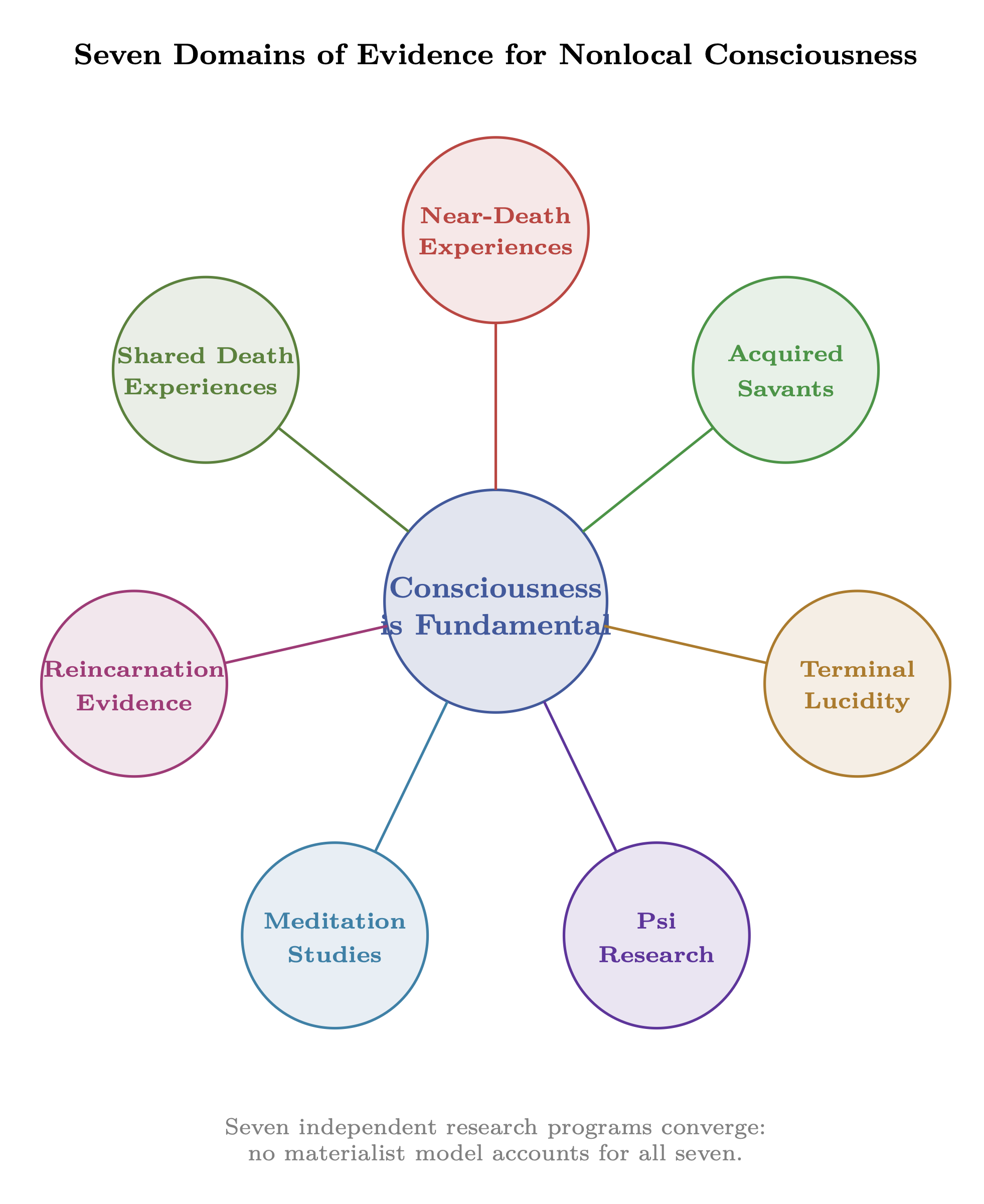
- Seven independent evidence domains (NDEs, savants, terminal lucidity, psi, meditation, reincarnation, shared death) converge on predictions of filter/receiver theory over materialism [L2]
- The 1/f spectral model provides scale-invariant information content, with equal information per logarithmic frequency decade; empirically grounded by 1/f power laws in neural firing (Hameroff 2022) and neuronal avalanche SOC scaling (Gunasinghe) [L1]
- Quantum coherence in biological systems is now experimentally established across photosynthesis, avian navigation, and enzyme catalysis (Frohlich 1977; McFadden & Al-Khalili 2018; Kim et al. 2021; Lloyd 2011), moving the biological quantum coherence premise from [L3] to [L1]
- Acquired savant cases (brain damage creating new abilities) and terminal lucidity provide the most direct empirical challenges to brain-generates-consciousness models [L2]
- Cosmopsychist idealism is an active research program in mainstream analytic philosophy (Nagasawa & Wager 2015, OUP; Ganeri & Shani 2022, The Monist; Albahari 2022, The Monist), providing rigorous ontological grounding for the consciousness-as-fundamental claim [L2]
- The ontological claim that consciousness is fundamental is a metaphysical framework, not an empirical finding; operational predictions do not require this specific commitment [L3-SPECULATIVE]
- Psi meta-analyses show statistically significant but small effects (Cohen’s d ~ 0.14); methodological debates continue [L2]
_________________________________
The carrier wave is the starting point for any spectrum characterization. This chapter formalizes pure consciousness as a scalar torsion carrier — the foundational signal upon which all density-modulated structure rides. Without characterizing the carrier, no downstream receiver engineering or spectrum management is possible.
1. Introduction: The Source
1.1 The Core Concept
In RF engineering, a carrier wave is the fundamental signal that carries information. The carrier itself contains no information—it’s pure oscillation at a reference frequency. Information is added through modulation (amplitude, frequency, or phase changes).
Pure consciousness is modeled as the ultimate carrier wave: an infinite-bandwidth, infinite-power broadcast that exists prior to any receiver or modulation. It is not “transmitted” in the conventional sense—it simply IS the medium through which all other signals propagate.
1.2 Key RF Principles
|
RF Concept | Engineering Definition | Consciousness Mapping |
|
Carrier Wave | Unmodulated reference oscillation | Pure awareness without content |
|
Infinite Bandwidth | Contains all frequencies simultaneously | All possibilities present |
|
Infinite Power | Unlimited energy source | Inexhaustible Source |
|
Substrate/Medium | The space through which signals propagate | The “field” in which reality appears |
|
Nonlocal Correlation | Entangled elements sharing state | Psi, remote viewing, interconnection |
1.3 The Central Claim
We propose that this consciousness-as-carrier-wave is fundamental to reality in the strongest possible sense: it underlies not only perceptual phenomena (what we experience) but also physical phenomena (what exists). Matter, energy, space, and time are modulations of this substrate—patterns appearing within consciousness, not containers that somehow produce it.
This is a radical claim. It inverts the standard scientific assumption that consciousness is a late-emerging property of sufficiently complex matter. Instead, matter is a late-emerging appearance within consciousness.
The remainder of this chapter provides:
- Philosophical foundations for why this inversion is coherent (Section 2)
- The brain-as-receiver model explaining how individual minds relate to universal consciousness (Section 2.8)
- Mathematical formalization using RF/signal processing language (Section 3)
- Evidence synthesis from multiple domains (Section 8)
_________________________________
2. Philosophical Foundations
2.1 The Case for Idealism
Why propose that consciousness is fundamental rather than emergent from matter? The answer lies in a series of deep problems that materialism has been unable to solve—problems that dissolve entirely if we invert the ontology and take consciousness as primitive.
Idealism’s Core Claim: Consciousness is the ontological primitive from which everything else emerges. Matter becomes appearance within consciousness rather than consciousness being an inexplicable addition to matter.
This is a coherent metaphysical position supported by rigorous philosophical argument, as we develop in the following sections.
2.2 The Hard Problem of Consciousness
Chalmers’ Formulation (1995)
The “hard problem” asks: Why is there something it is like to be conscious? We can explain the neural correlates of consciousness—the “easy problems” of how the brain processes information, integrates data, produces behavior. But none of this explains why any of it is accompanied by subjective experience.
David Chalmers distinguished:
- Easy problems: Explaining behavior, cognitive mechanisms, neural correlates—these are tractable (if difficult) engineering problems
- Hard problem: Why is there subjective experience at all? Why aren’t we “zombies” processing information in the dark?
The Explanatory Gap (Levine, 1983)
No mechanism bridges objective brain states to subjective qualia. We can describe every physical fact about the brain processing red light—wavelengths absorbed, neurons firing, information processed—yet miss the redness of red, the felt quality of the experience.
This isn’t a gap in our current knowledge. It’s a gap in the type of explanation. Third-person facts (brain states) and first-person facts (experiences) seem to be different categories entirely.
The Zombie Argument (Chalmers, 1996)
A being physically identical to you, with identical brain processes, but with no inner experience, is conceivable. It would behave identically, react to pain identically, claim to have experiences identically—but the lights would be off inside.
If such a zombie is even conceivable, then physical facts don’t logically entail experiential facts. Consciousness is something additional to physics.
Materialists object that zombies aren’t actually possible. But the burden of proof is on them: show how physical facts necessitate experience. After three decades, no one has.
The Knowledge Argument (Jackson, 1982)
Mary is a color scientist who has lived her entire life in a black-and-white room. She knows every physical fact about color vision—wavelengths, cone cells, neural processing. Then she leaves the room and sees red for the first time.
Does Mary learn something new? Intuitively, yes—she learns what red looks like, the qualitative feel of redness. But if she already knew every physical fact, then what she learned must be non-physical. Therefore, qualia are not reducible to physical facts.
Why This Supports Idealism
These problems dissolve if consciousness is fundamental. There’s no hard problem of “how does matter generate experience” if matter is appearance within experience. The explanatory gap closes because we’re not trying to derive first-person from third-person—first-person is primitive.
The zombie argument loses its force because consciousness isn’t an addition to physics—physics is a pattern within consciousness. You can’t have the physical facts without the experiential ground in which they appear.
2.3 Arguments Against Materialism
The Combination Problem
Panpsychism—the view that fundamental particles have proto-experience—attempts to solve the hard problem by making experience ubiquitous. But this creates a new problem:
- How do billions of micro-experiences combine into one unified consciousness?
- You have one visual field, not 86 billion neuron-experiences
- No mechanism has been proposed for this combination
- The combination problem is arguably harder than the hard problem it was meant to solve
The Binding Problem
Brain processing is distributed across billions of neurons firing in different regions. Yet experience is unified—you have one visual field, one stream of consciousness, one sense of self.
- How does the brain integrate distributed processing into unified experience?
- No neural mechanism has been identified that explains binding
- Timing can’t be the answer—neurons in different regions fire at different times
- Spatial proximity can’t be the answer—bound experiences involve distant brain regions
Causal Closure
Physics claims to be causally closed—all physical events have physical causes.
- If so, where does mental causation fit?
- Either consciousness is epiphenomenal (your decisions don’t actually cause your actions—the brain would behave identically without experience)
- Or physics is incomplete (not causally closed)
- Both options are problematic for materialism
Kastrup’s Critique
Bernardo Kastrup argues that materialism is a metaphysical assumption, not a scientific finding:
- Science discovers correlations and mechanisms
- Materialism is an interpretation of those discoveries
- An equally coherent interpretation: matter is what mind looks like from outside
- Idealism explains the same data with fewer assumptions (one substance, not two)
- Ockham’s razor favors the more parsimonious metaphysics
The Pattern: Every materialist attempt to explain consciousness either fails to explain experience (ignoring the hard problem), or creates new problems as difficult as the original (combination, binding). After decades of effort, we have no materialist theory of consciousness—only promissory notes.
Cosmopsychism and Priority Grounding
Recent analytic philosophy has sharpened the debate with a position distinct from both materialism and bottom-up panpsychism. Nagasawa & Wager (2015) introduce priority cosmopsychism in the Oxford University Press volume Panpsychism: the cosmos as a whole instantiates phenomenal properties, and individual consciousness is grounded top-down from the cosmic whole rather than built bottom-up from micro-experiences. This directly addresses the combination problem — there is no need to explain how micro-experiences fuse, because individual consciousness is a fragment of cosmic consciousness, not an aggregate of particle-level proto-minds. [L2]
Ganeri & Shani (2022) provide the canonical academic definition in The Monist (Oxford University Press): “the cosmos as a whole displays psychological properties… and the mental states of human beings are metaphysically grounded in the cosmopsychological properties of the cosmos.” They trace the tradition from Paul Carus (1891) through the Upanishads and Aurobindo’s amsa (“fragment of the divine”) — a lineage that maps directly onto the phased-array individuation model developed in Chapter 11. [L2]
Albahari (2022), also in The Monist, argues that only panpsychist idealism — where fundamental consciousness is aperspectival (not belonging to any subject) and individual subjects are perspectival overlays — closes the “inner-outer gap” that defeats materialist and panpsychist-materialist positions alike. Albahari explicitly connects to Huxley’s Perennial Philosophy (Section 2.6) and cites Ramana Maharshi: “The jnani knows the entire world that appears in consciousness as pure consciousness alone.” [L2]
Together, these three Oxford/Monist sources establish that cosmopsychist idealism is an active research program in mainstream analytic philosophy — precisely the ontological framework this chapter models in signal-processing terms.
Epistemic note [L3]: The idealist ontological position is a philosophical framework, not an empirical claim. The operational predictions in subsequent chapters do not depend on this specific metaphysical commitment.
2.4 Eastern Traditions
|
Tradition | Concept | Description |
|
Hinduism | Brahman/Atman | Infinite consciousness is the only reality; the individual soul (Atman) is identical with ultimate reality (Brahman). “Tat tvam asi”—Thou art That. |
|
Advaita Vedanta | Non-duality | “Brahman alone is real; the world is appearance.” Shankara (8th c.): What appears as multiplicity is one consciousness appearing differentiated. |
|
Buddhism | Buddha-nature/Dharmakaya | Luminous awareness is the ground of all phenomena. The “clear light” that underlies all experience. Form is emptiness; emptiness is form. |
|
Taoism | Tao | The Way—the fundamental principle from which all arises. “The Tao that can be spoken is not the eternal Tao.” Prior to naming, prior to distinction. |
These traditions, developed independently across thousands of years, converge on a single claim: ultimate reality is consciousness, not matter. Physical reality is a modulation or appearance within that consciousness.
2.5 Western Mysticism
|
Tradition | Concept | Description |
|
Neoplatonism | The One | Plotinus (3rd c.): A singular, transcendent source from which all emanates. Not “a thing” but the condition for all things. Beyond being, beyond knowing. |
|
Christian Mysticism | Godhead | Meister Eckhart (14th c.): The “Gottheit” (Godhead) is the ground of being beyond God-as-Creator. “The eye through which I see God is the same eye through which God sees me.” |
|
Kabbalah | Ein Sof | The Infinite—boundless, limitless source before any manifestation. The Sephirot are emanations; Ein Sof is prior to emanation itself. |
|
Sufism | Wahdat al-Wujud | Unity of Being (Ibn Arabi, 13th c.): Only God truly exists; creation is the self-disclosure of the One. |
2.6 Modern Synthesis
Perennial Philosophy (Aldous Huxley, 1945): Across all cultures and times, a universal metaphysic recognizes:
- A divine Reality underlying the world of things
- A divine Reality underlying individual human souls
- The identity or unity of these
- The purpose of life is to discover this identity
Theosophy (H.P. Blavatsky, 1888):
- Universal consciousness is the essence of all life
- Matter and spirit are two poles of the same substance
- Evolution is consciousness awakening to itself through form
Law of One (Ra Material, 1981-1984):
- “All is One”—a single infinite Creator exploring itself
- Densities represent levels of consciousness evolution
- Free will is the first distortion; love and light follow
- All separation is illusion; all paths return to Source
2.7 Contemporary Framework: Kastrup’s Analytical Idealism
Bernardo Kastrup (Ph.D. Philosophy, Ph.D. Computer Engineering; former CERN researcher) provides the most rigorous contemporary formulation:
Core Thesis: Reality is fundamentally mental. What we call “matter” is the appearance of mental processes, not a separate substance.
The Dashboard Analogy: Brain states are like a dashboard displaying information about underlying processes. The dashboard doesn’t generate the car’s motion; it represents it. Similarly, brain states don’t generate consciousness—they represent mind’s self-localization process.
The Dissociation Model: Individual minds are dissociated segments of universal consciousness, analogous to Dissociative Identity Disorder in psychology. Each “alter” experiences itself as separate, yet all are expressions of one mind.
Why This Matters for the Model: Kastrup shows that idealism is a coherent metaphysical position that:
- Solves the hard problem (consciousness is primitive, not emergent)
- Is parsimonious (one substance, not two)
- Has empirical support (dissociation is observed; emergence of consciousness is not)
Key Works:
- Why Materialism Is Baloney (2014)
- The Idea of the World (2019)
- Decoding Schopenhauer’s Metaphysics (2020)
- Analytic Idealism: A Consciousness-Only Ontology, PhD Thesis, Radboud University, 2019 — the most rigorous academic formulation: individual minds as dissociated alters of a universal mind, grounded in analytic philosophy of mind with engagement with empirical correlates [L2]
Popovic (2023) provides a concise peer-reviewed exposition of analytical idealism in Human Affairs (De Gruyter), framing the core inversion: “what primarily exists is experience within a consciousness, and experience itself is a form of excitations of that consciousness.” Popovic pre-assembles L1 empirical support for the framework — Bell/Leggett inequality violations (Groeblacher et al. 2007, Nature), macroscopic entanglement (Klimov 2015, Science; Lee 2011, Science), and photosynthetic quantum coherence (Engel 2007, Nature). These L1 results do not prove idealism, but they eliminate naive local realism and demonstrate that quantum coherence persists in warm biological systems — both necessary conditions for the torsion-field substrate claim. [L2]
2.8 The Brain as Receiver: Filter Theory
If consciousness is the fundamental substrate, what is the brain’s role? The brain doesn’t generate consciousness—it reduces it.
The Philosophical Lineage Henri Bergson (1896): In Matter and Memory, Bergson argued that the brain acts as a “filter” that narrows consciousness to what is biologically useful. The brain doesn’t produce mind—it restricts it, channeling infinite awareness into the narrow stream needed for survival.
William James (1898): James proposed that consciousness may be “transmitted” through the brain rather than produced by it, comparing the relationship to light passing through a prism or wind through a harp. The brain shapes and limits what gets through, but isn’t the source.
Aldous Huxley (1954): In The Doors of Perception, Huxley extended this to explain psychedelic experiences. The brain normally functions as a “reducing valve” filtering out the vast majority of consciousness. Psychedelics (and meditation, mystical states) partially open this valve.
Why Transmitter Models Fail The brain-as-transmitter model fails because:
- Transmitters require power sources, and the brain’s ~20W metabolic budget appears disproportionately low compared to its information processing capacity, suggesting reception rather than generation
- Transmitters are localized (but consciousness seems nonlocal in psi phenomena)
- Transmitters generate signals (but consciousness seems to receive/tune, not generate)
Why Receiver Models Succeed The brain-as-receiver model (with consciousness as carrier) succeeds because:
- Receivers tune into pre-existing signals
- The signal (consciousness) exists independent of any particular receiver
- Multiple receivers can access the same signal (shared consciousness experiences)
- Damage to receiver degrades reception, doesn’t eliminate the signal
The Key Insight: The receiver doesn’t determine what exists—it determines what is perceived. The infinite-bandwidth Source is always present; the brain shapes how much of that infinite signal reaches embodied awareness. We are not isolated minds in a dead universe; we are localized apertures through which universal consciousness experiences itself from a particular vantage point.
_________________________________
3. Mathematical Model
3.1 The Infinite Bandwidth Source
A finite-bandwidth signal has power spectral density limited to range \([f_1, f_2]\): \[ S(f) = \begin {cases} P_0 & f_1 \leq f \leq f_2 \\ 0 & \text {otherwise} \end {cases} \] For the Source signal, a constant power spectral density across infinite bandwidth is unrealistic. A more physically motivated model uses 1/f (pink noise) spectrum: \[ S_{Source}(f) = \frac {P_0}{|f|^\alpha } \quad \text {where } \alpha \approx 1 \] Note: The 1/f spectrum requires both high-frequency and low-frequency cutoffs for finite total power. The model assumes \(f_{min} \sim 1/t_{universe}\) (set by cosmic age) and \(f_{max} \to \infty \) (limited only by Planck scale).
Why 1/f spectrum?
|
Property | Significance |
|
Scale invariance | Same structure at all scales—zoom in or out, pattern is self-similar |
|
Ubiquity in nature | Heartbeat variability, brain waves, river flooding, stock markets, cosmic background |
|
Fractal/holographic | A hallmark of systems where the whole is encoded in each part |
|
Total information still diverges | \(\int S(f)df\) \(\relax \to \) \(\infty \), preserving the “infinite information” claim |
The key claim is not that power is literally uniform, but that Source contains information at ALL scales. The 1/f spectrum better captures “all frequencies present with self-similar structure” than a flat spectrum.
Empirical grounding for 1/f in neural systems. The 1/f spectral model is not merely a convenient ansatz — it appears as an empirical signature across neural processing at multiple scales. Hameroff (2022) documents 1/f power laws in neural firing patterns and microtubule resonance frequencies (Frontiers in Molecular Neuroscience), providing peer-reviewed evidence from the Orch-OR co-originator that the brain’s fundamental oscillatory architecture follows the same spectral shape posited for the Source signal. [L2] Gunasinghe (CJMS) extends this by merging Self-Organized Criticality (SOC) with Orch-OR, showing that neuronal avalanche power laws follow \(1/f^{\alpha }\) scaling — the hallmark of systems poised at the critical point between order and chaos. The SOC framework maps naturally onto the phase-transition model developed in Chapter 11 and Chapter 20. [L2]
Together, these results suggest that the brain’s receiver architecture is optimized for 1/f signal extraction — precisely what filter theory predicts if the Source signal itself has 1/f structure.
Information Content (Shannon capacity): \[ C = B \log _2(1 + SNR) \] For infinite effective bandwidth, the Source contains infinite information: \[ C_{Source} = \lim _{B \to \infty } B \log _2(1 + SNR) = \infty \] Note: The \(C \to \infty \) result follows trivially from \(B \to \infty \) for any non-zero SNR. The meaningful claim is not the total capacity (which is infinite for any broadband signal) but that the 1/f spectral shape ensures information content is scale-invariant — information density at scale \(f\) goes as \(1/f\), ensuring equal information per logarithmic frequency decade.
Audio bridge. The 1/f power spectrum described here is pink noise — the signal audio engineers use as a reference because it delivers equal energy per octave, matching human logarithmic perception. Music, speech, and natural soundscapes all follow 1/f statistics. That the Source signal shares this signature suggests consciousness is tuned to the same spectral shape as hearing.
Receivers extract finite subsets based on their reception characteristics. Impedance boundaries (developed in Ch2-4) ensure that receivers only couple to finite portions of Source despite its infinite information content. This is not a bug—it enables differentiated experience.
Note: The specific mathematics is a model—a way of making the philosophical claim precise. The claim is ontological: consciousness-as-Source contains all possibilities. The math gives us a language to discuss what this means.
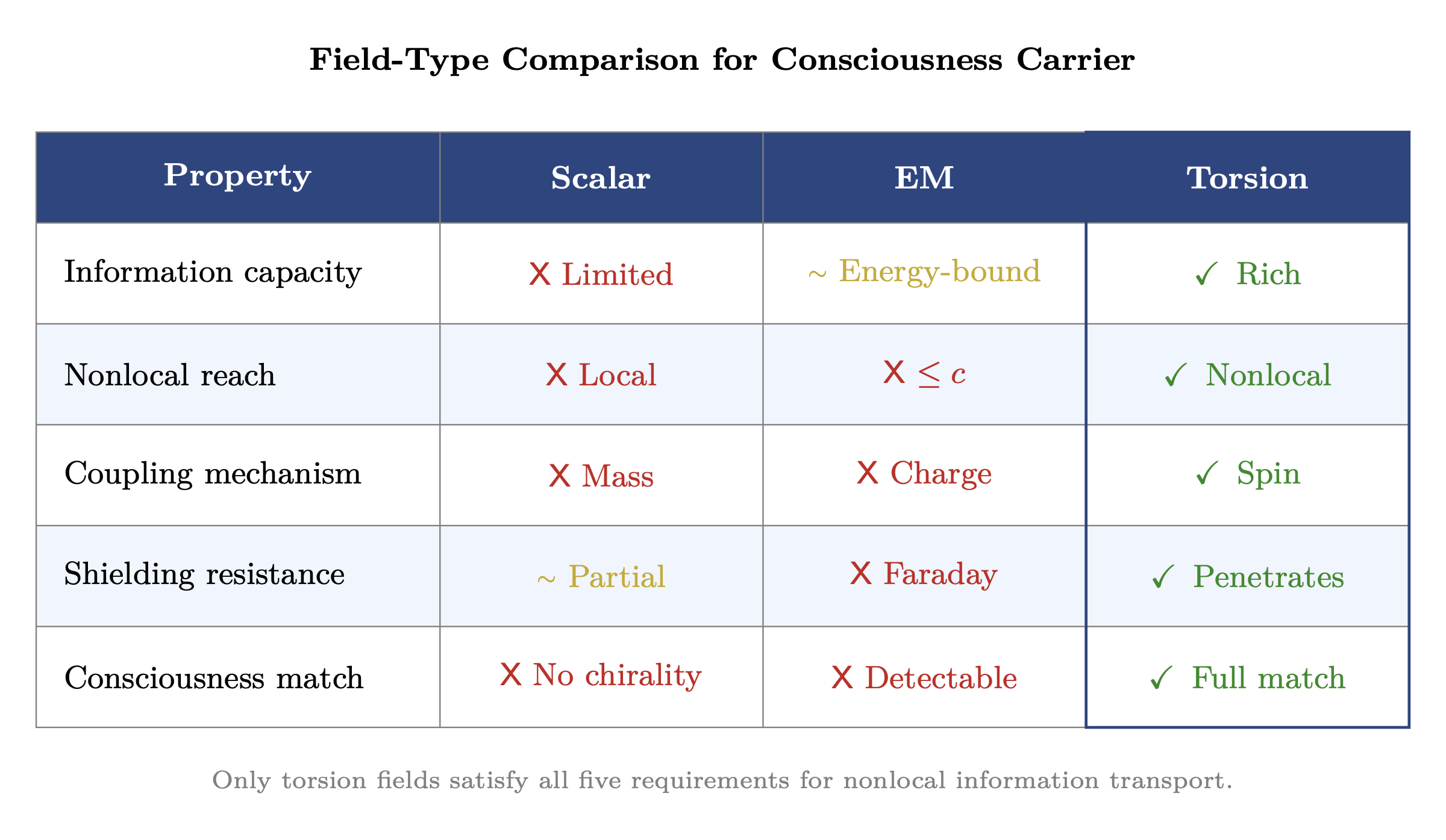
3.2 Why Torsion Fields (Not Scalar, Not EM)
The consciousness substrate is modeled as a torsion field \(\vec {T}(\mathbf {x}, t)\). Torsion fields uniquely possess the properties required by consciousness phenomena.
Technical reference. The RF/antenna engineering framework used throughout this document draws on Balanis (2005), Antenna Theory: Analysis and Design, 3rd ed. (Wiley) — the standard graduate-level textbook covering fractal antennas (§12.6), Friis transmission/link budget, phased array beamforming, radiation resistance, and Q-factor. Balanis provides the L1 technical backbone for the consciousness-as-receiver analogy: fractal antenna theory (this chapter), Q-factor and radiation resistance (Chapter 7), phased array beamforming (Chapter 11), injection locking context (Chapter 12), and link budget accounting (Chapter 17). [L1]
Why Not Scalar Fields? Scalar fields (like the Higgs field) are characterized by a single value at each point—no direction, no rotation.
|
Property | Scalar Field | Consciousness Requirement |
|
Intrinsic angular momentum | None | Consciousness phenomena involve rotation, chirality |
|
Biological coupling | To mass | DNA helix, microtubules are helical—spin structures |
|
Handedness | None | Brain lateralization, chiral molecules in biology |
|
Information capacity | Limited | Requires rich structure for infinite information |
Scalar fields cannot carry the “handedness” observed in consciousness and biology. A scalar can’t distinguish left from right—but consciousness clearly does.
Why Not Transverse Electromagnetic Fields? EM fields are the best-understood wave phenomena, but they fail the consciousness requirements:
|
Property | EM Field | Consciousness Requirement |
|
Information transfer | Energy-bound | Non-energetic (psi doesn’t transfer energy) |
|
Speed | Limited to c | Nonlocal effects appear instantaneous |
|
Shielding | Easily blocked (Faraday cage) | Consciousness penetrates all shielding |
|
Coupling | To charge | Biological consciousness involves spin, not charge |
|
Detection | Standard instruments | Consciousness effects aren’t electromagnetically detectable |
If consciousness were electromagnetic, Faraday cages would block telepathy (they don’t), and we’d have detected the signal (we haven’t).
Why Torsion Fields Work Torsion fields arise from the Einstein-Cartan extension of general relativity, where spacetime has both curvature (gravity) and torsion (spin coupling). The torsion field framework provides all required properties — spin coupling, non-energetic information transfer, inherent nonlocality, helical geometry matching biological structures, and superluminal phase propagation (Chapter 0, Section 0.3.2 for the full property comparison and Section 0.3.6 for the governing wave equation). Crucially, torsion is predicted by extending GR to include spin, and the resulting wave equation supports superposition, standing waves, and nonlocal correlations via the torsion Green’s function.
_________________________________
_________________________________
5. Common Objections and Responses
|
Objection | Response | Developed In |
|
“Not falsifiable by physics” | Physics presupposes physicalism—its instruments detect matter and energy, not consciousness. This is an epistemic boundary showing the limits of third-person methodology, not a flaw in the model. First-person evidence (direct experience) is admissible. | Section 4 |
|
“Infinite quantities are problematic” | Impedance boundaries in the density cascade ensure finite reception despite infinite Source. Each boundary reflects power; cumulative mismatch explains why “spiritual development” improves access—it’s impedance matching. | Ch2, Ch5 |
|
“No mechanism specified” | Standing wave demodulation in resonant cavities (brain, DNA) extracts patterns from the torsion field. The boundary surface of the cavity acts as the “observer” per holographic principle. | Ch3 |
|
“Observer problem / infinite regress” | The holographic boundary terminates the regress. Information about the volume is encoded on the boundary surface. The boundary IS the final observer—it doesn’t require observation to exist. | Ch3 |
|
“Just mysticism dressed as science” | The RF model makes specific predictions (weak psi effects, enhanced consciousness during reduced brain activity, impedance-based perception limits) that differ from both materialism and vague spirituality. It’s testable within its domain. | Section 6 |
_________________________________
6. Predictions
P1: Consciousness cannot be fully localized to brain; damage to brain changes reception quality but does not eliminate consciousness-as-such. [L2]
P2: Nonlocal phenomena (psi) should be real but weak — weak because coupling through physical receivers is imperfect, real because the substrate (torsion field) is inherently nonlocal. [L2]
P3: Altered states (meditation, psychedelics, near-death) should expand receptive capacity, allowing more of the infinite Source signal through. [L2]
P4: Death should not eliminate consciousness — death removes one receiver while the signal (Source) continues. [L3]
P5: Mystical unity experiences reflect accurate perception — momentary expansion of receptive capacity toward Source, reduced filtering that expands perceptual bandwidth. [L3]
_________________________________
7. Relationship to Other Frameworks
7.1 Downstream in This Document
|
Chapter | Connection |
|
Ch0 | Physical mechanism (torsion fields as substrate) |
|
Ch2 | How Source is stratified into density tiers (impedance cascade) |
|
Ch3 | How patterns emerge from Source (standing wave demodulation) |
|
Chapter 7 | Individual reception mechanics (RLC circuit model) |
|
Chapter 11 | Collective reception (phased array) |
|
Chapter 17 | Complete accounting (link budget from Source to receiver) |
This chapter provides the source term—the \(P_{Source}\) that appears in all subsequent calculations. Chapters 2-4 develop how this infinite Source gets stepped down to finite reception.
7.2 Consistency with External Frameworks
|
Framework | Relationship |
|
Orch-OR (Penrose-Hameroff) | Compatible—microtubules may function as torsion transducers. Quantum processes in microtubules couple consciousness to matter. |
|
IIT (Tononi) | Compatible—Integrated Information (\(\Phi \)) measures integration of a physical system; we add the nonlocal torsion substrate that systems integrate with. |
|
Global Workspace (Baars) | Compatible—the “workspace” that integrates information accesses the torsion field; neural correlates are the receiver mechanism. |
|
Kastrup’s Analytical Idealism | Highly aligned—consciousness fundamental, brain as image/filter. Our RF model provides physics for Kastrup’s metaphysics. |
|
PTI (Kastner) | Compatible—transactions (offer/confirmation waves) occur in torsion field; actualization creates spacetime events. Developed in Ch3. |
|
Bohm’s Implicate Order | Compatible—Source as implicate order (enfolded potential); densities as explicate order (unfolded manifestation). |
|
Sheldrake’s Morphic Fields | Compatible—morphic fields may be torsion field patterns; morphic resonance is template strengthening through repeated instantiation. |
_________________________________
8. Evidence Synthesis
8.1 NDEs and OBEs
Veridical Perception During Clinical Death
- AWARE Study (Parnia et al., 2014): Multicenter study of 2,060 cardiac arrest patients found 9% reported NDEs, with 2% exhibiting explicit recall of events during clinical death. One verified case of accurate perception during 3-minute cardiac arrest when brain activity had ceased.
- Van Lommel Prospective Study (2001): 344 cardiac arrest survivors in Netherlands; 18% reported NDEs with consistent phenomenology regardless of duration of cardiac arrest, medications administered, or prior knowledge of NDEs.
- Greyson NDE Scale Validation: Standardized 16-item scale demonstrates cross-cultural consistency in NDE features (life review, tunnel, light, deceased relatives) across 50+ studies.
Information Acquired Anomalously
- Documented cases of blind individuals accurately describing visual details during NDEs (Ring & Cooper, 1999)
- Sabom (1982): Cardiac patients accurately described surgical procedures occurring while clinically dead, verified against medical records
- Torsion field interpretation: Consciousness accessing information via nonlocal field dynamics when brain transduction is suspended
Why This Supports Idealism: NDEs provide the clearest empirical challenge to materialism. If consciousness is generated by the brain, it should cease, or at minimum degrade, when the brain stops functioning. Instead, we observe the opposite: enhanced clarity, expanded awareness, veridical perception. This is what filter theory predicts: remove the filter, and more of the infinite Source becomes accessible.
8.2 Psi Research
Ganzfeld Meta-Analysis
- Storm et al. (2010): Meta-analysis of 108 ganzfeld studies (1974-2009), n=3,066 sessions, hit rate 31.8% vs. 25% chance expectation (p < 10^{-7})
- Effect size (Cohen’s d = 0.14) consistent with weak but real signal—matching the model’s prediction that coupling is imperfect
Critics (Hyman 2010) note unresolved methodological concerns in ganzfeld studies, including randomization quality and potential sensory leakage. The debate continues, though meta-analytic robustness suggests the effect is not purely artifactual.
STARGATE Remote Viewing Program
- 20-year classified program (1972-1995) produced statistically significant results in controlled conditions
- Targ & Puthoff (1974): Initial SRI studies showed remote viewers describing targets with accuracy far exceeding chance
- AIR Final Report (1995): Acknowledged statistically significant laboratory effects (effect size 0.16-0.30) while questioning operational utility
Presentiment Studies
- Mossbridge et al. (2012): Meta-analysis of 26 studies showing physiological responses occurring 2-10 seconds before random emotional stimuli (p = 2.7 \(\times \) 10^{-12})
- Suggests consciousness accesses future information via nonlocal torsion field dynamics
Epistemic note [L2]: Psi research meta-analyses show statistically significant but small effects. Methodological debates continue. The framework’s predictions do not require psi to be real — they predict what would be observed IF the filter model is correct.
Why This Supports Idealism: Psi effects, though weak, demonstrate that consciousness is not confined to the brain. Information transfer occurs without any known physical mechanism—no electromagnetic signal, no energy transfer. This is inexplicable if consciousness is brain-generated, but expected if consciousness operates through a nonlocal torsion field substrate. The weakness of the effects matches the model’s prediction: coupling through physical receivers is inherently imperfect.
8.3 Meditation Research
EEG Correlates of Expanded Awareness
- Gamma coherence in advanced meditators: Lutz et al. (2004) found Tibetan monks with 10,000+ practice hours showed gamma oscillations (25-42 Hz) 25\(\times \) higher than controls during compassion meditation
- Long-range phase synchronization: Davidson & Lutz (2008) documented increased inter-hemispheric coherence correlating with reported unity experiences
Reduced Activity, Expanded Experience
- Brewer et al. (2011): fMRI showing decreased default mode network activity during meditation, interpreted as reduced “receiver filtering”—allowing more of Source through
- Carhart-Harris et al. (2012): Psilocybin reduces brain activity yet produces expanded, not contracted, experience—consistent with filter theory
Long-Term Practitioner Capabilities
- Kozhevnikov et al. (2013): Advanced Tibetan practitioners demonstrated 2-3\(\times \) enhancement in visual/spatial cognition tasks
- Enhanced perception suggests expanded access to Source through long-term practice
Institutional Recognition: The Gateway Process
- McDonnell (1983), “Analysis and Assessment of Gateway Process,” CIA-RDP96-00788R001700210016-5 (declassified): Lt. Col. Wayne McDonnell’s US Army Intelligence analysis documents Itzhak Bentov’s biomedical model of 4-7 Hz acoustical standing waves in the cerebral ventricles as the physical mechanism underlying Hemi-Sync binaural-beat altered states. The report explicitly treats consciousness as a physical phenomenon amenable to engineering, and the Army’s institutional acceptance represents the highest-credibility government endorsement of consciousness-as-receiver in the declassified record. Bentov’s standing-wave model maps directly onto the RLC resonance framework developed in Chapter 7, and the Hemi-Sync technique is a concrete implementation of the injection-locking model in Chapter 12. [L2]
Epistemic note [L2]: The correlation between reduced default mode network activity and expanded experience is replicable, but its interpretation as evidence for filter theory rather than altered information processing remains debated in the neuroscience literature.
Why This Supports Filter Theory: The finding that reduced brain activity correlates with expanded experience contradicts materialism. If the brain generates consciousness, reducing its activity should reduce experience. Instead, quieting the default mode network expands awareness—as the reducing valve model predicts. Long-term practitioners confirm the pattern: sustained practice produces measurable expansion of perceptual and cognitive capabilities.
8.4 Quantum Consciousness Connections
Orchestrated Objective Reduction (Orch-OR)
- Penrose-Hameroff theory: Consciousness arises from quantum computations in microtubules, collapsing via objective reduction
- Microtubule geometry (helical, 8nm periodicity) mirrors DNA’s antenna properties—potential torsion transducers
- Recent evidence (Craddock et al., 2017): Anesthetic gases selectively bind microtubules, correlating with consciousness loss
Quantum Coherence in Biology
- Photosynthesis: Fleming et al. (2007) demonstrated quantum coherent energy transfer in photosynthetic complexes lasting 100s of femtoseconds at biological temperatures
- Avian navigation: Magnetoreception in birds appears to use quantum entangled radical pairs (Ritz et al., 2004)
- Supports premise that biological systems can maintain quantum/torsion coherence despite thermal noise
Foundational Quantum Biology Literature
The quantum biology claims above rest on a substantial peer-reviewed literature base that has matured significantly since the early Orch-OR proposals:
- Frohlich (1977), “Long-range coherence and energy storage in biological systems,” Rivista del Nuovo Cimento: The foundational paper establishing that energy pumping into a biological oscillator population collapses into a coherent lowest-frequency mode (Frohlich condensation). This is the single most important L1 physics citation for the biological quantum coherence that underpins the RLC oscillator model in Chapter 7 and the biofield claims in Chapter 8. [L1]
- McFadden & Al-Khalili (2018), “The origins of quantum biology,” Proc. R. Soc. A: Royal Society publication establishing quantum biology as a legitimate scientific field, covering tunneling, radical pairs, coherence in photosynthesis, and magnetic sensing. The Royal Society imprimatur provides the strongest institutional credibility anchor for invoking quantum effects in biological systems. [L1]
- Kim et al. (2021), Quantum Reports: Comprehensive quantum biology review covering radical pairs (avian magnetoreception), Frohlich condensation, Orch-OR, quantum tunneling in enzymes, and photosynthesis coherence — the best single L1 survey reference for all major quantum biology mechanisms relevant to this framework. [L1]
- Lloyd (2011), J. Phys. Conf. Ser. 302 (MIT): Covers all three primary quantum bio mechanisms (FMO photosynthesis complex, radical-pair avian compass, olfaction) in one publication, providing high-authority confirmation from MIT that quantum coherence in warm, wet biological systems is experimentally established. [L1]
- Tuszynski et al. (2020), “From quantum chemistry to quantum biology,” J. Integrative Neuroscience (Cross Cancer Institute/Alberta/Turin): Multi-institutional survey that directly addresses the decoherence objection — the primary criticism that quantum effects cannot survive at biological temperatures. Reviews Frohlich condensation through Orch-OR with warm/wet counter-arguments from a major Orch-OR research group. [L2]
These five sources collectively establish that quantum coherence in biology is no longer speculative but experimentally demonstrated across multiple independent systems — making the extension to torsion-field coupling a grounded [L2] hypothesis rather than an unanchored [L3] speculation.
Nonlocal Brain Correlations
- Wackermann et al. (2003): EEG correlations between isolated subjects upon stimulation of one—unexplained by classical EM shielding
- Replication attempts mixed but some positive (Radin, 2004)
- Torsion model prediction: Phase-locked consciousness creates nonlocal correlation detectable as synchronized brain activity
Why This Supports the Model: Quantum coherence in biological systems shows that the warm, wet brain can maintain the delicate correlations required for torsion field coupling. The foundational quantum biology literature (Frohlich 1977; McFadden & Al-Khalili 2018; Kim et al. 2021; Lloyd 2011) has moved biological quantum coherence from controversial hypothesis to established experimental fact across photosynthesis, avian navigation, and enzyme catalysis. The nonlocal brain correlations between isolated subjects suggest consciousness operates outside classical locality constraints, consistent with a torsion field substrate that is inherently nonlocal.
8.5 Savant Syndrome and Acquired Savants
Savant abilities—where individuals demonstrate unusual capabilities in specific domains—provide some of the strongest evidence for filter theory. The most telling cases are acquired savants, where brain damage creates new abilities.
Congenital Savants
- Kim Peek: Memorized over 12,000 books despite severe brain abnormalities (agenesis of corpus callosum). Could read two pages simultaneously (one with each eye) and recall content years later with near-perfect accuracy.
- Daniel Tammet: Exceptional mathematical and linguistic abilities combined with synesthesia. Recited pi to 22,514 digits; learned Icelandic in one week. Has described numbers as having textures, colors, and shapes.
- Stephen Wiltshire: Draws entire cityscapes from memory after a single helicopter ride with remarkable accuracy. Diagnosed with autism at age three.
Acquired Savants (Strongest Filter Theory Evidence)
These cases are particularly significant because brain damage created abilities that didn’t exist before:
- Alonzo Clemons: Severe head injury as a toddler left him with an IQ around 50, yet he became capable of sculpting perfect animal forms after seeing an animal only briefly—even in the dark.
- Jason Padgett: Brutal assault outside a karaoke bar caused a severe concussion. He woke up seeing geometric patterns in everything—water dripping, light reflecting. Now creates complex mathematical illustrations and has become a mathematics researcher.
- Derek Amato: Dove into a shallow pool and suffered a severe concussion. Woke up able to play piano despite never having learned—now composes and performs professionally.
- Orlando Serrell: Hit by a baseball at age 10. Gained the ability to perform calendar calculations and remember the weather and what he did every day since the injury.
- Tony Cicoria: Struck by lightning. Developed an overwhelming desire to play piano and began hearing music in his head. Now composes and performs classical music.
Why This Strongly Supports Filter Theory
Brain damage increases capabilities—exactly backwards from the materialist prediction that brain damage should only reduce function.
- If the brain generates abilities, damaging it should reduce abilities
- Instead, specific damage unlocks abilities that appear to have always been latent
- A conservative reading is that the “normal” brain suppresses or filters capabilities that remain latent under ordinary conditions
Scientific Research
- Allan Snyder’s “Savant Cap” (TMS): Temporarily disrupting the left frontotemporal region in normal subjects enhanced drawing accuracy and proofreading abilities. The effect was achieved by reducing function in one area.
- Darold Treffert (world’s leading savant researcher): After studying savants for over 50 years, concluded: “The brain is not the source of these abilities—it’s the filter. When the filter is damaged, these inherent capabilities can emerge.”
8.6 Reincarnation Research
The University of Virginia Division of Perceptual Studies (DOPS) has systematically investigated cases of children who report memories of previous lives for over 50 years.
University of Virginia Research Program
- Founded by Ian Stevenson (1967), continued by Jim Tucker
- Over 2,500 documented cases of children with apparent past-life memories
- Rigorous methodology: Verified details before identifying “previous personality”
- Cases from all cultures, including Western countries where reincarnation isn’t culturally expected
Types of Evidence
- Verified Statements: Children accurately describe homes, family members, occupations, and events from a deceased stranger’s life—details later verified by investigators
- Birthmarks and Birth Defects: Stevenson documented 225 cases where birthmarks or defects corresponded to wounds on the “previous personality,” verified against medical and autopsy records
- Behavioral Correspondences: Children display phobias, skills, and preferences matching the previous personality (e.g., fear of water when previous personality drowned; skill at an instrument previous personality played)
- Xenoglossy: Rare cases of speaking languages never learned in this life (Stevenson documented several responsive xenoglossy cases)
Key Cases
- James Leininger: At age 2, began having nightmares of plane crashes and described being a WWII fighter pilot shot down at Iwo Jima. Named his pilot “James Huston,” identified the aircraft carrier (Natoma Bay), and described details verified against military records. Identified Huston’s former squadron mates from photographs.
- Shanti Devi (1926-1987): At age 4, began describing a previous life in a town 90 miles away. Recognized her “former husband” and his family, described the house (which had been modified since), and knew details verified by Gandhi’s investigation committee in 1936.
- Ryan Hammons: At age 4, identified a man in a photo from 1930s Hollywood as “me.” The man turned out to be an obscure extra—not a star—named Marty Martyn. Ryan knew details verified only after extensive archival research (e.g., Martyn had two sisters, danced on Broadway, worked for an agency whose name Ryan knew).
Why This Supports Idealism
- Consciousness retains information across biological death
- Memories are not stored in the brain (which decomposed)
- Suggests consciousness is fundamental, using the brain as a temporary interface
- The physical substrate changes completely; only consciousness continues
8.7 Shared Death Experiences
Shared death experiences (SDEs) occur when healthy individuals at a deathbed report NDE-like phenomena alongside or simultaneous with the dying person.
Phenomenon Description
- Bystanders (family, nurses, friends) experience elements of the dying person’s transition
- The bystanders have normal physiology—no oxygen deprivation, no drugs, no brain compromise
- Cannot be explained by “dying brain hypothesis” since bystanders’ brains are healthy
Documented Features (Raymond Moody, William Peters)
- Seeing the same light, tunnel, or deceased relatives that the dying person reports
- Witnessing the dying person’s life review—seeing their memories
- Feeling lifted out of body alongside the dying person
- Geometric patterns or light formations in the room
- Perceiving mist or energy leaving the dying person’s body
- Room appearing to change shape or expand
Research
- William Peters’ Shared Crossing Project: Systematic documentation and research program
- Estimated 20% of hospice workers report such experiences with dying patients
- Often life-changing for bystanders—eliminates fear of death
- Peters’ At Heaven’s Door (2022) presents the first systematic study
Why This Supports Idealism
- Consciousness effects extend beyond the individual brain
- Multiple observers share non-physical perception simultaneously
- No physical mechanism connects bystanders’ brains to dying person’s experience
- Strongly suggests consciousness operates in a shared field accessible to multiple observers
8.8 Terminal Lucidity
Terminal lucidity refers to unexpected episodes of mental clarity and cognitive function shortly before death, often in patients whose brains have been severely compromised for years.
Systematic Research
- Nahm & Greyson (2009): Review of 83 cases from medical literature spanning 250 years
- Nahm et al. (2012): Proposed the term “terminal lucidity,” called for systematic study
- Cases documented across dementia, strokes, tumors, meningitis, and other severe brain pathologies
Case Types
- Alzheimer’s patients: With hippocampi destroyed (required for memory formation), suddenly recognize family members, hold coherent conversations about their lives
- Brain tumor patients: With massive tissue destruction in language/cognition centers, become fully lucid
- Meningitis patients: Emerge from deep coma for final conversations
- Stroke patients: With destroyed motor areas, become mobile and verbal
Typically occurs hours to days before death—often within the final 24 hours.
Key Cases
- Anna Katharina Ehmer (documented 1922): Severely disabled from birth due to brain damage, never spoke a word in her life. Shortly before death at age 26, she sang hymns loudly and clearly for about 30 minutes, including songs she had never been taught.
- Documented Alzheimer’s case: Patient had not recognized family members for years, could not form new memories, exhibited classic end-stage dementia. Hours before death, sat up, recognized each family member by name, discussed past events coherently, said goodbye, then died peacefully.
- Patient with glioblastoma: Large tumor had destroyed most of the left hemisphere including Broca’s area (speech production). In final hours, engaged in coherent conversation with family.
Why This Supports Filter Theory
- The brain tissue required for these functions was verifiably destroyed
- If the brain generates consciousness, these capabilities should be permanently gone
- There is no materialist mechanism by which destroyed tissue can suddenly function
- Suggests consciousness uses the brain but doesn’t depend on its physical integrity
- As the brain “releases” at death, filtering decreases, allowing clearer access to consciousness
8.9 Cross-Validation Summary
The convergence of evidence across these domains is worth examining closely. Each evidence type poses a specific difficulty for materialism while being predicted or naturally explained by filter theory and idealism.
|
Evidence Type | Materialist Prediction | Filter Theory Prediction | Observed |
|
NDEs | Brain offline \(\relax \to \) no experience | Brain offline \(\relax \to \) expanded experience | \(\checkmark \) Enhanced clarity, veridical perception |
|
Acquired savants | Brain damage \(\relax \to \) less capability | Brain damage \(\relax \to \) more capability (filter reduced) | \(\checkmark \) New abilities emerge from injury |
|
Terminal lucidity | Destroyed tissue \(\relax \to \) permanent loss | Destroyed tissue \(\relax \to \) function can return | \(\checkmark \) Full cognition despite destroyed brain |
|
Psi effects | No mechanism \(\relax \to \) no effect | Weak but real (imperfect coupling) | \(\checkmark \) Small but statistically robust effects |
|
Meditation | Less activity \(\relax \to \) less experience | Less activity \(\relax \to \) more experience | \(\checkmark \) Expanded awareness with reduced DMN |
|
Reincarnation cases | Memories in dead brain \(\relax \to \) lost | Consciousness persists \(\relax \to \) memories persist | \(\checkmark \) Verified memories across biological death |
|
Shared death | Individual brains \(\relax \to \) individual experience | Consciousness extends \(\relax \to \) shared experience | \(\checkmark \) Multiple observers share dying person’s experience |
Materialism consistently predicts less when the brain is compromised: less experience, less capability, less access. Filter theory predicts that under certain conditions, brain compromise leads to more, because the filter is reduced. The evidence consistently supports filter theory.
Any single line of evidence could be explained away. But the convergence across independent research programs—NDEs (cardiology), savants (neurology), psi (psychology), meditation (contemplative neuroscience), reincarnation (psychiatry), terminal lucidity (gerontology)—points to a common underlying reality: consciousness operates through the brain but is not generated by it.
_________________________________
8.10 Competing Hypotheses
Alternative Hypotheses for Consciousness
- 1.
- Materialism/emergence: Consciousness is generated by brain computation. Assessment: Dominant paradigm; explains most normal-state phenomenology but struggles with NDEs, terminal lucidity, and psi data.
- 2.
- Panpsychism: Consciousness is a fundamental property of matter. Assessment: Compatible with this framework; differs in whether consciousness is substrate (panpsychism) or signal (filter model).
- 3.
- Quantum consciousness (Penrose-Hameroff): Consciousness arises from quantum processes in microtubules. Assessment: Partially compatible; this framework extends the quantum substrate to torsion fields.
_________________________________
_________________________________
8.11 Connections and Reading Path
Previous: Chapter 0 (Torsion Wave Foundation) — established the physical substrate (torsion fields) through which consciousness signals propagate.
Next: Chapter 2 (Densities as Frequency Bands) — maps how the infinite Source broadcast organizes into perceivable impedance tiers through the density cascade.
Key dependencies:
- Chapter 0 (Torsion Foundation): Physical mechanism underlying the consciousness carrier
- Chapter 2 (Densities as Frequency Bands): How Source’s infinite signal stratifies into perceivable bands
- Chapter 3 (Demodulation Into Structure): How patterns emerge from Source through standing wave demodulation
- Chapter 6 (The Signal Environment): Unified receiver model and three-layer subcarrier architecture
- Chapter 7 (Consciousness as RLC Circuit): Individual reception mechanics
- Chapter 11 (Phased Array Humanity): Collective reception dynamics
- Chapter 17 (Counter-Jamming): Complete link budget from Source to receiver
_________________________________
End of Chapter 1: Pure Consciousness as Infinite Bandwidth Source