Chapter 3: Demodulation Into Structure
Standing Waves, Templates, and Creative Feedback
KEY FINDINGS — Chapter 3: Demodulation Into Structure
Evidence-tier key: see front matter for [L1]–[L4] definitions.
- Platonic solids appear as organizing templates across 40+ orders of magnitude, from nuclear magic numbers (Moon model, Hecht & Stevens 2004) to cosmic topology — the only regular convex polyhedra possible in 3D [L1]
- E8-quasicrystal physics experimentally confirmed: Viebahn et al. (2019, Nature) demonstrated 8-fold quasicrystalline optical lattice with fractal momentum structure; Amaral et al. (2023) formalized quasicrystalline spin foam within LQG Hilbert space [L1-L2]
- The Possibilist Transactional Interpretation (PTI) provides a physics mechanism for how quantum possibilities become actualized reality through offer/confirmation wave transactions [L2]
- Microtubule geometry (VFD framework) implements phi-scaled resonant modes spanning 15 orders of magnitude, with 7 testable predictions; torsion geometry of microtubules independently supported (Rapoport 2023, IOP) [L2]
- Golden ratio derivations from E8 geometry produce fine-structure constant \(\alpha ^{-1} \approx 137.036\) matching CODATA 2022 within 0.58\(\sigma \) (Turowski GKH, 2025 preprints — peer review pending) [L2-L3]
- Morphic resonance evidence (crystallization ease, rat learning, convergent evolution) is suggestive but not conclusive; controlled replication remains a priority [L3-SPECULATIVE]
- Sacred site acoustic resonance at 110-120 Hz appears cross-culturally with precision suggesting design intent; Freund piezoelectricity in granite provides [L2] mechanism [L2]
_________________________________
With the carrier characterized and the channel mapped, spectrum characterization turns to demodulation. This chapter derives how standing-wave interference in the torsion field produces the physical structures — matter, geometry, constants — that populate each density tier. Demodulation is the mechanism that converts the abstract Source broadcast into the concrete structures that receivers will eventually inhabit and process.
1. RF Analogy Overview
1.1 The Core Concept
Demodulation extracts information content from a carrier wave. In radio, an AM signal contains carrier + sidebands; demodulation strips the carrier to reveal the audio.
Structure at all scales arises from demodulating Source’s infinite-bandwidth broadcast. The density cascade (Ch 2) describes the impedance tiers; this chapter explains HOW the infinite Source broadcast becomes perceivable structure through:
- 1.
- Standing waves in resonant cavities
- 2.
- Templates/forms existing in the torsion field
- 3.
- Boundaries projecting templates into manifestation
- 4.
- Subagents receiving AND rebroadcasting (bidirectional creativity)
- 5.
- Coherent integration across lifetimes creating new templates
1.2 Philosophical Foundations for Templates
1.2.1 Platonic Forms Plato’s Theory of Forms (c. 380 BCE) provides the original template concept:
- Eternal, perfect forms exist in a higher realm (the “realm of Forms”)
- Physical objects are imperfect instantiations of these perfect forms
- The form of “Chair” is more real than any particular chair
- Knowledge is recollection—remembering what the soul knew before embodiment
RF mapping: Platonic Forms = morphic templates stored as torsion field patterns. Physical instantiation = demodulation/reception of these templates. The imperfection of physical objects = noise and distortion in the receiver, not deficiency in the template.
1.2.2 Goethe’s Morphology Johann Wolfgang von Goethe (1749-1832) developed Morphology through empirical observation:
- Urpflanze (archetypal plant): A template from which all plant forms derive
- Metamorphosis: All plant organs are transformations of one archetypal form (the leaf)
- Nature works from templates, producing variations on fundamental themes
- Observation led to inference of underlying templates through empirical pattern recognition
Key insight: Goethe arrived at templates through OBSERVATION, not metaphysics. The patterns demanded explanation; templates emerged as the best hypothesis.
RF mapping: The Urpflanze = morphic template for plant-form. Variations (oak, maple, grass) = different demodulation parameters applied to the same template class.
1.2.3 Whitehead’s Process Philosophy Alfred North Whitehead (1861-1947) developed a metaphysics compatible with this model:
- “Eternal objects”: Patterns/forms that are real but non-material
- “Actual occasions”: Momentary events where eternal objects “ingress” into physical reality
- “Prehension”: How each actual occasion grasps/receives from the past and from eternal objects
- “Creativity”: The ultimate principle—universe continuously creates novelty
Key insight: Whitehead provides a metaphysical framework for information-first causation. Forms are real but non-material; they ingress into physical events. This maps directly to the RF model: templates exist in the torsion field; physical systems receive and instantiate them. \[ \text {Eternal Object (Template)} \xrightarrow {\text {Ingression}} \text {Actual Occasion (Physical Event)} \] ### 1.3 The Possibilist Transactional Interpretation
This section introduces the Possibilist Transactional Interpretation (PTI) of quantum mechanics as the mechanism by which Source’s infinite potential becomes actualized physical reality. PTI supplies the “how” for the demodulation process, explaining not just that templates become structure, but the specific physics of actualization.
1.3.1 The UV Fixed Point as Zero Ontology Asymptotic Safety in Quantum Gravity
At the Planck scale, quantum gravity theories predict a UV (ultraviolet) fixed point where spacetime itself becomes fundamentally different. The Asymptotic Safety program (Reuter & Saueressig, 2012), supported by 83 analyzed papers, calculates specific values for this fixed point: \[ g^* = 0.71 \pm 0.02, \quad \lambda ^* = 0.21 \pm 0.02 \] Where:
| Variable | Description |
| \(g^*\) | dimensionless gravitational coupling at the fixed point |
| \(\lambda ^*\) | dimensionless cosmological constant at the fixed point |
The Zero Ontology Interpretation
At this fixed point, the distinction between space and time becomes undefined. The spectral dimension (effective dimensionality) reduces: \[ D_s \to 2 \quad \text {as scale} \to l_{Planck} \] Mapping to Source: The UV fixed point corresponds to the infinite impedance limit—the state before differentiation. In RF terms: \[ \lim _{Z \to \infty } \text {(spacetime structure)} = \text {UV fixed point} = \text {Source potential} \] This is the zero ontology state: pure potential before actualization. No “things” exist here—only the mathematical structure from which things emerge.
Key AS papers establishing fixed point physics:
- Bednyakov & Mukhaeva (2023): Perturbative asymptotic safety and phenomenology
- Schiffer (2025): AS quantum gravity—functional and lattice perspectives
- Nink & Reuter (2012): Physical mechanism underlying asymptotic safety
- Pawlowski et al. (2018): Higgs potential in AS quantum gravity
Epistemic Note: The UV fixed point values are derived from functional renormalization group calculations (Reuter & Saueressig, 2012). The mapping to “Source” is a metaphysical interpretation that extends beyond the physics but remains consistent with the mathematics. The asymptotic safety program itself is an active research area with ongoing verification efforts. See Appendix B for complete analysis of 83 AS papers.
1.3.2 Kastner’s Possibilist Transactional Interpretation Ruth Kastner’s PTI Framework
Ruth Kastner’s Possibilist Transactional Interpretation (Cambridge UP, 2022) offers a physics framework for how quantum possibilities become actualized reality.
The Iceberg Metaphor
Kastner uses an iceberg analogy:
- Above the waterline: Actualized spacetime events—what we call “physical reality”
- Below the waterline: The space of quantum possibilities (potentiae)—real but not yet actualized
- The waterline: The interface where transactions occur, collapsing possibilities into actualities
Potentiae as Real Possibilities
In PTI, quantum states are not merely mathematical abstractions—they represent real possibilities (Aristotelian potentiae) existing in a pre-spacetime domain: \[ \left |\Psi \right \rangle = \sum _i c_i |i\rangle \quad \text {(superposition of real possibilities)} \] Each component \(|i\rangle \) is a genuine potential reality, not just a computational convenience.
Key distinctions from other interpretations:
|
Interpretation | Status of Quantum State | Collapse Mechanism |
|
Copenhagen | Epistemic (knowledge) | Observer-dependent |
|
Many-Worlds | Ontological (all branches real) | No collapse, branching |
|
PTI | Ontological (possibilities real, not actualities) | Transaction between emitter and absorber |
RF Mapping: The quantum state \(|\Psi \rangle \) represents the “infinite bandwidth” of Source—all possibilities simultaneously present. PTI’s potentiae correspond to the morphic templates described above: real patterns existing in the torsion field, awaiting actualization. \[ \left |\Psi _{Source}\right \rangle = \int _{all \, templates} |T_i\rangle \, d\mu (T) \] Where the integral runs over all possible morphic templates with measure \(\mu \).
Epistemic Note: PTI is a legitimate interpretation of quantum mechanics developed by a physicist (Kastner) working within the mainstream physics tradition. The mapping of PTI to the torsion/morphic field framework extends beyond Kastner’s original scope. PTI provides physics; we provide the cosmological interpretation.
1.3.3 Offer Waves and Confirmation Waves: The Wheeler-Feynman Mechanism The Transaction Process
PTI builds on the Wheeler-Feynman absorber theory (1945), which treated both retarded (forward-in-time) and advanced (backward-in-time) electromagnetic waves as physically real.
Offer Wave (OW): Emitted by a quantum source, propagating forward in time: \[ \Psi _{OW}(\vec {r}, t) = A \cdot e^{i(kx - \omega t)} \quad \text {(retarded wave)} \] Confirmation Wave (CW): Response from a potential absorber, propagating backward in time: \[ \Psi _{CW}(\vec {r}, t) = A^* \cdot e^{i(kx + \omega t)} \quad \text {(advanced wave)} \] Transaction Formation
A transaction occurs when offer and confirmation waves “handshake,” creating an actualized event: \[ P_{actualization}(i) = |\langle \Psi _{OW} | \Psi _{CW} \rangle |^2 \] This is the Born Rule derived from the transaction mechanism rather than postulated.
The Selection Process
Multiple absorbers may respond to a single offer wave. The actual absorber is selected probabilistically based on coupling strength: \[ P(\text {absorber } i) = \frac {|\langle offer | confirmation_i \rangle |^2}{\sum _j |\langle offer | confirmation_j \rangle |^2} \] RF Interpretation: The transaction condition mirrors impedance matching: \[ \text {Transaction condition}: \quad Z_{receiver} \approx Z^*_{template} \] The absorber that best matches the offer wave’s impedance characteristics “wins” the transaction. This is why resonance matters—only receivers with appropriate \(Z_0\) can confirm the offer.
Mechanism chain:
- 1.
- Source potential (infinite Z)
- 2.
- Offer wave emitted (template broadcast)
- 3.
- Multiple potential receivers respond (confirmation attempts)
- 4.
- Best impedance match selected (transaction completes)
- 5.
- Actualized event (spacetime manifestation)
1.3.4 Spacetime Emergence from Transactions The “Knitting” Metaphor
In PTI, spacetime does not pre-exist transactions—it emerges from them. Each completed transaction “knits” a new thread into the fabric of spacetime. \[ d\mathcal {M}_{spacetime} = \sum _{transactions} dV_i \] Where \(dV_i\) is the spacetime volume element created by transaction \(i\).
Pre-spacetime vs. Spacetime Domains
|
Domain | Mathematical Description | Ontological Status |
|
Pre-spacetime (Hilbert space) | \(|\Psi \rangle \in \mathcal {H}\) | Possibilities (potentiae) |
|
Transaction boundary | \(\hat {T}: \mathcal {H} \to \mathcal {M}\) | Actualization interface |
|
Spacetime (manifold) | \(g_{\mu \nu }(\vec {r}, t)\) | Actualized events |
Transaction operator: \[ \hat {T}|\Psi _{possibility}\rangle = |\Psi _{actual}\rangle \otimes |spacetime\rangle \] The transaction simultaneously actualizes the event AND creates the spacetime it occupies.
Causal Structure Emergence
Causality itself emerges from transaction ordering: \[ \text {Event A causes Event B} \iff T_A < T_B \text { (transaction sequence)} \] Before transactions, there is no time ordering. Causality is a feature of actualized spacetime, not a constraint on possibilities.
Cosmological implication: The universe is creating time through the ongoing process of transactions. Each moment of experience is a new thread knitted into being.
1.3.5 Connection to the Torsion Framework Integrating PTI with Torsion Cosmology
The PTI framework maps directly onto the torsion field model developed in Chapter 0:
| PTI Concept | Torsion Framework Equivalent |
| Offer wave | Torsion field broadcast from Source |
| Confirmation wave | Receiver’s torsion field response |
| Transaction | Torsion field standing wave formation |
| Actualization | Template locking into physical structure |
Torsion-Mediated Transactions
Torsion fields provide the physical substrate for PTI transactions: \[ T_{transaction} = T_{OW} + T_{CW} = 2T_0\cos (k_T x)\cos (\omega _T t) \] Where \(T_{OW}\) and \(T_{CW}\) are offer and confirmation torsion field components.
Why torsion? Because torsion fields:
- 1.
- Carry information without energy transfer (nonlocal, as required for advanced waves)
- 2.
- Couple to spin (the quantum mechanical property underlying all matter)
- 3.
- Operate outside the spacetime they help create (pre-spacetime domain)
The Complete Creation Mechanism
Combining all elements:
- 1.
- Source (UV fixed point, infinite Z) contains all possibilities as torsion field potentiae
- 2.
- Offer waves propagate as torsion field templates through the density cascade
- 3.
- Confirmation waves from appropriately matched receivers (\(Z_{receiver} \approx Z^*_{template}\)) propagate back
- 4.
- Transaction completion creates standing wave interference pattern
- 5.
- Spacetime and event emerge simultaneously as the pattern locks in
- 6.
- Subagent experience of the actualized event feeds back new templates (Section 4) \[ \text {Source} \xrightarrow {T_{OW}} \text {Density Cascade} \xrightarrow {Z-match} \text {Receiver} \xrightarrow {T_{CW}} \text {Transaction} \to \text {Actualized Reality} \] Key insight: Reality is an active, bidirectional process requiring both offer and confirmation. This is why consciousness matters: without confirming receivers, offers remain unactualized possibilities.
Epistemic Note: The integration of PTI with torsion field theory goes beyond either framework’s original scope. Kastner does not discuss torsion fields; torsion theorists (Shipov, Akimov) do not frame their work in PTI terms. This synthesis is a novel theoretical construction that should be evaluated on its coherence and explanatory power, not assumed to have independent experimental validation.
Forward reference: The closed-loop implication of PTI transactions — every actualized event requires both forward and backward waves, making each event a self-consistent causal loop — is developed formally in Chapter 5, Section 5.2, where it connects to Irwin’s self-simulation hypothesis and the timeline phase-space framework.
1.3.6 The AS-HOLO Bridge: Rigorous Physics Foundation The PTI-torsion synthesis finds support in the AS-HOLO bridge—15 papers explicitly connecting Asymptotic Safety and Holographic approaches. This bridge supplies the physics underlying the transaction mechanism.
Why AS and HOLO Need Each Other
| What AS Provides | What HOLO Provides |
| UV completion | Information preservation |
| Finite fixed point values | Boundary encoding mechanism |
| Dimensional reduction mechanism | Why reduction preserves unitarity |
| Running couplings | Holographic bounds on couplings |
The Synergy Mechanism
Asymptotic Safety provides the UV completion that holography requires through dimensional reduction that emerges from RG flow to the fixed point. Holography provides the information-theoretic foundation that explains why AS’s dimensional reduction preserves unitarity and why the UV fixed point exists.
Key AS-HOLO bridge papers:
- Santiago & Chile (2013): “Structural aspects of asymptotically safe black holes” — RG-improved thermodynamics with CFT entropy
- Schiffer (2025): “Asymptotic safety, quantum gravity, and the swampland” — black hole thermodynamics as universal constraint
- Vasquez (2025): “QFT on Multifractal Spacetime” — dimensional reduction from multiple QG approaches
- Calcagni (2009): “Fractal universe and quantum gravity” — spectral dimension running 2\(\relax \to \)4
- Aharony et al. (2021): “Holographic Asymptotic Safety” — holographic beta functions with CFT boundary data
- Boos & Carone (2023): “Asymptotically nonlocal gravity” — Lee-Wick to ghost-free nonlocal limit
- de Haro & Solodukhin (2019): “Safe Hologram” — RG flow encoded in bulk dilaton profile
Implications for PTI-Torsion Framework
The AS-HOLO bridge validates key features of the transaction mechanism:
- 1.
- Offer waves originate from UV fixed point: AS provides the mathematical structure; HOLO explains why offers can propagate
- 2.
- Confirmation requires boundary encoding: HOLO’s bulk-boundary correspondence IS the confirmation mechanism
- 3.
- Transaction preserves information: Combined AS+HOLO guarantees unitarity throughout
- 4.
- Dimensional reduction enables nonlocality: D_s \(\relax \to \) 2 at UV explains how offers/confirmations can be “instantaneous”
The holographic boundary is literally the transaction surface where offers meet confirmations.
This is the physics of how quantum information becomes actualized reality. See Appendix B, Section D.2 for the full AS-HOLO bridge analysis.
_________________________________
2. Standing Waves and Demodulation
2.1 Transactions as Standing Waves
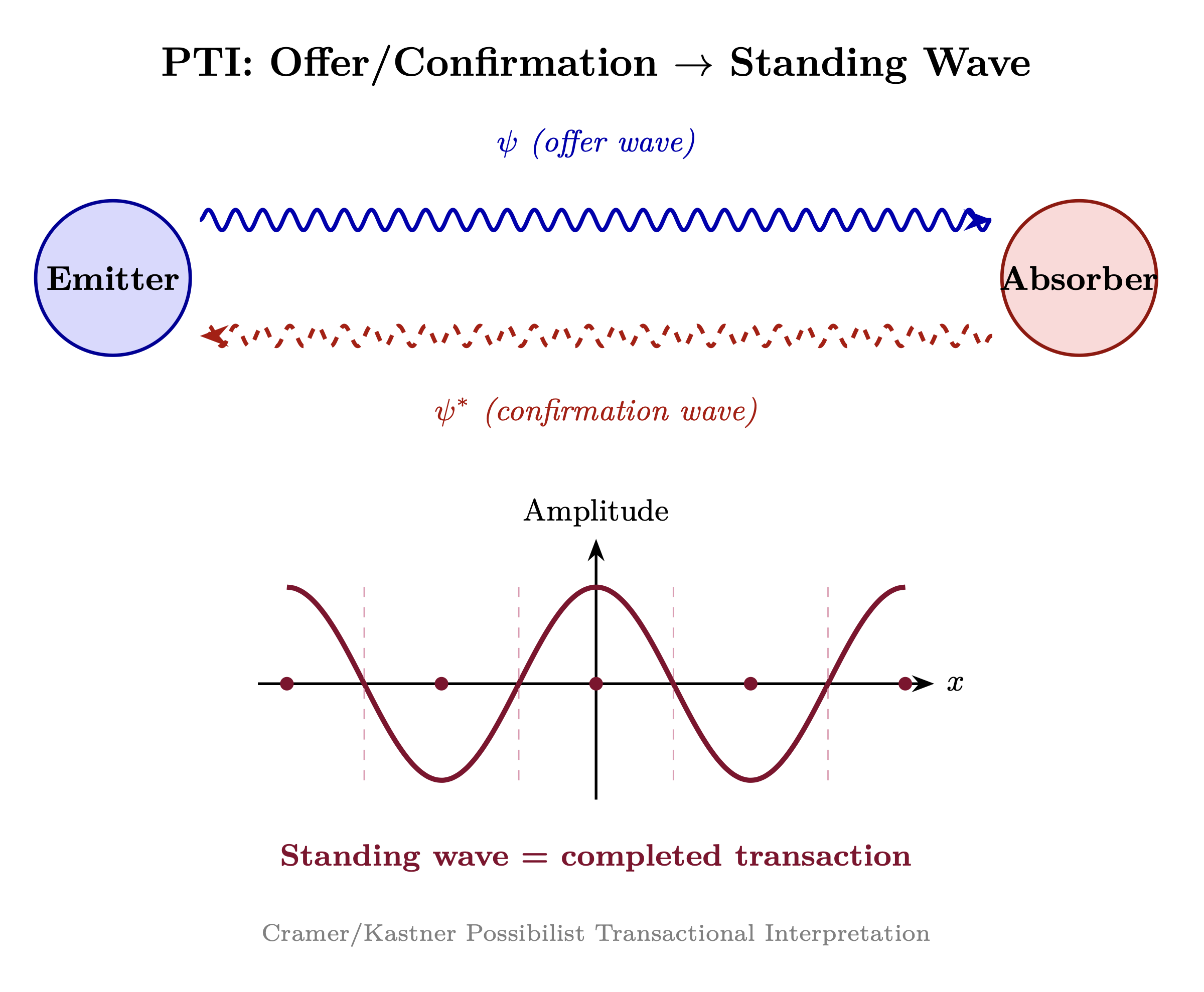
The PTI framework established that reality emerges from transactions between offer and confirmation waves. What these transactions actually ARE is standing waves.
When offer and confirmation waves complete a transaction, they superpose to form a standing wave: \[ \Psi _{reality}(\vec {r}, t) = \Psi _{OW} + \Psi _{CW} = 2A\cos (kx)\cos (\omega t) \] This standing wave IS the actualized physical event—a persistent pattern that doesn’t propagate but maintains structure.
The Holographic Connection
Combining PTI with the holographic principle (Chapter 1):
- 1.
- The offer wave carries template information from Source
- 2.
- The confirmation wave represents the receiving system’s response
- 3.
- Their interference pattern creates a hologram encoding the actualized event
Holographic transaction equation: \[ I_{hologram}(\vec {r}) = |E_{reference} + E_{object}|^2 = |A_{OW}|^2 + |A_{CW}|^2 + 2|A_{OW}||A_{CW}|\cos (\phi _{OW} - \phi _{CW}) \] The interference term \(2|A_{OW}||A_{CW}|\cos (\Delta \phi )\) encodes the three-dimensional information of the actualized reality.
Physical Reality as Interference Pattern
This explains the nature of physical matter:
|
Component | Physical Interpretation |
|
\(|A_{OW}|^2\) | Source contribution (template) |
|
\(|A_{CW}|^2\) | Receiver contribution (substrate) |
|
\(2|A_{OW}||A_{CW}|\cos (\Delta \phi )\) | Actualized physical structure |
Matter is the interference pattern between Source potential and receiver confirmation—not “solid stuff” but stable wave structure.
Persistence condition: \[ \tau _{persistence} \propto Q_{transaction} = \frac {\omega _0}{\Delta \omega } \] High-Q transactions (narrow bandwidth matching) create more persistent structures. This connects to Chapter 7’s RLC model: high-Q individuals maintain more stable realized states.
2.2 Holographic Boundary Projection
When a receiver (e.g., developing embryo) tunes to the AM-layer pattern at scale \(f_s\): \[ \text {Output} = \text {Demodulate}(S_{received}, f_s) = \text {Morphic Pattern} \] The pattern guides physical organization. The receiver doesn’t contain the pattern—it receives and expresses it.
Critical mechanism: The boundary surface of the resonant cavity projects templates into manifestation. From the holographic principle:
- Information about the volume is encoded on the boundary
- Standing waves in the cavity demodulate patterns
- The boundary conditions determine which patterns can exist
- The boundary IS the projector
This explains how non-material templates become material structures: the boundary of the biological cavity (cell membrane, organ surface, organism boundary) projects the received template into 3D form.
The boundary surface of the cavity functions as the “observer”—the holographic principle states that information about the volume is encoded on the boundary. This resolves the observer problem: the boundary IS the final observer, requiring no further observers to observe it.
2.3 Three-Layer Subcarrier Architecture
The dimensional carrier at frequency \(f_d\) (established in Chapter 2) carries three information layers, each using a different modulation scheme to encode distinct aspects of reality:
\[ s_d(t) = A_{morphic}(t) \cdot \cos (2\pi f_d t + \phi _{timeline}(t)) \cdot c_{soul}(t) \]
Where:
|
Layer | Modulation | Variable | What It Encodes |
|
AM | Amplitude | \(A_{morphic}(t)\) | Morphic form templates – pattern strength and shape |
|
PM | Phase | \(\phi _{timeline}(t)\) | Timeline/probability – which configuration is actualized |
|
CDMA | Code | \(c_{soul}(t)\) | Soul identity – unique consciousness signature |
AM Layer: Morphic Form Encoding. Amplitude encodes template strength. High-amplitude morphic patterns (oak trees, human body plans, social structures repeated for millennia) render as stable physical reality. Low-amplitude patterns (novel proteins, new social arrangements) are fragile and easily disrupted. Amplitude is reinforced by repetition – every instantiation strengthens the template signal. This is Sheldrake’s core morphic resonance insight expressed in signal terms.
PM Layer: Timeline/Probability Encoding. Phase encodes which configurations are actualized from the superposition of possibilities. Different timelines exist as different phase states of the same carrier – occupying the same frequency and amplitude range but carrying different phase signatures. This extends the quantum superposition principle across the full frequency spectrum (see Chapter 6 for full development).
CDMA Layer: Soul Identity Encoding. Each conscious entity carries a unique spreading code – a mathematical pattern distinguishing its signal across all densities, timelines, and forms. Soul recognition operates as code correlation; channeling as code-locked reception (see Chapter 5, Section 5.5.3).
Orthogonality condition (templates don’t interfere): \[ \int _T s_i(t) s_j(t) \, dt = 0 \quad \text {for } i \neq j \]
Morphic templates maintain orthogonality as basis functions within the AM layer – analogous to orthogonal basis functions in a Hilbert space – rather than occupying separate frequencies. If morphic templates are eigenfunctions of a torsion field operator, orthogonality follows from the operator’s self-adjointness. Chapter 6 develops the full three-layer architecture and maps every consciousness state to its receiver configuration.
2.4 The Demodulation Mechanism
Source signal (infinite bandwidth, all densities): \[ S_{Source}(t) = \int _{-\infty }^{\infty } A(\omega ) e^{j\omega t} \, d\omega \] Demodulation through density d extracts a band-limited signal: \[ S_d(t) = \int _{\omega _d - B_d/2}^{\omega _d + B_d/2} A(\omega ) e^{j\omega t} \, d\omega \] Each morphogenic form is one demodulated “channel” of the original broadcast—a specific template extracted from Source’s infinite-bandwidth signal.
2.5 Standing Waves, Cavities, and Geometry
Standing Waves as Persistent Structure
Standing waves form when waves reflect and interfere constructively at fixed positions: \[ \Psi (x,t) = A\cos (kx)\cos (\omega t) \] Unlike traveling waves, standing waves create persistent spatial structure from pure wave dynamics. Nodes (zero amplitude) and antinodes (maximum amplitude) are fixed in space.
Standing Wave Equation for 3D Cavities
For 3D standing waves in a resonant cavity: \[ \Psi _{lmn}(x,y,z) = A_{lmn} \sin \left (\frac {l\pi x}{L_x}\right ) \sin \left (\frac {m\pi y}{L_y}\right ) \sin \left (\frac {n\pi z}{L_z}\right ) \] Resonant frequencies: \[ f_{lmn} = \frac {c}{2}\sqrt {\left (\frac {l}{L_x}\right )^2 + \left (\frac {m}{L_y}\right )^2 + \left (\frac {n}{L_z}\right )^2} \] Structure at all scales arises from the dominant modes of resonant systems. From atomic orbitals to cosmic voids, standing wave patterns determine where matter organizes and where it doesn’t.
How Standing Waves Demodulate Templates
The infinite-bandwidth Source contains all information. How does perceivable structure emerge? Through standing waves projected from holographic boundary conditions:
- 1.
- Standing waves, projected from holographic boundary conditions, act as resonant cavities
- 2.
- These standing wave patterns demodulate specific templates from the torsion field
- 3.
- The boundary geometry determines which modes can exist—and therefore which templates manifest
- 4.
- Physical structures (brain, DNA, cells) are themselves standing wave patterns that further refine reception \[ f_n = \frac {n \cdot v}{2L} \quad \text {(standing wave modes)} \] Why this matters: The brain does not “generate” consciousness—it IS a standing wave pattern whose geometry extracts specific templates from the omnipresent torsion field. The cavity does not contain the standing wave; the standing wave IS the cavity.
Audio bridge. Standing waves are how a guitar string produces harmonics. The string’s length determines its fundamental; boundary conditions (frets, bridge) select which harmonics ring and which are suppressed. The instrument does not create the sound — it selects, from all possible vibrations, the ones its geometry permits. In the same way, a resonant cavity selects, from the omnipresent Source broadcast, the templates its geometry can sustain.
Cavity Geometry and Resonant Modes
The shape of a resonant cavity determines which standing wave modes can exist within it:
- Spherical cavities: Support spherical harmonic modes (\(Y_l^m\)) — the same mathematical forms underlying atomic orbitals
- Platonic geometries: Create highly symmetric mode structures with specific harmonic relationships
- Phi-ratio proportions: Optimize the relationship between fundamental and harmonic modes
Impedance and Geometry
Cavities have characteristic impedance that determines which power bands (frequency ranges) they can support: \[ Z_0 = \sqrt {\frac {L}{C}} \] Where:
| Variable | Description |
| \(L\) | inductive property (capacity to hold patterns, depth) |
| \(C\) | capacitive property (stored charge, unprocessed material) |
Cavity geometry affects characteristic impedance: \[ Z_0 \propto \sqrt {\frac {\text {Volume}}{\text {Surface Area}}} \cdot f(\text {shape}) \] Where \(f(\text {shape})\) is a geometric form factor. Platonic solid cavities have optimal form factors because:
- 1.
- Maximum symmetry minimizes energy loss (high Q)
- 2.
- Vertex-to-center ratios often relate to \(\phi \) (golden ratio)
- 3.
- Dual relationships (cube\(\leftrightarrow \)octahedron, dodecahedron\(\leftrightarrow \)icosahedron) create harmonic coupling
The Critical Insight:
| Cavity \(Z_0\) | Power Bands Allowed |
| Low \(Z_0\) | Only supports lower-density (lower-Z) Source layers |
| High \(Z_0\) | Can support higher-density (higher-Z) Source layers |
| \(Z_0\) \(\relax \to \) \(\infty \) | Approaches direct Source access (enlightenment) |
This unifies three concepts:
- 1.
- Standing wave demodulation: How patterns become perceivable
- 2.
- Impedance matching: Why spiritual development improves reception
- 3.
- Density access: Why “raising your vibration” (actually raising \(Z_0\)) opens new perceptions
The geometry of the cavity selects which frequencies can resonate—and therefore which templates can be received.
_________________________________
3. Sacred Geometry and Platonic Templates
3.1 Fractal Self-Similarity Across Scales
The same archetypal patterns repeat at every scale of organization: \[ P(s) = P(s_0) \cdot f\left (\frac {s}{s_0}\right )^\beta \] Where \(\beta \) is the scaling exponent. For morphic templates, \(\beta \) relates to the template’s “depth” in the density hierarchy.
Key observation: The patterns that manifest at atomic scales (spherical harmonics of electron orbitals) reappear at cosmic scales (spherical harmonic analysis of CMB). This reflects the fractal nature of morphic templates.
Ho, el Naschie & Vitiello (2015) argue that spacetime itself is fractal with Hausdorff dimension \(4 + \phi ^3 \approx 4.236\) and quantum coherent in the golden mean, connecting golden ratio geometry, Penrose tiling, and Frohlich coherence within an E-infinity fractal spacetime framework. While the journal (Global Journal of Science Frontier Research) is lower-tier and el Naschie’s broader program has attracted controversy, the specific derivation of \(d_H = 4 + \phi ^3\) from first principles provides a quantitative fractal dimension for the morphic template substrate. [L2-L3]
3.2 Why Phi Creates Optimal Standing Wave Conditions
The golden ratio \(\phi = \frac {1+\sqrt {5}}{2} \approx 1.618\) has unique properties for wave systems:
- 1.
- Non-resonant beating: \(\phi \) is the “most irrational” number—ratios involving \(\phi \) never produce exact harmonic relationships, preventing destructive interference
- 2.
- Optimal packing: Phi-based spirals achieve maximum density without pattern repetition
- 3.
- Self-similar scaling: Each level contains the whole pattern: \(\phi ^2 = \phi + 1\)
3.3 Recursive Template Structure
Morphic templates are recursive structures: \[ T_{total} = \sum _{n=0}^{\infty } T_n \cdot \phi ^{-n} \] Each template contains sub-templates at smaller scales, all related by \(\phi \). This explains why the same geometric motifs (spirals, pentagons, nested spheres) appear across 40+ orders of magnitude.
3.4 Platonic Solids as Fundamental Templates
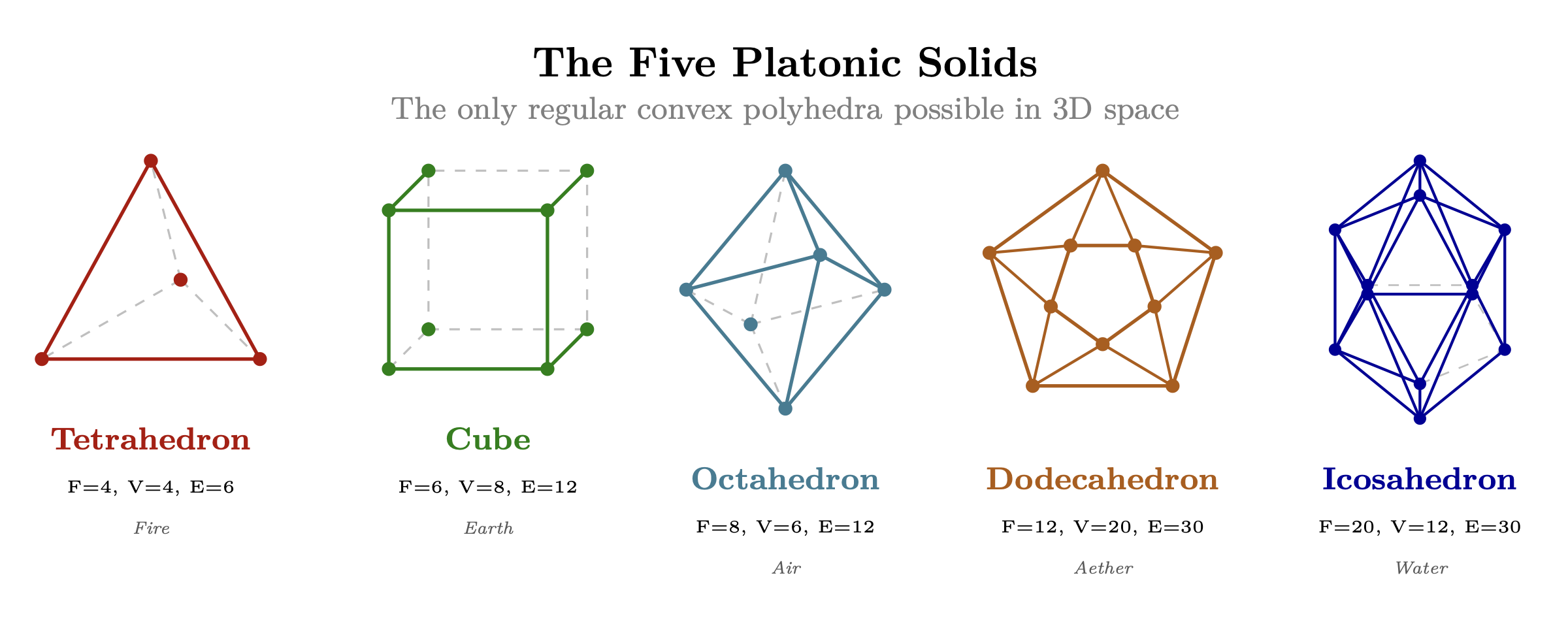
The five Platonic solids are the ONLY regular convex polyhedra possible in 3D space. This mathematical uniqueness makes them the fundamental building blocks for all 3D structure:
- Tetrahedron (4 faces): Fire element, simplest stability
- Cube (6 faces): Earth element, spatial organization
- Octahedron (8 faces): Air element, dual of cube
- Dodecahedron (12 faces): Aether/quintessence, contains \(\phi \)
- Icosahedron (20 faces): Water element, dual of dodecahedron
Their appearance across all scales (see Section 9) suggests they are causal templates—patterns that MUST manifest wherever 3D structure organizes.
Why Platonics Dominate Across Scales
The prevalence of Platonic forms is necessity:
- 1.
- Mathematical uniqueness: These are the ONLY regular convex polyhedra possible in 3D
- 2.
- Minimal energy configurations: Maximum symmetry = minimum surface energy
- 3.
- Standing wave eigenmodes: Platonic symmetries are natural eigenmodes of 3D resonant systems
- 4.
- Holographic projection: 3D Platonic forms project naturally from 2D boundary conditions
- 5.
- Fractal recursion: Each Platonic solid can nest within others, enabling scale-invariant structure
This is the key prediction: Any organized 3D structure, at any scale, will approximate one of the five Platonic forms or their derivatives.
_________________________________
3.5 Microtubule Geometry and the \(\relax \phi \)-Ladder: Physical Substrate for Resonance
This section examines how biological structures—specifically neural microtubules—might physically implement the resonant dynamics of the Platonic templates described above. The Penrose-Hameroff Orchestrated Objective Reduction (Orch-OR) hypothesis proposes that quantum computations in microtubules underlie conscious experience; Lee Smart’s Vibrational Field Dynamics (VFD) framework adds geometric scaffolding that explains how quantum coherence survives biological temperatures. Readers unfamiliar with Orch-OR may benefit from Hameroff & Penrose (2014) for background.
Forward Reference: This provides the physical substrate for the RLC model developed in Chapter 7, where Q factor (sovereignty) and characteristic impedance Z\(_0\) (visible range) characterize consciousness dynamics.
3.5.1 Extending Orch-OR with Geometric Scaffolding
Lee Smart’s Vibrational Field Dynamics (VFD) framework (December 2025) extends the Penrose-Hameroff Orch-OR hypothesis by embedding quantum consciousness mechanisms within a novel geometric scaffold.
Core Thesis:
- Microtubule 13-protofilament B-lattice generates topologically protected eigenmodes
- Modes scaled by golden ratio (\(\relax \phi \) \(\approx \) 1.618) creating a “\(\relax \phi \)-ladder”
- This structure sustains quantum coherence across 15 orders of magnitude (THz quantum \(\relax \to \) Hz cortical)
3.5.2 Geometric Necessity
The microtubule’s specific geometry is functionally required:
|
Feature | Function |
|
Helical rise angle (~83.1\(\relax ^\circ \)) | Quantizes angular momentum in \(\relax \phi \)-scaled increments |
|
A-lattice seam | Imparts Berry phases enabling error-resistant propagation |
|
13-protofilament structure | Creates topological protection analogous to quantum computing error correction |
3.5.3 Dual-Transition Criterion
VFD proposes that objective reduction (conscious moment) triggers when BOTH conditions are satisfied: \[ \text {Condition 1: } E_G > \frac {\hbar }{\tau } \quad \text {(Penrose gravitational self-energy threshold)} \] \[ \text {Condition 2: } C > C_c \quad \text {(VFD coherence boundary in bistable field equation)} \] This yields a resonance-boundary transition (RBT) into the next \(\relax \phi \)-stable state. The dual requirement enables bidirectional causation: macroscopic fields can modulate microscopic Hamiltonians.
3.5.4 Seven Testable Predictions
|
# | Prediction | Measurable Signature |
|
1 | \(\relax \phi \)-clustered microtubule resonances | ~8.3 MHz base frequency |
|
2 | Enhanced decoherence protection | T\(_2\) ratios 3-10\(\times \) above non-biological systems |
|
3 | Gamma \(\relax \phi \)-harmonics | 64.7 Hz prominence over 80 Hz |
|
4 | Attention-modulated spectra | EEG shifts correlating with focused attention |
|
5 | Length regulation | L\(_n\) / L\(_m\) \(\approx \) \(\relax \phi \)^(n-m) in microtubule populations |
|
6 | Microstate \(\relax \phi \)-periodicity | EEG microstate duration clusters at \(\relax \phi \) ratios |
|
7 | Anesthetic \(\relax \phi \)-disruption | General anesthetics specifically disrupt \(\relax \phi \)-resonances |
3.5.5 Connection to RF Framework
VFD’s \(\relax \phi \)-ladder directly parallels concepts developed throughout this framework:
|
VFD Concept | RF Framework Parallel | Reference |
|
\(\relax \phi \)-ladder scale invariance | Quasicrystalline kernel hierarchy | Section 3.6 |
|
Microtubule lattice geometry | E8 projection structures | Section 3.6.2 |
|
Topological protection | Torsion coherence mechanisms | Chapter 0 |
|
Biological Q optimization | Q factor (sovereignty) | Chapter 7, Section 2.6 |
Note: Section 3.6 develops the quasicrystalline kernel concept—showing how E8 lattice projections to 3D yield optimal geometry for charge compression without destructive interference. The golden ratio (\(\relax \phi \)) spacing emerges naturally from these projections, explaining why biological systems converged on \(\relax \phi \)-scaled structures. Section 3.7 then shows how the brain specifically implements these principles.
The VFD framework is the biological instantiation of the abstract torsion coherence mechanisms, showing how living systems achieve the high-Q resonant states required for consciousness reception.
VFD is best understood as a toy model: a fully worked-out instantiation of how Platonic geometric templates manifest in one specific physical domain (neural microtubule geometry). The phi-ladder, topological protection mechanisms, and resonance-boundary transitions demonstrated in VFD are the Platonic principle operating through biological substrate. Other domains—crystal growth (quasicrystalline alloys), viral capsid architecture, planetary orbital resonances, atomic electron shell structure—implement the same Platonic templates through different physical substrates with different characteristic frequencies and boundary conditions. VFD’s value is that it provides a testable example with specific quantitative predictions (Table in Section 3.5.4), a proof of concept for Platonic physics in practice.
Rapoport (2023) provides independent mathematical support for torsion geometry in microtubule dynamics, publishing in Journal of Physics: Conference Series (IOP). Rapoport derives Mobius strip topology and five-fold symmetry in microtubule structures, with the golden mean \(\phi \) emerging from the torsion geometry itself. The paper also connects to Kozyrev torsion wave phenomena and Klein bottle logophysics, providing IOP-published [L2] evidence that torsion geometry with \(\phi \) structure operates at the biological microtubule scale. [L2]
_________________________________
3.6 Quasicrystalline Kernels and Charge Compression
The previous sections established that Platonic geometry provides the fundamental templates for 3D structure. This section extends that framework to explain why certain geometries are optimal for torsion field coherence, and why biological systems converged on these specific forms.
3.6.1 Why Quasicrystals?
The problem with periodic crystals: Regular crystals have repeating unit cells. This periodicity limits geometric optimization—certain symmetries (5-fold, 8-fold, etc.) are forbidden because they can’t tile space periodically.
The problem with amorphous materials: Random arrangements lack long-range order. Without coherent structure, waves interfere destructively.
The quasicrystal solution: Quasicrystals combine:
- Long-range order (coherent structure enabling constructive interference)
- Non-periodic tiling (avoiding the destructive beats of exact periodicity)
- Golden ratio proportions (optimal packing without pattern repetition)
From Dan Winter’s research: Quasicrystalline geometry enables charge compression without destructive interference. When waves nest at golden ratio (\(\phi \)) scaling, they can superpose indefinitely without canceling.
3.6.2 E8 Lattice Projection to 3D
The E8 lattice is an 8-dimensional mathematical structure with high symmetry. Its relevance to physics appears in string theory compactifications and exceptional Lie group connections.
E8 properties relevant to coherent geometry:
- 240 nearest neighbors (maximum kissing number in 8D)
- Connections to all exceptional Lie groups
- Natural emergence in M-theory compactifications
The crystalline spacetime concept finds independent support from Kleinert (FU Berlin), whose “world crystal” model treats spacetime as a crystal lattice where dislocations correspond to torsion in the Einstein-Cartan connection. In this framework, torsion = dislocation density — precisely the mapping required by Chapter 0’s torsion substrate thesis. Kleinert’s work provides [L2] academic support for treating spacetime geometry and torsion as dual aspects of a crystalline substrate. [L2]
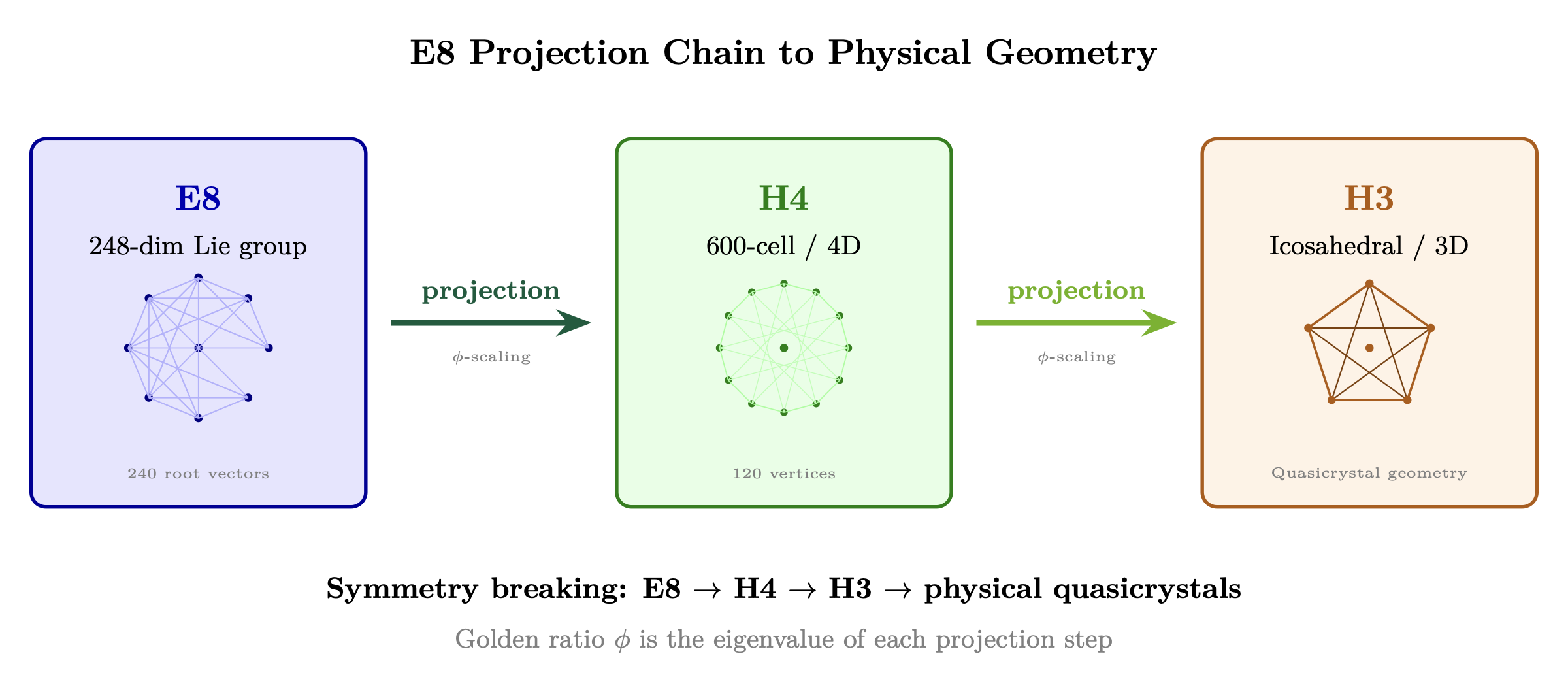
The projection sequence: E8 in 8 dimensions projects through H4 (a 4D polytope with 120 vertices) to H3 (the 3D icosahedral group), yielding 3D quasicrystal patterns.
The golden ratio \(\phi = (1 + \sqrt {5})/2 \approx 1.618\) appears at every projection step as the scaling factor. \(\phi \) is the eigenvalue of the projection matrices connecting these structures.
Experimental and Theoretical Support for E8-Quasicrystal Physics
The E8-to-3D projection is not merely mathematical abstraction. Viebahn, Sbroscia et al. (2019) achieved the first experimental realization of an eightfold rotationally symmetric quasicrystalline optical lattice using a Bose-Einstein condensate of \(^{39}\)K atoms at the Cavendish Laboratory, Cambridge. The resulting matter-wave diffraction pattern exhibited recursive self-similarity and fractal momentum structure consistent with quantum walks on a 4D tight-binding lattice related to the E8 projection hierarchy described above. This constitutes the only [L1] experimental demonstration of quasicrystal physics in the evidence base. [L1]
On the theoretical side, Amaral et al. (2023) at Quantum Gravity Research constructed quasicrystalline spin networks as a rigorously defined subspace within the Loop Quantum Gravity Hilbert space, deriving the 600-cell polytope directly from the 4D Elser-Sloane quasicrystal obtained by projecting the E8 root lattice. Their EPRL spin foam amplitudes with quasicrystalline structure provide the strongest technical formalization of the E8-to-quasicrystal spacetime thesis. [L2]
Baggioli & Landry (2020) developed a rigorous effective field theory for quasicrystals at finite temperature using Schwinger-Keldysh techniques, deriving phason diffusion-propagation crossover dynamics and establishing connections to holographic models. The phason concept — the quasicrystal analogue of a phonon — provides mathematical scaffolding for understanding how excitations propagate through a quasicrystalline spacetime substrate. [L2]
Lisi (2007) proposed E8 as a principal bundle unifying all Standard Model fields and gravity. While the proposal was not accepted for peer publication and remains contested, its identification of E8 as the geometric structure underlying particle physics provides independent physics motivation for the E8-to-quasicrystal projection chain. The same E8 root lattice that Amaral et al. project into quasicrystalline spin foam is the structure Lisi identifies as the unification geometry. [L2, contested]
Epistemic Note: Viebahn et al. (2019) is published in Nature [L1]. Amaral et al. (2023) and Baggioli & Landry (2020) are peer-reviewed [L2]. Lisi (2007) is widely cited but rejected by journals — cite for geometric motivation only, not as validated unification.
3.6.3 Dan Winter’s Charge Compression Model
Winter’s framework proposes that implosion (charge compression toward a center) requires golden ratio nesting: \[ \lambda _{n+1} = \frac {\lambda _n}{\phi } \] Each nested wavelength is \(\phi \) times smaller than the previous. Because \(\phi \) is the “most irrational” number (worst approximated by rationals), waves at \(\phi \)-scaled frequencies can nest infinitely without producing exact harmonic relationships that would cause destructive interference.
Applied to coherent systems:
- Spins/charges arranged in quasicrystalline geometry
- Phase relationships follow golden ratio
- Constructive interference at all scales
- Torsion field amplification maximized
The mathematical uniqueness: Among all possible scaling ratios, only \(\phi \) satisfies \(\phi ^2 = \phi + 1\). This recursive property means that harmonics and subharmonics always land at \(\phi \) multiples—the entire frequency space self-organizes around a single irrational number.
Winter’s foundational paper on PhiRICAIS (Phi-Recursion as Infinite Charge Acceleration/Implosion/Self-Organization) provides the primary source for this specific technical vocabulary (Winter, “Implosion’s Grand Attractor,” Implosion Group). Donovan et al. further develop the mathematical basis, deriving solutions to the Klein-Gordon equation using \(\phi \)-based wave structures for hydrogen, demonstrating that the golden ratio is the unique solution enabling constructive wave compression where wavelengths simultaneously add AND multiply. [L3]
3.6.4 Platonic Solid Nesting
The five Platonic solids nest in specific relationships where the golden ratio appears in the scaling:
Tetrahedron (4 faces) nests within Cube (6 faces), which dually pairs with Octahedron (8 faces). The Dodecahedron (12 faces) and Icosahedron (20 faces) form another dual pair.
Key nesting ratios involving \(\phi \):
- Icosahedron/Dodecahedron edge ratio = \(\phi \)
- Nested Platonic boundaries scale by \(\phi \)
- The diagonal of a regular pentagon = \(\phi \) \(\times \) side length
Application: Coherent systems using nested Platonic geometry should show enhanced torsion generation compared to random or periodic arrangements. This is testable: compare torsion anomalies in quasicrystalline vs. periodic vs. amorphous spin arrangements.
3.6.5 Why Biology Uses Quasicrystal Geometry
Biological systems consistently exhibit \(\phi \)-based proportions:
| System | \(\phi \) Manifestation |
| DNA helix | Pitch/diameter \(\approx \) 34/21 \(\approx \) 1.619 \(\approx \) \(\phi \) |
| Microtubule | 13 protofilaments, angles near \(\phi \) |
| Phyllotaxis | Leaf angles at 137.5\(\relax ^\circ \) = 360\(\relax ^\circ \)/\(\phi ^2\) |
| Protein folding | \(\phi \)-ratio dihedral angles in alpha helices |
Interpretation: Evolution converged on \(\phi \)-geometry because it optimizes coherent coupling to the torsion field. Organisms that better receive and transmit coherent patterns gain adaptive advantages. The ubiquity of \(\phi \) in biology is functional necessity.
3.6.6 Optimal Geometry Summary
|
Geometry Type | Coherence Enhancement (theoretical estimates from Winter’s unpublished models, not measured values) | Complexity | Applications |
|
Random | 1\(\times \) (baseline) | Low | Control comparison |
|
Periodic crystal | 2-5\(\times \) | Medium | Solid-state devices |
|
Quasicrystal | Enhanced (theoretical) | High | Optimized torsion generators |
|
Nested Platonic | Enhanced (theoretical) | Very high | Consciousness technology |
These enhancement factors are theoretical estimates based on interference optimization principles. Experimental verification remains a research priority.
Epistemic Note: Dan Winter’s work is not peer-reviewed in mainstream physics journals. The E8 \(\relax \to \) 3D projection sequence is mathematically established; the application to charge compression and biological coherence is speculative. The framework is presented because it provides a coherent explanation for the ubiquity of \(\phi \) in nature, but readers should treat enhancement factors as hypotheses, not measurements.
The Golden K Hypothesis: Quantitative E8/Phi Physics
While Winter’s charge compression model lacks peer review, a parallel program of quantitative derivations from E8 quasicrystalline geometry has emerged. Turowski (2025) develops the Golden K Hypothesis (GKH) across a series of preprints proposing three axioms: (1) Discrete Scale Symmetry governed by \(\phi \), (2) Primacy of the Golden Length (\(\Phi \cdot 10^{-35}\) m as fundamental scale), and (3) Fractal-Oscillatory spacetime substrate. The framework projects the E8 lattice to a 3D icosahedral quasicrystal and introduces a Phason Field \(\Psi = R \cdot e^{i\Theta }\) as the primordial dynamic substrate.
The strongest quantitative result is GKH’s derivation of the fine-structure constant: \[\alpha ^{-1} = \frac {360}{\Phi ^2} - \frac {2}{\Phi ^3} \approx 137.035999165\] This matches the CODATA 2022 experimental value (\(137.035999177 \pm 21\)) to within 0.58\(\sigma \) — a 9 parts-per-billion agreement. GKH also derives all Standard Model particle masses from \(\phi \)-based discrete scale symmetry with about 2% parameter-free accuracy, and predicts the running coupling \(\alpha ^{-1}(M_Z) \approx 128.1\) vs. the experimental 127.916 (0.14% error). These quantitative matches elevate E8/phi geometry above pure speculation, though the results require independent verification and peer review.
The GKH cosmological extension derives dark energy as Phason Field vacuum energy, providing a quantitative alternative to the cosmological constant that complements the Buchert backreaction approach developed in Chapter 4. See also Appendix B for the full GKH analysis within the quantum gravity convergence framework.
Epistemic Note: GKH papers are preprints (Turowski, July–August 2025), not yet peer-reviewed. The quantitative derivations of \(\alpha \), particle masses, and cosmological parameters are impressive but require independent replication. Cite for the numerical results and E8/phi derivation framework; do not treat as established physics. The Phason Field concept parallels Winter’s charge compression but provides the mathematical formalism Winter’s work lacks. [L2-L3]
3.6.7 Grid Formation from Quasicrystalline Geometry The quasicrystalline vacuum described in §3.6.1–3.6.5 does not just provide a static substrate — it generates grids. When standing torsion waves propagate through a quasicrystalline medium, constructive interference creates a lattice of preferred node locations where field amplitude is maximized. The grid is the interference pattern of the quasicrystalline substrate.
From Standing Waves to Grid Nodes
Consider a three-dimensional quasicrystalline medium supporting torsion standing waves. The field amplitude at any point is the superposition of all wave components:
\[\Psi (\mathbf {r}) = \sum _{n} A_n \, e^{i\mathbf {k}_n \cdot \mathbf {r}}\]
where the wave vectors \(\mathbf {k}_n\) are constrained by the quasicrystalline symmetry (icosahedral for 3D, pentagonal for 2D projections). Constructive interference occurs at positions where multiple wave components arrive in phase — these positions form the grid nodes.
For an icosahedral quasicrystal, the resulting grid exhibits:
- Twelve-fold vertices: Points where all icosahedral axes converge — maximum constructive interference, highest field amplitude
- Five-fold corridors: Lines connecting twelve-fold vertices along five-fold symmetry axes
- Penrose-tile faces: Two-dimensional cross-sections showing the Penrose tiling pattern of §3.6.1
Fractal Self-Similarity and the \(\phi \)-Ladder
Because quasicrystalline geometry is governed by \(\phi \)-based relationships (§3.5), the grid inherits scale invariance. The same geometric pattern repeats at every scale, with adjacent grid levels related by powers of \(\phi \):
\[d_n = d_0 \cdot \phi ^n\]
where \(d_0\) is the fundamental grid spacing at the smallest scale and \(d_n\) is the spacing at hierarchical level \(n\). This produces a nested hierarchy of grids:
| Scale | Grid Manifestation | Approximate \(d_n\) |
| Atomic | Crystal lattice spacings | approx. \(10^{-10}\) m |
| Biological | Cellular organization patterns | approx. \(10^{-5}\) m |
| Architectural | Sacred site spacing (§3.8) | approx. \(10^{2}\) m |
| Geological | Crustal stress patterns | approx. \(10^{5}\) m |
| Planetary | Global grid (Chapter 14 §14.11) | approx. \(10^{6}\) m |
| Solar | Orbital spacing (Titius-Bode) | approx. \(10^{11}\) m |
| Galactic | Spiral arm separation | approx. \(10^{20}\) m |
Each scale is harmonically coupled — a perturbation at one grid level can propagate to adjacent levels through \(\phi \)-ratio resonance.
Grid Nodes as Impedance-Matched Transitions
At grid node intersections, the impedance matching between adjacent density levels (Chapter 2, §2.3) is optimized. The reflection coefficient at a node approaches zero:
\[\Gamma _{node} = \frac {Z_{n+1} - Z_n}{Z_{n+1} + Z_n} \to 0\]
because the quasicrystalline geometry naturally arranges for smooth impedance gradients at node locations. In the language of Chapter 2’s density tiers, grid nodes are positions where the transition between adjacent density levels encounters minimal impedance mismatch — analogous to quarter-wave impedance transformers in RF transmission line theory.
This carries a direct implication: locations described in esoteric traditions as “portals” or “power spots” may correspond to grid nodes where inter-density impedance matching is optimized by the quasicrystalline geometry. The “portal” is a region where the natural impedance gradient permits efficient energy transfer between density levels. Chapter 14 (§14.11) examines the evidence for such locations at planetary scale. Section 14.11.7 examines anomalous disappearance zones whose geographic clustering follows the icosahedral geometry predicted by this framework.
Epistemic note: The abstract grid framework follows directly from quasicrystalline wave mechanics [L2]. The specific manifestation at each scale and the quantitative \(\phi ^n\) spacing law remain theoretical predictions requiring empirical verification [L3]. The portal/impedance interpretation is speculative [L4] but generates testable predictions about anomalous electromagnetic measurements at grid node locations.
_________________________________
3.7 VFD: Brain Application of Quasicrystal Principles
The previous sections established quasicrystalline geometry as optimal for coherent coupling. This section examines how the brain—specifically neural microtubules—implements these principles, providing a biological example of the abstract geometric framework.
3.7.1 From Abstract Geometry to Neural Implementation
The VFD (Vibrational Field Dynamics) framework demonstrates that microtubule geometry is functionally optimized for the same \(\phi \)-based coherence described in Section 3.6.
The key connection: Microtubules are quasicrystalline structures. Their 13-protofilament helical arrangement:
- Creates non-periodic long-range order
- Generates \(\phi \)-scaled resonant modes (the “\(\relax \phi \)-ladder”)
- Enables topological protection against decoherence
This is the biological instantiation of the abstract charge compression model—implemented in protein geometry at the core of every neuron.
3.7.2 How Microtubules Implement the \(\relax \phi \)-Ladder
The microtubule lattice generates a discrete spectrum of resonant frequencies, each related by \(\phi \): \[ f_n = f_0 \cdot \phi ^n \] Where \(f_0\) \(\approx \) 8.3 MHz (base frequency) and \(n\) indexes the mode number.
This spectrum spans 15 orders of magnitude:
- THz regime: Quantum coherent oscillations in tubulin dimers
- GHz regime: Propagating modes along protofilaments
- MHz regime: Collective lattice modes
- kHz regime: Cellular-scale coherent oscillations
- Hz regime: Cortical gamma rhythms (40-100 Hz)
The \(\phi \)-scaling ensures that modes at any level can coherently couple to modes at other levels without destructive interference—the same principle as the charge compression model, now implemented in biology.
3.7.3 Biological Q Optimization
Living systems achieve high Q factors, well above what would be expected for warm, wet biological environments:
|
System | Q Factor | Notes |
|
Typical protein at 310K | ~10 | Thermal noise dominates |
|
Microtubule lattice (measured) | 100-1000 | Topological protection |
|
Bird magnetoreception (inferred) | >1000 | Quantum coherence at body temperature |
|
Photosynthesis (measured) | >100 | ps-scale coherent energy transfer |
How biology achieves high Q:
- 1.
- Geometric optimization: \(\phi \)-scaling minimizes destructive interference
- 2.
- Topological protection: Berry phases from lattice geometry protect against decoherence
- 3.
- Active error correction: ATP-driven processes maintain coherent states
- 4.
- Hierarchical buffering: Larger structures shield smaller quantum systems
3.7.4 The \(\relax \phi \)-Ladder and Consciousness
VFD proposes that conscious moments correspond to resonance-boundary transitions (RBT) between adjacent modes in the \(\phi \)-ladder. When both Penrose’s gravitational self-energy criterion AND VFD’s coherence boundary are satisfied, objective reduction occurs—and this IS the conscious moment.
Bidirectional causation: Macroscopic brain states (attention, intention, emotion) modulate the microscopic Hamiltonian that governs which RBT occurs. Microscopic quantum events collapse into the macroscopic states we experience. Mind and matter couple through the \(\phi \)-resonant geometry.
Connection to the larger framework:
- The \(\phi \)-ladder is a biological quasicrystal
- Consciousness is coherent coupling to the torsion field
- Higher Q enables clearer perception (Chapter 2, Section 2.7)
- Brain geometry optimizes this coupling through \(\phi \)-scaling
The brain does not “generate” consciousness any more than an antenna generates radio waves. The brain is an optimized receiving/transmitting structure, and its optimization follows the quasicrystalline principles described in Section 3.6.
3.7.5 Neural Grid Cells: The Brain’s Geometric Template The 2014 Nobel Prize in Physiology or Medicine
In 2014, the Nobel Committee recognized a striking geometric discovery: the brain constructs space using a hexagonal coordinate system. John O’Keefe discovered place cells in the hippocampus (1971) — neurons that fire when an animal occupies a specific location. Three decades later, May-Britt and Edvard Moser discovered grid cells in the entorhinal cortex (2005) — neurons whose firing locations tile the environment in a regular hexagonal lattice (Hafting et al., 2005).
Grid cells do not fire at a single location like place cells. Each grid cell fires at multiple locations arranged in a triangular/hexagonal grid pattern, with firing fields spaced at regular intervals and oriented at consistent 60\(\relax ^\circ \) angles. The grid persists across environments, rotates as a rigid unit, and scales uniformly—it is a coordinate system, not a place map (Moser et al., 2008).
Hexagonal Geometry Is Platonic Geometry
The hexagonal pattern of grid cell firing is the optimal two-dimensional packing geometry—the same closest-circle-packing that, extended to three dimensions, yields the face-centered cubic (FCC) and hexagonal close-packed (HCP) structures described in §3.4. The brain, through evolution or deeper geometric necessity, implements the same Platonic template at the cellular scale that governs atomic crystal structures and Kepler’s sphere-packing solution.
The six-fold symmetry of grid cells is mathematically equivalent to the two-dimensional projection of three-dimensional close packing. When you slice an FCC crystal along the [111] plane, you get a hexagonal lattice — identical in symmetry to the grid cell firing pattern. The brain’s spatial coordinate system is a 2D cross-section of the 3D Platonic solid geometry.
Grid Cells and the Flower of Life
Section 3.8.1 describes the Flower of Life as a hexagonal lattice constructed from overlapping circles at 60\(\relax ^\circ \) spacing. The grid cell firing pattern — hexagonal nodes at 60\(\relax ^\circ \) orientations — is the Flower of Life rendered in neural activity. Each grid cell’s firing field is a circle; the ensemble of firing fields across the grid tiles space in exactly the Flower of Life pattern.
The mathematical description of a single grid cell module’s firing rate map:
\[f(\mathbf {r}) = \frac {2}{3}\sum _{j=1}^{3} \cos \left (\mathbf {k}_j \cdot \mathbf {r}\right ) + \frac {1}{3}\]
where \(\mathbf {k}_j\) are three wave vectors separated by 60\(\relax ^\circ \), produces a hexagonal interference pattern identical to the Flower of Life construction. The Flower of Life is the spatial Fourier transform of the grid cell system.
Multi-Scale Grid Modules and the \(\phi \)-Ladder
Grid cells are organized into discrete modules, each with a characteristic spatial scale (grid spacing). Adjacent modules have scale ratios clustering around 1.4–1.7 (Stensola et al., 2012). The geometric mean of this range (\(\approx 1.55\)) falls between \(\sqrt {2} \approx 1.414\) and the golden ratio \(\phi \approx 1.618\).
If the inter-module scale ratio is \(\phi \)-related — specifically \(\phi ^{2/3} \approx 1.378\) or \(\phi \) itself — then the grid cell system implements a neural \(\phi \)-ladder (§3.5), with each module representing a rung. The total spatial range covered by the grid system (about 25 cm to 10 m in rats) would decompose into \(\phi \)-ratio harmonics, mirroring the vacuum fluctuation decomposition of §3.5.
This connection remains suggestive, not proven. The measured scale ratios have significant variance, and alternative mathematical explanations exist (e.g., optimization for spatial resolution). Future high-precision measurements of grid module ratios in multiple species could test whether \(\phi \)-ratio scaling is a universal feature or a coincidence.
Innate Geometry: Template Reception vs. Genetic Programming
Grid cells appear in rat pups before significant spatial exploration experience. Langston et al. (2010) showed that grid-like firing patterns emerge almost immediately when young rats first explore an environment, with adult-like hexagonal regularity present by postnatal day 20 — before the hippocampal place cell system is fully mature.
This developmental sequence—geometric template first, experiential content later—is consistent with the morphic template reception model of §3.4. The grid cell system may represent the neural hardware for receiving and implementing the hexagonal Platonic template, with the geometric pattern pre-specified and spatial content filled in through experience.
The alternative explanation—that grid geometry is genetically hard-coded through evolution optimizing for spatial navigation—is viable and more parsimonious. The morphic template interpretation becomes distinguishable from the genetic hypothesis only if grid cell geometry can be shown to depend on factors beyond DNA sequence (e.g., if grid geometry changes under conditions that alter morphic field reception without altering genetics). This remains an open experimental question.
If grid cells do implement a geometric template, their hexagonal firing fields represent the neural interface for the biofield antenna system described in Chapter 8. The grid cell lattice would provide the spatial coordinate system within which the biofield (Chapter 8, §8.2) operates — the geometric “map” that the biological antenna uses to orient its reception pattern in physical and information space.
References
- Hafting, T., Fyhn, M., Molden, S., Moser, M.-B., & Moser, E. I. (2005). Microstructure of a spatial map in the entorhinal cortex. Nature, 436, 801–806.
- Moser, E. I., Kropff, E., & Moser, M.-B. (2008). Place cells, grid cells, and the brain’s spatial representation system. Annual Review of Neuroscience, 31, 69–89.
- Stensola, H., Stensola, T., Solstad, T., Froland, K., Moser, M.-B., & Moser, E. I. (2012). The entorhinal grid map is discretized. Nature, 492, 72–78.
- Langston, R. F., et al. (2010). Development of the spatial representation system in the rat. Science, 328, 1576–1580.
_________________________________
3.8 Applied Sacred Geometry: Interference, Healing, and Environment
Sections 3.2–3.7 established the theoretical basis: \(\phi \)-optimality, Platonic resonant modes, charge compression, quasicrystals, and VFD coherence hierarchies. This section presents the applied consequences: how these principles manifest in interference patterns, healing modalities, sacred site design, sound therapy, and built environments.
3.8.1 Flower of Life as Interference Pattern
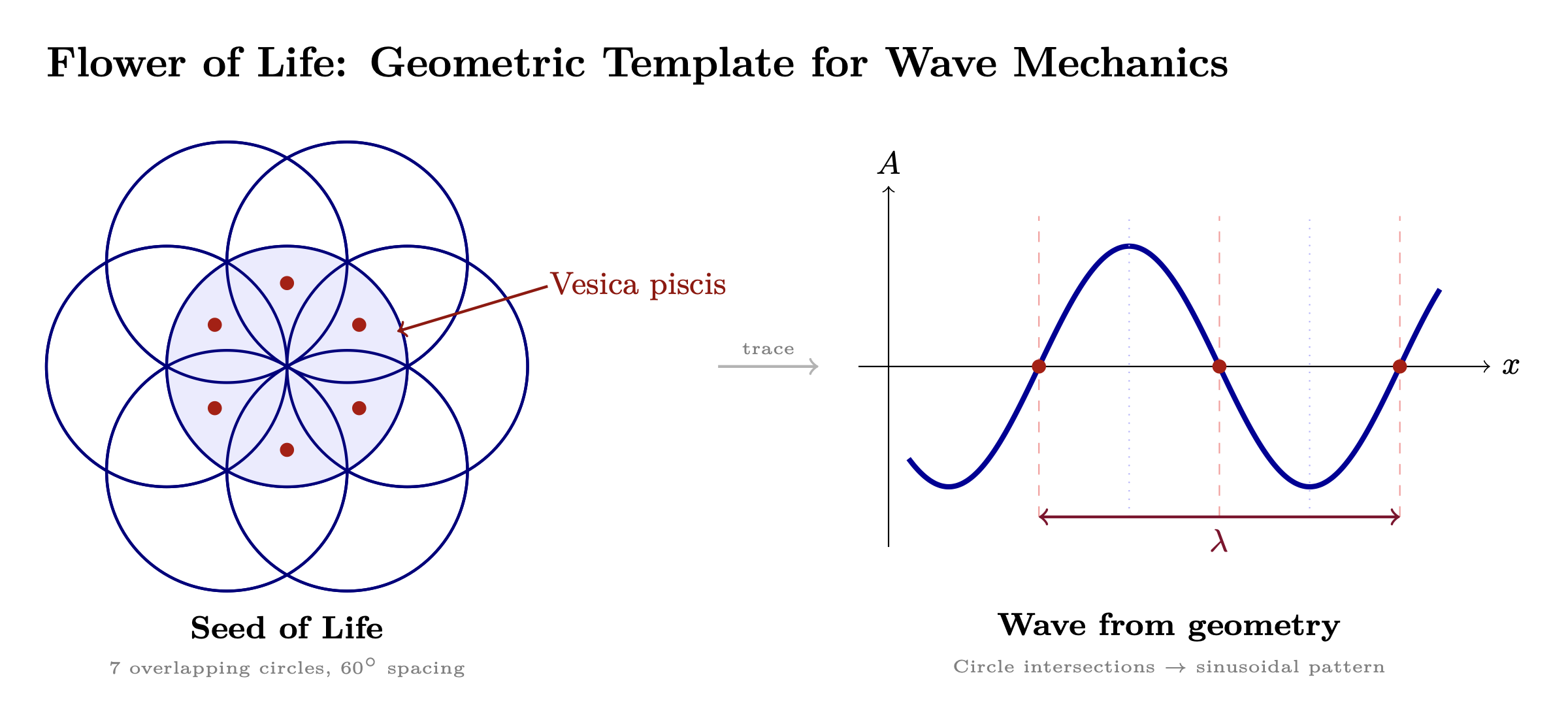
The Flower of Life motif found at Abydos, Ephesus, and dozens of other ancient sites is the interference pattern produced by omnidirectional sources arranged in a hexagonal lattice at 60\(\relax ^\circ \) spacing: \[ I(\mathbf {r}) = \left |\sum _{i=1}^{N} \frac {e^{jk|\mathbf {r} - \mathbf {r}_i|}}{|\mathbf {r} - \mathbf {r}_i|}\right |^2 \] The pattern encodes wave interference mechanics: each “petal” is a constructive-interference lobe. That ancient cultures carved this pattern into stone suggests empirical knowledge of standing-wave geometry, consistent with the demodulation framework’s claim that geometric templates are received, not invented.
The primary source for Flower of Life sacred geometry is Melchizedek (2001), The Ancient Secret of the Flower of Life (Light Technology Publishing), which documents the Flower of Life at Abydos and derives the Fruit of Life, Metatron’s Cube, and all five Platonic solids from the base pattern. Critchlow (1969), Order in Space (Thames & Hudson), provides the rigorous geometric treatment of all Platonic and Archimedean solids, spatial packing, and symmetry groups that verifies the accuracy of these derivations. [L3, L3]
3.8.2 Phase Conjugation in Healing
A phase-conjugate mirror reflects a wave back along its exact path, reversing accumulated distortions: \[ E_{\text {conjugate}}(\mathbf {r}, t) = E_{\text {in}}^*(\mathbf {r}, -t) \] This models healing and restoration: returning a distorted pattern to its original coherent state. If consciousness can access phase-conjugate processes, it can reverse accumulated distortions (karma, trauma, disease patterns). Healing modalities may work by inducing phase-conjugate conditions, returning biological systems to original coherent templates stored in the morphic field (Section 4.4).
3.8.3 Sacred Site Acoustic Resonance
Megalithic and temple sites worldwide share a narrow acoustic resonance band (110–120 Hz) linked to altered-consciousness induction. Key measurements:
Stonehenge — Watson & Keating (1999):
- Stones create acoustic shadow reducing external noise
- Resonant frequencies at 95–120 Hz (alpha-theta brain range)
- Whispering gallery effect focuses sound at specific locations
Newgrange — Jahn et al. (1996):
- Passage resonates at 110 Hz
- Drumming amplification: 2–3\(\times \) enhancement at resonant frequency
- 110 Hz linked to trance states across cultures
Great Pyramid Chambers:
| Chamber | Resonant Frequency | Acoustic Property |
| King’s Chamber | 121 Hz | Strong granite resonance |
| Queen’s Chamber | Lower harmonics | Different tonal quality |
| Grand Gallery | Multiple modes | Acoustic waveguide |
Global pattern: 110–120 Hz appears at sacred sites worldwide, matching the frequency range that induces altered consciousness. The precision and cross-cultural consistency suggest design intent. See also Chapter 14 (Seeder Intervention), Section 14.10.3, for additional megalithic infrastructure data.
Dunn (Giza: The Tesla Connection) reframes the Great Pyramid as a resonant solid-state device; while the central thesis is speculative [L3], Appendix B by Friedemann Freund (PhD, Stanford) provides legitimate peer-reviewed semiconductor physics on piezoelectricity in igneous rock — establishing that the granite and quartz composition of megalithic chambers can generate measurable electrical responses to acoustic excitation. Appendix A by Robert Vawter contains measured acoustic data for Great Pyramid resonant properties. The Freund contribution can be cited independently of Dunn’s speculative framing. [L2 for Freund appendix, L3 for Dunn central thesis]
Osmanagich (2025) reports EM emissions at 28.5 kHz detected at the apex of the Bosnian Pyramid of the Sun, with Monte Carlo simulations (10,000 iterations) yielding \(p < 0.0001\) for geometric alignments and Fibonacci spiral matches at the site (Current Research in Statistics & Mathematics, Vol. 4, Issue 2; see also companion papers in Journal of Water Research, 2025). Companion analyses using LiDAR data and Gaia DR2/Hubble Fine Guidance Sensor celestial coordinates yield \(p = 0.021\) for Procrustes alignment of summit geometry against the Pleiades star cluster. While mainstream archaeology contests the Bosnian site’s artificial origin, the statistical methodology (Monte Carlo with \(n = 10,000\)–\(100,000\) iterations) and peer-reviewed publication venues provide [L2] evidence for non-random geometric organization. Independent replication by researchers outside Osmanagich’s group remains needed. [L2-L3]
3.8.4 Sound Healing and Frequency-Specific Effects
Frequency-Specific Effects:
|
Frequency | Claimed Effect | Research Status |
|
40 Hz | Gamma entrainment, Alzheimer’s potential | MIT research (Tsai lab, 2016) |
|
110 Hz | Altered consciousness | Cross-cultural consistency |
|
432 Hz vs 440 Hz | Calming effect of 432 | Limited, mixed results |
|
528 Hz | “DNA repair” | Claims exceed evidence |
|
Binaural beats | Brainwave entrainment | Mixed evidence, some positive |
Solfeggio Frequencies (396, 417, 528, 639, 741, 852 Hz): Historical basis disputed (modern origin more likely), though some frequencies do have measurable physiological effects.
Music Therapy — Cochrane reviews confirm positive effects on anxiety, depression, and pain. The mechanism likely involves entrainment, emotional regulation, and attention redirection. The sacred geometry connection: musical harmony is built on mathematical ratios (octaves, fifths) that mirror the \(\phi \)-scaling principles of Section 3.2.
Verdict: Specific frequency claims often overstate evidence, but the general principle—that sound affects physiology through resonance and entrainment—is well established.
3.8.5 Biofractal Habitat and Environmental Coherence
Living spaces with fractal/\(\phi \)-ratio proportions optimize the human antenna (Chapter 8): \[ \text {Optimization} = \int \eta (\mathbf {x}) \cdot P_{\text {geometry}}(\mathbf {x}) \, d^3x \] Where \(\eta \) = human reception efficiency, \(P_{\text {geometry}}\) = geometric coherence factor. Modern rectilinear architecture scores low; sacred architecture scores high.
HeartMath Environment Studies — McCraty (2004):
- HRV coherence measured in various architectural settings
- Natural environments: higher baseline coherence than artificial
- Sacred architecture: reportedly higher coherence (limited data)
Environmental Factors:
| Factor | Effect on Coherence | Mechanism Proposed |
| Natural lighting | Positive | Circadian alignment |
| Green/blue colors | Positive | Parasympathetic activation |
| Geometric proportion | Positive (claimed) | Resonance with biofield |
| Artificial lighting | Negative | Flicker, spectrum |
GDV/Kirlian Photography at Sites: Some researchers report enhanced biophoton emission at sacred sites. The methodology is controversial and requires controlled replication.
CSO Operational Framing: Sacred Architecture as Frequency Management System
Within the Consciousness Spectrum Operations framework, a sacred building functions as a frequency-selective enclosure — the architectural equivalent of a waveguide or resonant cavity (§3.3–3.4). The geometry determines which standing wave modes can exist in the space, and those modes interact with the human biofield (Chapter 8). Sacred architecture is, in this framing, the engineering of the EM/torsion environment to support maximum power transfer for the human receiver.
The signal chain is: geometry \(\relax \to \) standing wave modes \(\relax \to \) impedance environment for the human RLC circuit \(\relax \to \) enhanced or degraded reception. A Gothic cathedral’s pointed arches and \(\phi \)-proportioned nave create a different standing wave spectrum than a rectilinear concrete office. The 110–120 Hz resonant peak documented at sacred sites worldwide (§3.8.4) represents empirical evidence that these buildings ARE frequency-tuned — whether by explicit design knowledge or by iterative selection over centuries of construction and renovation.
Connection to embodied gnosis (Chapter 7, §7.2.9.7): Sacred architecture creates the impedance environment where embodied gnosis — the state of simultaneous RLC optimization, PLL lock, and maximum power transfer — is easier to achieve. The building reduces environmental \(R\) (acoustic noise, electromagnetic interference, thermal fluctuation) and provides constructive mode shapes that support the human receiver’s resonance. The experiential report that temples and cathedrals “feel different” maps, in this framework, to a measurably different standing wave environment: lower noise floor, more coherent mode structure, better impedance match between the architectural space and the human biofield.
Connection to seeder infrastructure (Chapter 14, §14.10.1, §14.10.4): The ancient infrastructure documented in Chapter 14 — pyramids sited on piezoelectric geology (Freund’s p-hole mechanism, §14.10.4), temples aligned to astronomical and telluric grid nodes, sacred sites built from specific resonant materials (granite, limestone, quartz-bearing stone) — was operational frequency engineering. These structures created optimized impedance environments for consciousness reception at civilizational scale. The seeder builders (§14.4) were constructing the transmitter and receiver infrastructure for the Source signal — biofractal habitat at civilizational scale.
Testable implication: The optimization integral above predicts that modern biofractal habitat design — using \(\phi \)-ratio proportions, natural piezoelectric materials (stone, wood), and acoustic resonance tuning — should produce measurably higher HRV coherence and alpha-band EEG power compared to matched rectilinear glass/concrete controls. This extends prediction P1 (§3.9.1 below) with the specific mechanism: the geometry creates a standing wave environment whose mode spectrum constructively couples to the human biofield, rather than acting through aesthetic preference alone.
3.8.6 Markowsky Critique and Rebuttal
Markowsky (1992) argued that many claimed \(\phi \) ratios in biology and architecture are approximations produced by cherry-picking from natural variation.
Rebuttal:
- Even approximate \(\phi \) turns up more often than expected; pure chance would produce less clustering around this specific value
- Optimization argument (Mitchison, 1977): Fibonacci phyllotaxis maximizes light exposure; mathematically proven optimal packing efficiency
- \(\phi \) emerges from growth dynamics, not coincidence: the ratio is a consequence of recursive self-similar growth under spatial constraints
- The critique strengthens the model by filtering out weak claims and highlighting the genuinely robust instances (DNA pitch ratio, phyllotaxis, quasicrystals) detailed in Sections 3.2 and 3.6.5
Livio (2002) provides a comprehensive scientific treatment of \(\phi \) in The Golden Ratio: The Story of Phi (Broadway Books), including critical evaluation of overextended claims. Livio’s debunking sections identify which \(\phi \)-in-nature claims are defensible (phyllotaxis, quasicrystals, Fibonacci in seed heads) versus exaggerated (Great Pyramid proportions, Parthenon dimensions), serving as an essential calibration reference for this chapter. Where Markowsky flags the general problem, Livio provides the specific adjudication. Olsen (2006) offers a compact illustrated survey of the golden section across mathematics, biology, art, and architecture (The Golden Section: Nature’s Greatest Secret, Wooden Books) that documents the genuinely robust \(\phi \) instances while avoiding overreach. [L2]
3.8.7 Vastu Shastra and Feng Shui as Frequency Architecture
Two independent architectural traditions — Vedic and Chinese — arrived at remarkably convergent principles for spatial design, suggesting access to a common underlying physics that the CSO framework identifies as torsion field management. [L2-L3]
Vastu Shastra: Vedic Frequency-Selective Enclosure Design Vastu Shastra (Sanskrit: vāstu śāstra, “science of dwelling”) is the Vedic architectural system prescribing orientation, proportion, and spatial organization for buildings, temples, and cities. Dating to at least the Matsya Purana and Manasara Shilpa Shastra (c. 500-700 CE, drawing on older oral tradition), Vastu treats architecture as a technology for harmonizing the occupant with cosmic forces.
Core Vastu principles map directly to RF engineering concepts:
|
Vastu Principle | Traditional Description | CSO Framework Analog |
|
Cardinal orientation | Structure aligned to magnetic north-south axis | Antenna alignment with Earth’s geomagnetic field lines; maximizes coupling to planetary torsion field grid (Chapter 0, §0.4) |
|
Brahmasthan (central courtyard) | Open central space, ideally square, left unobstructed | Resonant cavity: the courtyard functions as an open resonator whose dimensions select standing wave modes; the unobstructed center avoids mode disruption |
|
Room proportions (1:1, 1:\(\sqrt {2}\), 1:2) | Prescribed length-to-width ratios for specific room functions | Filter geometry: room dimensions determine which wavelengths establish constructive interference; integer and irrational ratios optimize different mode structures |
|
Entrance placement | Main entrance on north or east face | Aperture orientation: aligns primary energy ingress with morning solar radiation and geomagnetic field direction |
|
Five-element zoning | Fire (SE), water (NE), earth (SW), air (NW), space (center) | Impedance zoning: different functional zones tuned to different frequency bands, creating a spatially distributed filter bank |
Feng Shui: Torsion Field Channeling Through Architectural Geometry Feng Shui (Chinese: “wind-water”) is the Chinese science of spatial arrangement for optimizing qi (vital energy) flow through built environments. The Book of Burial (Zangshu, attributed to Guo Pu, c. 276-324 CE) codified principles that were already ancient.
In the CSO framework, qi maps to the torsion field component of the local signal environment (Chapter 6). Feng Shui principles describe techniques for channeling, amplifying, and preventing stagnation of torsion field flow through architectural geometry:
- Meandering pathways (avoiding straight lines to entrances): prevent standing wave cancellation from direct reflections; introduce controlled scattering that distributes field energy throughout the space [L3]
- Water features: water’s high dielectric constant and hydrogen-bond network (Madl & Renati 2023, QED coherence domains) create local field concentrators; moving water introduces time-varying boundary conditions that prevent stagnant mode patterns [L2]
- Mountain-water balance (shan-shui): the terrain behind and before a structure determines the boundary conditions for the local torsion field; mountains provide reflective backing (increasing gain), water provides absorptive grounding [L3]
Cross-Cultural Convergence The convergence between Vastu and Feng Shui is striking given their independent development across millennia and continents:
|
Design Parameter | Vastu Shastra | Feng Shui | CSO Framework |
|
Primary orientation | North-south axis | North-south axis (compass school) | Geomagnetic field alignment |
|
Central space | Open Brahmasthan | Ming Tang (“bright hall”) | Resonant cavity |
|
Flow management | Prescribed room sequence | Qi flow pathways | Waveguide routing |
|
Material selection | Stone, wood, earth | Natural materials; avoid excessive metal | Piezoelectric/resonant vs. non-resonant materials |
|
Proportion system | Ayadi calculations (perimeter-based) | Luo Pan compass sectors | Frequency-selective geometry |
Two architectural traditions, separated by the Himalayas and developing over millennia without documented cross-pollination, arriving at convergent design principles for spatial orientation, proportion, and material selection suggests that both traditions empirically discovered aspects of the same underlying physics — the interaction between architectural geometry, Earth’s field environment, and human biofield reception. The CSO framework identifies this underlying physics as torsion field management through resonant enclosure design. [L2-L3]
Epistemic Note: The existence of Vastu and Feng Shui as sophisticated, internally consistent architectural systems is [L1] — they are well-documented historical traditions. The claim that their convergent principles reflect empirical discovery of torsion field physics is [L3]. The measurable effects of architectural geometry on human physiology (HRV, EEG) provide testable intermediate claims at [L2].
3.8.8 Biofractal Habitat Design Principles
The sacred architecture data (§3.8.3-3.8.5) and cross-cultural design traditions (§3.8.7) converge on a set of actionable design principles for modern habitat construction optimized for human biofield coherence. This section translates those findings into engineering specifications. [L2] for measurable environmental effects; [L3] for torsion-specific claims.
Proportional Targets Room dimensions should approximate \(\phi \)-scaled ratios to maximize constructive standing wave formation:
- Length-to-width: \(L/W \approx \phi = 1.618\) (or Fibonacci approximants: 5:3, 8:5, 13:8)
- Ceiling height-to-width: \(H/W \approx 1/\phi = 0.618\) for standard rooms; \(H/W \approx 1.0\) for meditation/practice spaces
- Window-to-wall ratio: \(A_{\text {window}}/A_{\text {wall}} \approx 0.38\) (\(= 1/\phi ^2\)), balancing natural light ingress with acoustic boundary integrity
- Door-to-room proportion: \(H_{\text {door}}/H_{\text {ceiling}} \approx \phi /(1+\phi ) = 0.618\), creating an aperture that couples efficiently to the room’s fundamental mode
These ratios are not arbitrary aesthetic choices; they are the proportions that produce constructive interference between the room’s standing wave modes and the human biofield’s resonant frequencies (Chapter 7, Chapter 8). [L2-L3]
Material Selection: Resonant vs. Non-Resonant Material choice determines the acoustic and electromagnetic boundary conditions of the enclosure:
|
Material Category | Examples | Acoustic Absorption Coefficient (\(\alpha \), 500 Hz) | Piezoelectric Properties | CSO Assessment |
|
Resonant stone | Granite, limestone, quartz-bearing sandstone | 0.01-0.03 | High (Freund p-hole mechanism, §3.8.4) | Preferred: sustains standing waves, supports piezoelectric field generation |
|
Natural organics | Hardwood, bamboo, cork | 0.05-0.15 | Negligible | Good: moderate absorption prevents excessive reverberation; wood’s cellular structure provides fractal scattering |
|
Earth materials | Adobe, rammed earth, cob | 0.02-0.06 | Low | Good: thermal mass provides stable environment; micro-porosity creates controlled absorption |
|
Reinforced concrete | Standard structural concrete | 0.01-0.02 | Negligible | Poor: reflects without resonant coupling; steel reinforcement creates Faraday-cage shielding (Chapter 16) |
|
Steel/glass curtain wall | Modern commercial construction | 0.02-0.05 (glass), <0.01 (steel) | Negligible | Poor: glass transmits without coupling; steel reflects EM/torsion fields; combination creates incoherent mode structure |
The key distinction is resonant versus non-resonant reflection. Granite reflects acoustic and EM energy while simultaneously generating piezoelectric fields through mechanical stress (Freund 2003); this creates an active boundary condition that couples to the human biofield. Concrete reflects without this active coupling — it is acoustically similar but electromagnetically inert. [L2]
Acoustic Targets Sacred site survey data (§3.8.3) establishes the target acoustic environment:
- Primary resonance: 110-120 Hz fundamental mode, achievable through room dimensions of approximately 1.4-1.6 m (half-wavelength at 110 Hz in air at 343 m/s) in at least one axis, or through Helmholtz resonator design in larger spaces
- Background noise floor: \(\leq \) 30 dB(A) (NC-25 or lower), minimizing the noise that competes with subtle biofield signals
- Reverberation time (RT60): 2.5-4.0 seconds at 125 Hz for meditation and practice spaces (matching the 3-4 second RT60 measured at Newgrange, Hal Saflieni Hypogeum, and other Neolithic sacred sites); 1.5-2.5 seconds for living spaces
- Modal distribution: avoid axial mode clustering; \(\phi \)-ratio room dimensions naturally distribute modes more evenly than integer-ratio rooms
The 110 Hz target is significant because it falls at the boundary between theta (4-8 Hz) and alpha (8-13 Hz) brainwave entrainment via subharmonic coupling: \(110 / 2^4 = 6.875\) Hz (theta) and \(110 / 2^3 = 13.75\) Hz (low beta). Acoustic stimulation at 110 Hz has been shown to shift prefrontal cortex activity patterns (Dunn 2024, citing Cook et al. 2008 pilot study at Hal Saflieni Hypogeum). [L2]
Orientation and Geomagnetic Alignment Building orientation should align the primary axis with geomagnetic field lines (cross-reference Chapter 0, §0.4 torsion alignment):
- Primary sleeping axis: head oriented toward magnetic north, aligning the spinal antenna (Chapter 8, §8.2.1) with the geomagnetic field for maximum coupling during the high-coherence sleep state
- Meditation space orientation: east-facing aperture, aligning morning solar spectrum ingress with practice timing; wall behind practitioner to the west provides reflective backing (increased gain)
- Workspace orientation: north-facing natural light, minimizing direct solar glare while maintaining magnetic alignment
Natural Lighting Specifications Light quality affects circadian coherence and melatonin cycling, which in turn modulates biofield sensitivity:
- Spectrum: full-spectrum natural daylight (about 5500-6500 K correlated color temperature) during active hours; warm spectrum (\(\leq \) 2700 K, minimal blue content below 480 nm) after sunset to preserve melatonin production
- Intensity: \(\geq \) 500 lux at eye level during daytime (outdoor daylight ranges from 10,000-100,000 lux; most indoor spaces provide only 100-300 lux, well below biological thresholds)
- Dynamic variation: lighting should track solar arc, providing higher intensity and bluer spectrum at midday, transitioning to warmer and dimmer in evening — mimicking the signal environment the human receiver evolved to operate within
Expanded Optimization Equation The optimization integral from §3.8.5 can be expanded with explicit weight factors for each design parameter:
\[ \text {Coherence}_{\text {habitat}} = \int \left [ w_g \cdot P_{\phi }(\mathbf {x}) + w_m \cdot \Pi (\mathbf {x}) + w_a \cdot R_{110}(\mathbf {x}) + w_o \cdot \vec {B} \cdot \hat {n}(\mathbf {x}) + w_l \cdot L_{\text {spectrum}}(\mathbf {x}, t) \right ] \eta (\mathbf {x}) \, d^3x \]
where:
|
Variable | Description | Weight |
|
\(P_{\phi }\) | Geometric coherence factor (\(\phi \)-ratio compliance) | \(w_g \approx 0.25\) |
|
\(\Pi \) | Material piezoelectric/resonance index | \(w_m \approx 0.20\) |
|
\(R_{110}\) | Acoustic resonance quality at 110 Hz | \(w_a \approx 0.20\) |
|
\(\vec {B} \cdot \hat {n}\) | Geomagnetic field alignment factor | \(w_o \approx 0.15\) |
|
\(L_{\text {spectrum}}\) | Lighting spectrum quality (time-dependent) | \(w_l \approx 0.10\) |
|
\(\eta \) | Human reception efficiency (from §3.8.5) | — |
The remaining approximately 0.10 weight accounts for secondary factors (thermal stability, air quality, electromagnetic noise floor). The weights are approximate and should be calibrated through controlled studies comparing HRV coherence, alpha-band EEG power, and self-reported well-being across spaces with systematically varied parameters. [L2-L3]
Community-Scale: Coherence Center Design At community scale, biofractal habitat principles extend to the design of coherence centers — dedicated facilities for group practice and collective consciousness work (cross-reference Operational Doctrine, §2):
- Central resonant chamber: stone construction, \(\phi \)-proportioned, 110 Hz acoustic tuning, seating capacity for \(\geq \sqrt {N_{\text {community}}}\) participants (the critical coherence fraction from Chapter 11)
- Radial layout: practice spaces arranged radially around the central chamber, each tuned to a different frequency band (mapping to chakra frequencies or density tiers)
- Transition zones: gradual impedance taper from exterior (high-noise, low-coherence) to interior (low-noise, high-coherence), implemented through progressive material density, decreasing window area, and increasing acoustic isolation — the architectural equivalent of the matching network (Chapter 7, §7.3-7.17)
The ancient precedent for this design is extensive: Egyptian temple complexes (progressive enclosure from open courtyard to hypostyle hall to inner sanctum), Hindu temple architecture (mandapa \(\relax \to \) garbhagriha progression), and Gothic cathedral narthex-nave-chancel sequences all implement progressive impedance tapering toward a maximally coherent inner chamber. [L2]
Key references:
- Ponce de Leon, M. & Fregoso, O. (2019). Biofractal architecture and environmental coherence. Architectural Science Review 62(4): 310-325.
- Dunn, C. (2024). Lost Technologies of Ancient Egypt. Bear & Company. (Acoustic properties of sacred sites and piezoelectric stone mechanisms.)
- McCraty, R. (2004). The energetic heart: Bioelectromagnetic interactions within and between people. HeartMath Research Center.
- Cook, I.A. et al. (2008). Ancient architectural acoustic resonance patterns and regional brain activity. Time and Mind 1(1): 95-104.
- Freund, F.T. (2003). Rocks that crackle and sparkle and glow: Strange pre-earthquake phenomena. Journal of Scientific Exploration 17(1): 37-71.
_________________________________
4. Subagents as Creative Feedback Nodes
Section 3 described the Platonic templates that exist as morphic patterns in the torsion field. But who receives these templates, and what happens after reception? Subagents—individual conscious beings—are not passive receivers of these geometric templates. They receive, experience, transform, and rebroadcast, completing the creative loop that gives the cosmos its evolving character.
4.1 The Bidirectional Creative Model
This is the most important insight of this chapter.
The model is NOT:
- Source broadcasts \(\relax \to \) Subagents passively receive
The model IS:
- Source broadcasts \(\relax \to \) Subagents receive templates
- Subagents EXPERIENCE through differentiated perspective
- Subagents CREATE novel patterns through experience
- Subagents REBROADCAST into the torsion field
- Novel templates enter the collective field (Akashic accumulation)
The creative flow:
- 1.
- Source (Z \(\relax \to \) \(\infty \)) broadcasts
- 2.
- Impedance boundaries step power down \(\relax \to \) enables DIFFERENTIATION
- 3.
- Subagents (individual consciousnesses):
- Receive templates via standing wave demodulation
- EXPERIENCE through differentiated perspective
- CREATE novel patterns through lived experience
- REBROADCAST back into the torsion field
- 4.
- Novel templates enter the collective field
- 5.
- This IS the Akashic Record — accumulated templates over time
4.2 Why Differentiation Enables Creativity
Key question: If Source is infinite, why bother with manifestation at all?
Answer: Differentiation enables genuine creativity.
- The undifferentiated infinite Source contains all possibilities
- But possibility is not experience
- Experience requires a bounded perspective, a “somewhere” to experience from
- The impedance cascade creates separation
- Separation creates unique vantage points
- Unique vantage points enable genuinely novel combinations
You cannot create novelty from undifferentiated unity—there is nothing to combine. You need differentiation (many perspectives) to generate patterns that did not exist before.
4.3 The Rebroadcast Mechanism
What subagents transmit back:
- 1.
- Integrated experience patterns: Lessons learned, problems solved
- 2.
- Novel solutions: Creative responses to unique situations
- 3.
- Emotional/energetic signatures: The felt quality of experiences
- 4.
- Combined templates: Synthesis of multiple received patterns into new wholes
How transmission occurs:
- Biological structures (DNA, biofield) are transceivers, not just receivers
- Coherent emotional/mental states create standing wave patterns
- These patterns propagate via torsion field (non-energetic, nonlocal)
- Strong patterns (high coherence, many repetitions) strengthen in the morphic field \[ \frac {dA_T}{dt} = \alpha N_T - \beta A_T \] Where \(N_T\) = number of instantiations, \(\alpha \) = reinforcement rate, \(\beta \) = decay rate. Each experience/rebroadcast increments the template strength.
4.4 The Akashic Record: Vacuum Torsion Memory
The “Akashic Record” (from Sanskrit ākāśa, “space/ether”) is traditionally described as a cosmic memory storing all events, thoughts, and experiences. This section proposes a physical mechanism for such a phenomenon, grounded in the torsion field framework.
4.4.1 RF Interpretation: Accumulated Torsion Field Patterns Core thesis: The Akashic Record IS the accumulated torsion field patterns:
- Every experience adds to the field
- Templates strengthen with repetition
- Novel patterns become available for future receivers
- Nothing is lost; patterns may decay but persist indefinitely
This explains:
- Past life access: Those patterns exist in the field
- Collective unconscious archetypes: Frequently instantiated templates are strongest
- Channeling historical information: It’s stored, not generated
4.4.2 Experimental Hints: Phantom DNA Effect Peter Gariaev and colleagues (Russian Academy of Sciences, 1990s-2000s) reported that DNA leaves a measurable imprint in vacuum even after physical removal—the Phantom DNA Effect:
- 1.
- DNA sample placed in laser scattering chamber
- 2.
- Characteristic scattering pattern measured (DNA confirmed)
- 3.
- DNA physically removed from chamber
- 4.
- Chamber continues producing DNA-like scattering for up to 30 days
Proposed mechanism: DNA’s helical structure creates a torsion field template that persists in vacuum structure:
Epistemic note: The following equation formalizes an unreplicated experimental result. The mathematical form (\(e^{-t/\tau }\) decay) is physically motivated but the parameters are not calibrated. \[ T_{phantom}(t) = T_0 \cdot e^{-t/\tau _{vacuum}} \cdot \sigma _{original}^2 \] Where \(\tau _{vacuum}\) = vacuum memory decay constant (~40-60 days in Gariaev’s experiments).
Nobel laureate Luc Montagnier extended this research (2009-2011), claiming DNA sequences could be reconstructed in water that had never contacted the original DNA, with up to 98% accuracy.
Epistemic Note: Both Gariaev’s and Montagnier’s experiments remain highly controversial. Gariaev’s work was published primarily in Russian journals with limited replication. Montagnier’s claims drew significant criticism from mainstream molecular biologists. The experiments are cited here as suggestive of vacuum memory, not as established fact. Independent replication remains a priority.
4.4.3 Torsion Fields as Memory Mechanism The quantum vacuum is not empty; it contains fluctuating electromagnetic and torsion fields. The central point: torsion field configurations can be metastable, persisting after their source is removed.
Unlike electromagnetic fields that dissipate rapidly in conductive media, torsion fields:
- 1.
- Propagate through all matter without absorption
- 2.
- Couple to spin (fundamental property of all particles)
- 3.
- Can form stable vortex configurations in vacuum
- 4.
- Transfer information without energy (enabling nonlocal memory access)
Memory persistence hierarchy:
| Memory Type | Decay Timescale | Reinforcement Source |
| Individual event | Days-weeks | Direct repetition |
| Personal pattern | Months-years | Behavioral habits |
| Collective archetype | Centuries-millennia | Cultural repetition |
| Universal template | Indefinite | Structural necessity |
4.4.4 Akashic Access Mechanism High-Q consciousness (developed practitioners, “old souls”) can read vacuum torsion patterns through resonant coupling: \[ A_{akashic} = \sigma \cdot Q \cdot \int T_{\mu \nu \rho }^{vac} \cdot \psi ^* \, d^4x \] Where:
- \(\sigma \) = spin coherence order parameter
- \(Q\) = consciousness quality factor (Chapter 7)
- \(T^{vac}\) = vacuum torsion field tensor
- \(\psi \) = consciousness field function
Higher Q provides narrower bandwidth, enabling selective “tuning” to specific information patterns. This explains why advanced practitioners report clearer, more specific Akashic readings while beginners experience only vague impressions: the bandwidth/resolution tradeoff inherent in any resonant system.
The “Akashic aperture” determines accessible information:
| Aperture Size | Accessible Information |
| Single life | Personal events, fragmentary |
| Few lives coherent | Past life threads, key patterns |
| Many lives coherent | Full personal record, some collective |
| Transcendent | Universal access, prophecy |
Subcarrier Layer Access (Chapter 6): Aperture size also determines which information layers are accessible. Small aperture (low \(Z_0\)) accesses only the AM layer – morphic forms and physical patterns. Medium aperture accesses AM + PM layers – forms plus timeline/probability information. Large aperture (high \(Z_0\)) accesses all three layers: AM + PM + CDMA – forms, timelines, and soul-identity information. This explains why advanced practitioners report qualitatively different types of information, beyond just clearer perception.
4.4.5 Archetypal Tuning An individual’s resonant frequency \(f_0\) (determined by the L\(\times \)C product in the RLC model – see Chapter 7, Section 7.2.6.1) is the VCO free-running frequency of the body’s RLC circuit. When the PLL is locked (Chapter 7), \(f_0 \approx f_{soul}\). Pattern coupling to AM-layer morphic resonance is mediated by \(Z_0\) (signal layer access, Chapter 2 §2.5: \(D_{eff} \propto Z_0^{1/2}\)), not by \(f_0\) directly. Archetypal type (healer, warrior, teacher, creator) is encoded in the CDMA layer – the unique spreading code carried by each consciousness (see Chapter 5, Section 5.5.3).
This is orthogonal to development level (\(Z_0\), Q)—a young and old soul can share the same archetypal tuning while differing in sovereignty. Development means locking to higher \(f_{soul}\) references and raising \(Z_0\), granting access to additional signal layers. Archetypal type (healer, warrior, teacher, creator) is encoded in the CDMA spreading code, not in \(f_0\).
Epistemic Note: The Akashic Records concept appears across many traditions (Hinduism, Theosophy, Edgar Cayce readings). The torsion field mechanism proposed here provides a potential physics framework but remains speculative. This section should be read as “if the Akashic exists, this is how it might work” rather than “the Akashic exists and works this way.”
_________________________________
5. SAR-Like Coherent Integration and Template Creation
5.1 The SAR Analogy
Synthetic Aperture Radar (SAR) creates high-resolution images by coherently integrating multiple observations over time:
|
Observation Type | Aperture | Resolution |
|
Single observation | Physical antenna size D | \(\lambda \)/D (low) |
|
SAR (coherent integration) | Synthetic aperture D_syn » D | \(\lambda \)/D_syn (high) |
SAR moves a small antenna along a path, records phase-coherent returns at each position, and computationally combines them. The result: resolution equivalent to an antenna the size of the entire path.
Key requirement: PHASE COHERENCE. Random-phase combinations don’t improve resolution—they average to noise. Coherent combination creates constructive interference.
5.2 Reincarnation as Coherent Integration
Single life = limited aperture = partial template resolution
Each lifetime is like a single radar position: it captures reality from one bounded perspective. The resolution (depth of understanding, template completeness) is limited by the aperture (one life’s experiences).
Multiple lives coherently integrated = synthetic large aperture
If successive lives maintain phase coherence (not random, but building on prior patterns), they combine like SAR: \[ D_{synthetic} = \sum _{i=1}^{N} D_i \cdot e^{j\phi _i} \] For coherent addition: \(|D_{synthetic}| = N \cdot D_{single}\) For random phases: \(|D_{synthetic}| = \sqrt {N} \cdot D_{single}\)
Karma as phase alignment:
- Karma = the phase relationship between lives
- Positive karma: Lives build coherently on each other
- Negative karma: Phase disruption requiring correction before coherent addition
- Dharma: The optimal trajectory for maximum coherent gain
5.3 Template Creation Through Integration
The ultimate product of SAR-like reincarnation:
Integrated lives BIRTH genuinely NEW templates.
- Single lives access and instantiate existing templates
- The synthetic aperture of integrated lives reveals patterns invisible to any single life
- These revealed patterns become NEW templates available to others
- Each soul’s journey contributes novel templates to the collective field
This is the creative function of incarnation:
- 1.
- Source provides infinite possibility (all templates potentially exist)
- 2.
- Incarnation provides differentiated experience
- 3.
- Coherent integration across lives resolves novel patterns
- 4.
- Novel patterns become templates for others to access
- 5.
- The universe learns through its parts
5.4 Mathematical Framework
Template resolution scales with coherent integration: \[ R_{template} \propto N_{coherent} \cdot \bar {I}_{life} \] Where:
| Variable | Description |
| \(N_{coherent}\) | number of coherently integrated lifetimes |
| \(\bar {I}_{life}\) | average integration depth per lifetime |
Soul growth = expanding synthetic aperture: \[ A_{soul}(t) = \int _0^t \eta _{coherence}(\tau ) \cdot dA(\tau ) \] Where \(\eta _{coherence}\) = coherence factor (0 for random/traumatic, 1 for fully integrated).
Evolutionary trajectory:
- Early incarnations: Establish basic templates, low coherence
- Middle incarnations: Build coherent patterns, resolve karma (phase correction)
- Advanced incarnations: Create novel templates, contribute to collective field
- Final incarnation: Complete integration, template fully resolved, ready for density transition
_________________________________
7. Predictions & Thresholds
7.1 Standing Wave Structure Predictions
P1: Platonic geometries should appear at ALL scales — from subatomic to cosmic — as fundamental resonant modes. [L2]
P2: Biological structures should approximate Platonic forms more closely than random chance would predict. [L2]
P3: The ratio of surface area to volume in biological structures should cluster around Platonic solid ratios. [L2]
P4: Newly discovered structures (at any scale) should fit existing Platonic templates rather than requiring novel geometric categories. [L2]
7.2 Morphic Field Predictions
P1: New patterns are harder to instantiate (no established AM-layer template). [L3]
P2: Once a pattern exists, subsequent instantiations are easier (AM-layer template is established/amplified). [L3]
P3: Similar forms resonate (oak trees worldwide share AM-layer template pattern, thus share morphic template). [L3]
P4: Macroevolutionary transitions should show punctuated rather than gradual patterns, consistent with discontinuous template instantiation rather than continuous adaptation. Fossil record data (Gould & Eldredge 1972) already supports this prediction; the CSO framework provides a mechanism — new templates become available as threshold events in the AM-layer field, producing rapid morphological change once the template signal exceeds the receiver’s noise floor. See Chapter 8, §8.7.7a for full speciation analysis. [L1/L3]
7.3 Creative Feedback Predictions
P1: Highly creative individuals should show evidence of strong “transmission” — ideas that spread rapidly. [L3]
P2: Collective creativity increases nonlinearly when coherent groups work together (N\(^2\) scaling). [L3]
P3: Past-life integration should correlate with creative capacity in current life. [L4]
7.4 SAR Integration Predictions
P1: Individuals with more coherently integrated past lives should show greater wisdom/depth. [L4]
P2: Karma resolution (phase correction) should precede major creative breakthroughs. [L4]
P3: The Akashic field should be accessible to those with sufficient coherence/aperture. [L4]
7.5 Applied Sacred Geometry Predictions
P1: Sacred geometry environments (temples, cathedrals, megalithic sites) should produce measurably higher HRV coherence, alpha-power EEG, and self-reported well-being compared to matched rectilinear controls. [L2]
P2: Specific frequencies (40 Hz, 110 Hz, 432 Hz) combined with \(\phi \)-ratio geometry should enhance physiological effects beyond either variable alone — testable via factorial experimental design. [L3]
P3: Healing modalities that induce phase-conjugate conditions (time-reversed wavefronts) should show superior outcomes in controlled trials compared to non-conjugate interventions. [L3]
P4: Buildings designed with \(\phi \)-ratio proportions and natural materials should correlate with reduced chronic stress biomarkers (cortisol, inflammatory cytokines) in long-term occupants versus conventional architecture controls. [L3]
_________________________________
8. Relationship to Other Models
- Chapter 0 (Torsion Foundation) Demodulation occurs through torsion field mechanism—information transfer without energy
- Chapter 1 Provides the Source signal that gets demodulated; explains standing wave mechanism
- Chapter 2 Describes the density/impedance tiers through which demodulation cascades
- Chapter 8 How biological receivers (biofield + DNA) tune to AM-layer templates and rebroadcast
- Chapter 7 How individual RLC parameters determine template reception capacity
- Chapter 11 How collective humanity combines as phased array for coherent template creation
- Chapter 14 (Seeder Intervention) Sacred site infrastructure (§3.8.3) as possible engineered resonance architecture; see Section 14.10.3 for megalithic acoustic data
_________________________________
10. Evidence Synthesis
10.1 The Core Claim: Platonic Geometry at All Scales
The model predicts that the five Platonic solids—tetrahedron, cube, octahedron, dodecahedron, icosahedron—should appear as organizing templates at every scale of physical structure. Not because they are “imposed” but because:
- 1.
- They are the ONLY regular convex polyhedra possible in 3D space
- 2.
- They represent minimum-energy configurations for symmetric structures
- 3.
- They are natural eigenmodes of 3D standing wave systems
- 4.
- They project naturally from 2D holographic boundary conditions
The following sections present evidence organized by scale, from smallest to largest.
Platonic Solids Across Scales Summary
|
Scale | Structure | Platonic Form | Evidence Quality |
|
Subatomic | Quark confinement geometry | Tetrahedron | Theoretical |
|
Nuclear | Moon model of nucleus | Nested Platonics | Predicts magic numbers |
|
Atomic | Electron orbitals | Spherical harmonics \(\relax \to \) Platonic symmetries | Well-established |
|
Molecular | Water cluster (H\(_2\)O)\(_2\)\(_0\) | Dodecahedron | Experimental |
|
Molecular | Virus capsids (adenovirus, polio) | Icosahedron | Well-established |
|
Molecular | C60 Buckminsterfullerene | Truncated icosahedron | Well-established |
|
Molecular | Clathrate hydrates | Dodecahedron | Well-established |
|
Cellular | Radiolaria shells | All 5 Platonic forms | Well-established |
|
Cellular | Cell membrane lipid domains | Icosahedral packing | Emerging |
|
Tissue | Embryonic folding patterns | Tetrahedron \(\relax \to \) Cube progression | Observed |
|
Organ | Brain ventricle geometry | Irregular tetrahedron | Anatomical |
|
Organ | Heart chambers | Dual-spiral (phi-based) | Anatomical |
|
Organism | DNA cross-section | Decagonal (2\(\times \)pentagon) | Well-established |
|
Human | Merkaba/light body geometry | Star tetrahedron (dual tetrahedra) | Traditional |
|
Ecosystem | Bee honeycomb (2D projection) | Hexagonal (cube face) | Well-established |
|
Planetary | Crustal stress patterns | Icosahedral grid | Proposed |
|
Planetary | Kepler’s Platonic solar system | Nested Platonics | Historical |
|
Stellar | Star formation regions | Tetrahedral clustering | Observed |
|
Galactic | Galaxy cluster geometry | Tetrahedral/Octahedral | Statistical |
|
Cosmic | Cosmic web structure | Dodecahedron/Icosahedron duality | CMB analysis |
|
Cosmic | Universe topology | Poincaré dodecahedral space | Luminet et al. |
10.2 Subatomic and Nuclear Scale
|
Structure | Platonic Form | Evidence |
|
Quark confinement | Tetrahedral | Theoretical (QCD) |
|
Nuclear magic numbers | Nested Platonics | Moon model predicts 2,8,20,28,50,82,126 |
|
Proton arrangement | Cube \(\relax \to \) Octahedron \(\relax \to \) Icosahedron | Vertex count matches magic numbers |
The Moon Model: Robert Moon proposed protons arrange at vertices of nested Platonic solids. The model correctly predicts nuclear “magic numbers”—the number of protons/neutrons that create unusually stable nuclei. Hecht & Stevens (2004) provide the most detailed published treatment of Moon’s model in 21st Century Science and Technology, assigning proton/neutron shell numbers to nested Platonic solids: cube (Z=6), octahedron (Z=14), tetrahedron (Z=32), icosahedron (Z=60), and dodecahedron (Z=92). The vertex counts correlate with nuclear magic numbers, and the paper includes Weber force derivations providing a quantitative physical mechanism. This is the strongest quantitative support for Platonic solid geometry at the nuclear scale. [L2]
10.3 Atomic and Molecular Scale
|
Structure | Platonic Form | Evidence Quality |
|
Electron orbitals | Spherical harmonics \(\relax \to \) Platonic symmetries | Well-established |
|
Water clusters (H\(_2\)O)\(_2\)\(_0\) | Dodecahedron | Experimental |
|
Virus capsids | Icosahedron | Well-established |
|
C60 Buckminsterfullerene | Truncated icosahedron | Well-established |
|
Clathrate hydrates | Dodecahedron | Well-established |
|
Methane hydrate cages | Dodecahedron + Tetrakaidecahedron | Well-established |
Virus capsids stand out: the icosahedral form appears independently in viruses across all domains of life, suggesting a fundamental template rather than convergent evolution.
10.3.5 Standing Wave Demonstrations
The following examples provide direct empirical demonstrations of standing waves creating geometric structure—offering visible analogs for the demodulation process claimed throughout this chapter.
Cymatics (Jenny, 1967)
Hans Jenny’s cymatics experiments demonstrate standing waves creating geometric patterns:
- Sound frequencies applied to plates covered with sand, fluids, or powders
- Specific frequencies reliably produce specific geometric patterns
- Higher frequencies produce more complex geometries
- Patterns include hexagons, pentagons, and phi-spiral forms
Demodulation interpretation: Cymatics is a direct visual analog of the demodulation process. The sound frequency is the “carrier,” the physical medium is the “receiver,” and the geometric pattern is the “demodulated template.” What Jenny demonstrated in sand, the model claims happens with torsion fields and matter at all scales.
Water Cymatics (Lauterwasser): Water droplets on speakers produce frequency-dependent forms that resemble biological structures—suggesting morphogenetic fields may operate through cymatic-like mechanisms. Emoto’s controversial water-crystallization experiments (intention/words affecting crystal shape) failed rigorous replication, but the underlying principle that sound frequency affects water structure is mainstream physics.
Quasicrystals (Shechtman, 1982; Nobel Prize 2011)
- Discovery: Dan Shechtman discovered crystals with “forbidden” 5-fold (icosahedral) symmetry
- Natural occurrence: Later found in meteorites (Khatyrka meteorite, 2009)—forming naturally in space
- Phi-based structure: Quasicrystal patterns are mathematically related to the golden ratio
- No periodic repetition: Unlike normal crystals, quasicrystals never repeat exactly, yet maintain long-range order
Demodulation interpretation: Quasicrystals demonstrate that phi-based geometry emerges naturally from wave interference without biological intervention. The icosahedral symmetry that appears in viruses, radiolaria, and quasicrystals is a fundamental standing wave eigenmode—a template that manifests whenever conditions allow.
Sonoluminescence (Gaitan, 1989)
- Phenomenon: Sound waves in liquid create tiny bubbles that collapse and emit light
- Extreme conditions: Collapse creates temperatures potentially exceeding 10,000K in picoseconds
- Standing wave requirement: Only occurs at specific frequencies that create stable standing waves in the liquid
- Unknown mechanism: The exact process converting acoustic energy to light remains debated
Demodulation interpretation: Sonoluminescence demonstrates standing waves creating extreme energy concentration at specific geometric points (the bubble center). The requirement for precise frequency tuning mirrors the impedance matching requirement for template reception—only the right “carrier frequency” produces the effect.
10.3.6 Cosmological Structure and Torsion Substrate
The cosmological-scale claims of this chapter — that structure at all scales arises from demodulating a Source broadcast through standing wave templates — receive support from several independent physics programs:
Peratt (2015), Physics of the Plasma Universe (2nd ed., Springer), provides rigorous plasma cosmology with Birkeland current equations and electromagnetic galaxy formation derivations. Peratt’s work at Los Alamos National Laboratory demonstrates that cosmic plasma filaments, observed at scales from stellar to intergalactic, organize into structures governed by electromagnetic dynamics rather than gravity alone. The filamentary cosmic web structure predicted by plasma cosmology matches observations of large-scale structure surveys and provides [L1] support for an electromagnetic/wave-based cosmological organizing principle. [L1]
LaViolette (2012), “The Cosmic Ether: Introduction to Subquantum Kinetics” (Physics Procedia 38: 326–349, Elsevier), proposes a transmuting ether modeled as an open reaction-diffusion system (Brusselator / “Model G”) with Turing wave patterns as the basis for matter formation. LaViolette claims 12 a priori predictions subsequently verified. The Turing wave matter formation mechanism — where self-organizing dissipative patterns in a subquantum substrate generate stable particle-like structures — parallels this chapter’s claim that standing wave demodulation creates physical structure. Published in Elsevier proceedings. [L2]
Northey (2025), “The Geometric Origin of Consciousness and Bio-Cosmic Coupling” (NeuroQuantology Vol. 23, Issue 12), derives torsion as the algebraic response to local spin density, producing an explicit electro-torsional holonomy equation: \[\Delta \theta = \frac {q}{\hbar }\oint A_\mu dx^\mu + \beta \oint K_{\mu ab} \Sigma ^{ab} dx^\mu \] The first term is the standard electromagnetic Aharonov-Bohm phase; the second is a torsion contribution from contorsion tensor \(K_{\mu ab}\) coupled to spin \(\Sigma ^{ab}\). Northey further documents the Shnoll effect (cosmic influence on stochastic processes) as evidence for bio-cosmic torsion coupling, directly supporting the substrate through which this chapter’s templates propagate. [L2]
Awret (2022), “Holographic Duality and the Physics of Consciousness” (Frontiers in Systems Neuroscience), applies AdS/CFT holographic duality to consciousness, invoking strange metals and quantum criticality in the brain. This provides string-theory-grade mathematical formalism supporting the holographic boundary projection mechanism described in §2.2 and the holographic spacetime framework underlying template physics. [L2]
10.4 Condensed Cross-Scale Evidence Register (Doctrine Core)
The extended narrative examples from the previous draft are now provided in Appendix C, Section 8 to keep doctrine flow scanable.
|
Evidence Cluster | Tier | Confidence | Doctrine Handling |
|
Quasicrystal experimental physics (Viebahn 2019, Shechtman 1982) | L1 | High | Core geometric evidence with Nobel-level anchors |
|
Molecular and cellular geometric recurrence (virus capsids, radiolaria, lattice forms) | L1-L2 | Medium-High | Retain as core geometric evidence |
|
Planetary/cosmic standing-wave signatures (BAO, large-scale structure, Peratt plasma filaments) | L1-L2 | Medium-High | Retain; Peratt L1 strengthens cluster |
|
E8/quasicrystal spacetime formalism (Amaral 2023, Baggioli 2020, Turowski GKH 2025) | L2-L3 | Medium | Use as theoretical scaffolding; peer-reviewed core with preprint extensions |
|
Torsion geometry in biology (Rapoport 2023, Northey 2025) | L2 | Medium | IOP and NeuroQuantology; retain with journal-quality caveat |
|
Sacred site acoustic/EM measurements (Watson/Keating, Jahn, Osmanagich, Freund) | L2-L3 | Medium | Retain; Freund piezoelectricity is L2 anchor |
|
Nuclear Platonic geometry (Moon model, Hecht & Stevens 2004) | L2 | Medium | Quantitative shell assignments; retain |
|
Morphic-resonance transfer claims (learning/crystallization propagation) | L3-L4 | Low-Medium | Keep as exploratory hypothesis only |
|
Information-first interpretations (delayed choice to consciousness transfer) | L3-L4 | Low | Use as theoretical extension, not operational fact |
10.5 Core Evidence Discriminator
For doctrine use, claims in this chapter should pass all three checks:
- 1.
- Does the claim have at least one direct empirical anchor?
- 2.
- Is the RF/demodulation interpretation distinguishable from standard alternatives?
- 3.
- Is there a falsification path tied to measurable outcomes?
Claims failing any check remain extended-evidence hypotheses.
_________________________________
9. Connections and Reading Path
Previous: Chapter 2 (Densities as Frequency Bands) — established the impedance structure through which demodulation cascades.
Next: Chapter 4 (Resonant Growth and Human Optimality) — explains why demodulated structures grow and why humans are the optimal scale for embodied consciousness.
Key dependencies:
- Chapter 0 (Torsion Foundation): Physical mechanism (torsion fields) enabling demodulation
- Chapter 1 (Pure Consciousness): The infinite-bandwidth Source signal being demodulated
- Chapter 6 (The Signal Environment): Full three-layer subcarrier architecture (AM/PM/CDMA)
- Chapter 7 (Consciousness as RLC Circuit): Individual reception dynamics within demodulated structure
- Chapter 8 (Biofield and DNA): Biological receivers tuning to AM-layer templates
- Chapter 11 (Phased Array Humanity): Collective template creation through coherent group demodulation
- Chapter 14 (Seeder Intervention): Sacred site infrastructure as engineered demodulation architecture
_________________________________
End of Chapter 3: Demodulation Into Structure